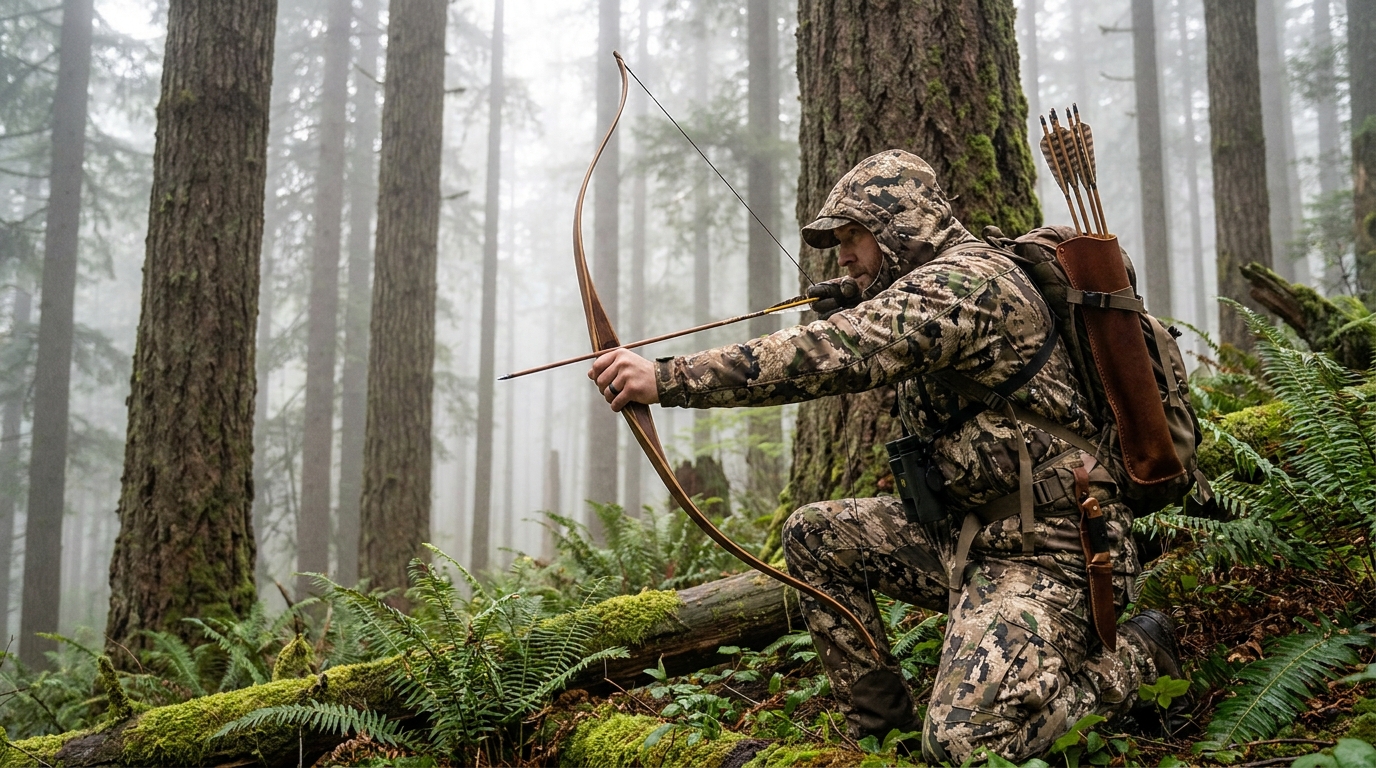
There's a reason traditional archery is growing faster than any other segment of the bowhunting world. It strips the hunt down to its most elemental form — a bent stick, a string, and a stick with feathers. No sights, no let-off, no cams. Just instinct, repetition, and the kind of closeness to your quarry that very few hunting pursuits demand. If you've been curious about trad archery, Oregon is one of the best places in the country to pursue it, with challenging terrain, abundant public land, and some of the most dedicated traditional archery communities in the West.
Recurve vs. Longbow: Choosing Your First Traditional Bow
The eternal trad debate. Here's the practical breakdown for hunters:
Recurve bows store more energy per inch of limb length due to their curved tips. They're typically shorter — 58 to 62 inches axle-to-axle — which makes them more maneuverable in tight timber and tree stands. The recurve is the most popular choice for new traditional hunters for good reason: they're widely available, forgiving of varying arrow spine, and easier to shoot accurately with proper form. Brands like Samick Sage, Bear Archery, and Black Widow dominate the hunting recurve market.
Longbows are longer — typically 64 to 68 inches — and have straight limbs with a slight reflex. They're generally smoother to draw and quieter than recurves, with less hand shock. Many experienced hunters prefer the longbow's feel and consider it the purest expression of traditional archery. The longer length is less practical in dense brush but excels in open-country spot-and-stalk situations.
For most new hunters, a 58- to 62-inch recurve in the 45- to 55-pound draw weight range is the right starting point.
Draw Weight: Enough to Hunt With, Light Enough to Practice With
Oregon regulations require a minimum draw weight of 40 pounds for deer and 45 pounds for elk when using archery equipment. This is a low bar — any bow you can comfortably shoot 50 to 100 arrows per day will exceed the minimum. The real consideration for hunting is penetration, and for that, a combination of draw weight, arrow weight, and sharp broadheads matters far more than raw poundage.
A 50-pound recurve shooting a heavy arrow (600 to 700 grains) with a well-tuned, razor-sharp cut-on-contact broadhead will drive through an elk's chest cavity cleanly at distances under 30 yards. Don't let anyone convince you that you need 65 or 70 pounds to kill big game — many traditional hunters take elk annually with 45- to 55-pound bows.
What matters more than poundage is being able to practice consistently. A bow you can shoot 30 minutes a day is worth far more than a 65-pound bow you can only manage 10 shots before your form deteriorates.
Arrow Selection for Traditional Archery Hunting
Arrow selection is more critical with traditional equipment than compound because trad bows have no mechanical guidance system — the arrow must flex correctly around the riser through the archer's paradox to fly true. This is governed by arrow spine (stiffness), which must be matched to your draw weight, draw length, and arrow length.
- Wood arrows: The traditional choice — Port Orford cedar is the classic. Beautiful to look at, quiet, and plenty accurate for hunting distances. Require more attention to weight-sorting and straightness checking.
- Carbon arrows: More consistent spine-to-spine than wood, lighter, and more durable. Popular among traditional hunters who want a performance edge without going full compound. Gold Tip Traditional and Black Eagle Vintage are top picks.
- Aluminum arrows: Durable and very consistent. Heavier than carbon, which is actually an advantage for traditional archery hunting (more kinetic energy, better penetration).
Work with an archery shop or use an online spine calculator to match your arrow to your setup. A poorly spined arrow will never fly well regardless of your form.
Broadhead Selection
Traditional archery hunters should be shooting cut-on-contact fixed-blade broadheads. The high-FOC (front-of-center) arrows common in trad archery, combined with a true single-bevel or two-blade cut-on-contact head, produce remarkable penetration. Popular choices include:
- Magnus Stinger 2-blade or 4-blade
- Grizzly Single Bevel
- Zwickey Delta or Eskimo
- Wensel Woodsman 3-blade
Sharpen your broadheads to scary-sharp before every hunt. With traditional archery, your broadhead is your penetration — don't compromise it.
Learning to Shoot: Instinctive Aiming
Most traditional hunters shoot instinctively — no gap-shooting, no sight pins, just a subconscious eye-hand coordination that develops through repetition, the same way you learn to catch a baseball. It takes longer to develop than shooting a compound with a peep sight and a sight, but once you have it, it's deeply intuitive and remarkably accurate at hunting distances.
The key is volume. Shoot every day if possible, starting at close range — 5 to 10 yards — and only moving back when your groups are consistently tight. Most traditional archers can reach hunting accuracy (8-inch groups at 20 yards under field conditions) within a season of dedicated practice. Keep your maximum hunting distance honest: 25 yards is the ceiling for most new traditional hunters, and 20 yards is a better standard until you've put real time in.
Hunting Strategies for Traditional Archery
Traditional archery demands closer shots than compound — which means you need to get closer to the animal. This changes your entire hunting strategy in productive ways:
- Treestands and ground blinds over trails, wallows, and food sources become more important. Get within 15 to 25 yards and wait.
- Still-hunting in quiet, damp conditions (Pacific Northwest hunters have a natural advantage here) can produce close encounters on feeding deer and elk.
- Calling elk with a cow call or bugle can bring bulls inside 20 yards — some of the most intense hunting experiences available to any hunter.
The constraint of close range forces you to become a better hunter. You learn more about wind, scent control, animal behavior, and reading terrain than most hunters who are comfortable shooting at 60 yards with a compound. That knowledge pays off no matter what equipment you pick up later.
Oregon Regulations Note
Oregon does not separate traditional archery equipment into its own season — recurve and longbow hunters participate in the same archery seasons as compound hunters. The equipment requirements (40-pound minimum draw weight for deer, 45 for elk) are the same. No broadhead minimum cutting diameter is specified in Oregon regulations, but a 7/8-inch or wider broadhead is a reasonable ethical standard.
Get Connected
Oregon's traditional archery community is welcoming and knowledge-rich. The Oregon Traditional Archers and various 3D archery ranges around the state offer year-round practice opportunities and events. If you're serious about hunting with traditional equipment, find a mentor — someone who has been doing it for years can accelerate your learning curve dramatically and help you avoid the common beginner pitfalls. The stick-and-string world has room for you.