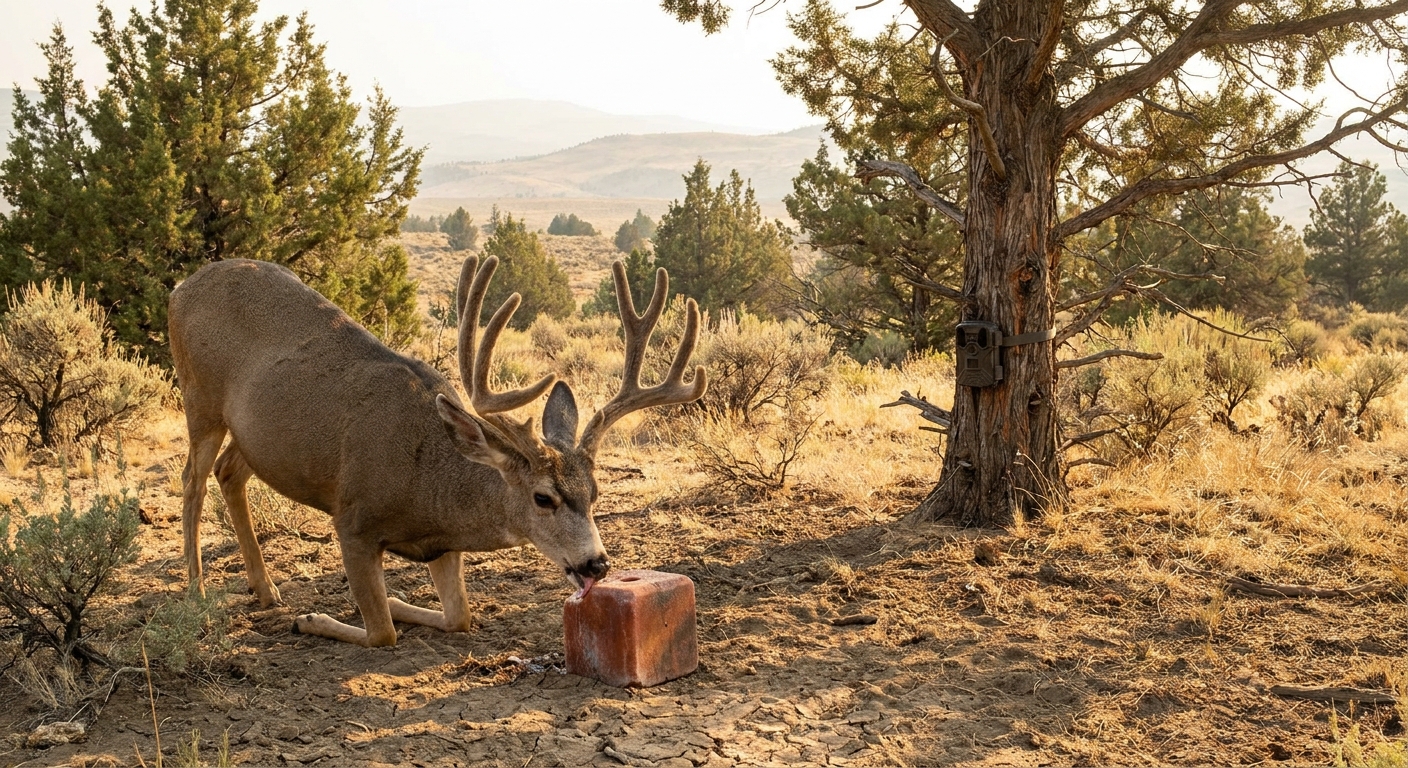
Every summer, bucks and bulls in velvet are doing something most hunters don't take enough advantage of: actively seeking minerals. Growing antlers are living tissue that demand calcium, phosphorus, sodium, and a suite of trace minerals. From late April through velvet strip in August or September, deer and elk will regularly travel to natural mineral deposits and manmade licks, giving hunters a reliable, recurring scouting opportunity. Setting up a mineral station on your hunting property or a legal public land area is one of the highest-return pre-season investments you can make.
Oregon Regulations: What's Legal and What's Not
Before you haul anything into the field, understand Oregon law on baiting and luring. Under Oregon Administrative Rules, it is illegal to hunt deer or elk over bait or a salt block — meaning you cannot shoot an animal while it is at or attracted to an artificial mineral or food source. However, placing mineral licks for scouting purposes (trail cameras, not hunting) is legal on private land in most circumstances.
On public land, including national forests and BLM, the rules are more nuanced. Placing mineral attractants is generally prohibited on public land without a permit. The practical approach: keep mineral stations on private land you have legal access to, or in areas where you scout but do not intend to hunt directly over the lick. Always check current ODFW and land management agency rules before setting anything out — regulations do update.
Critically: even if your mineral station is legal to place, you must not hunt within sight or shooting distance of it during season. Move your stands and blinds well away from lick sites once fall arrives.
Mineral Products That Work
The market offers dozens of deer and elk mineral products, but the fundamentals are simple. Animals are primarily seeking salt (sodium chloride) and macro-minerals. The most effective and cost-efficient options:
- Plain trace mineral salt blocks (red or brown): Available at any farm supply store for $5–8. These work. Cattle trace mineral blocks contain salt, calcium, phosphorus, and trace minerals that deer and elk will hammer all summer.
- Himalayan salt blocks: Naturally high in trace minerals and visually distinct for camera identification. Deer and elk use them heavily.
- Commercial deer mineral mixes: Products like Rack Rock, Trophy Rock powder, or Whitetail Institute 30-06 contain formulated mineral ratios and added attractants like anise or molasses. More expensive but effective for quick attraction and strong camera pulls.
- Soil minerals: Creating a bare dirt wallow-style lick by mixing mineral powder into bare soil produces a site that absorbs into the ground — animals return to lick the dirt long after the original product is gone, extending the scouting window.
Site Selection
Location is everything. A good mineral site on a poor travel corridor will underperform a mediocre mineral mix on a high-use trail. Look for:
- Pinch points and travel corridors: Saddles between drainages, ridge crossings, the junction of two draws — anywhere that naturally funnels animal movement. Deer and elk are more likely to commit to a lick they're already passing through territory near.
- South-facing slopes in spring: These green up earlier and hold deer and elk longer in May and June. Placing a lick here during peak velvet growth intercepts animals already using the area.
- Water proximity: Animals often mineral-lick and then water. Place licks within a quarter-mile of a reliable water source to maximize visits.
- Thermal and wind cover: Pick a location where your camera won't blow in the wind (false triggers waste battery and storage) and where animals can approach with natural cover. A lick placed in the open middle of a meadow gets fewer visits than one at the meadow edge near timber.
Camera Setup at Mineral Sites
Mineral stations are among the best trail camera placements in the scouting season. A few setup principles:
- Angle and height: Mount cameras 24–36 inches high, angled slightly down toward the lick. This captures face and antler detail far better than a camera mounted high at a steep downward angle. For velvet inventory, you want clean side or three-quarter profile shots.
- Burst mode: Set cameras to 3–5 photo bursts with a 15–30 second delay. Deer and elk will often work a lick for 2–5 minutes — you want multiple shots from different angles for identification.
- Video clips: If your camera supports 10–20 second video clips, alternate them with photo bursts. Video captures gait, body size, and antler movement in ways that stills miss.
- Check frequency: Visit lick cameras no more than every 3–4 weeks to minimize human scent pressure at the site. Wear rubber gloves when handling blocks and cameras. In July's heat, scent persists longer than you think.
- Multiple cameras: If you have the inventory, run two cameras on opposite sides of the lick. Bucks and bulls often approach and depart from different directions — two cameras cut your blind spots significantly.
Reading What You Find
By late July and early August, Oregon bucks and bulls are approaching full velvet development. Mineral station photos during this window give you the best antler inventory of the season — before velvet strips and the rut geometry of September and October changes behavior and range. Note individual animals by distinguishing characteristics: split brow tines, kicker points, sticker points, mass differences between bases. This is the time to identify shooter animals and begin planning entry and exit routes to their core areas before season opens.
A well-maintained mineral station visited consistently from May through velvet strip can generate hundreds of photos of the animals using your hunting area. That's more data than a dozen random boot-scouting trips — and it comes in while you're at work.