If you've spent time on Oregon's high desert ground squirrel fields, you know how humbling a 15-mph crosswind at 250 yards can be with a .22 LR. The .17 Remington Fireball was introduced by Remington in 2007 specifically to answer that problem — a tiny, high-velocity centerfire that pushes a 20-grain bullet to 4,000 fps, giving it a trajectory so flat and a wind drift so low that it effectively extends usable varmint range by 50–100 yards over rimfire options. Best of all, it's a handloader's dream: consistent brass, simple load development, and exceptional accuracy potential.
Cartridge Overview
The .17 Remington Fireball is a necked-down .221 Remington Fireball — itself based on the .222 Remington family. It's shorter and more efficient than the original .17 Remington, burning roughly 14–16 grains of powder versus the .17 Rem's 25+ grains. That means significantly less barrel erosion, a quieter report, and lower component cost per round — all big wins for anyone shooting 200+ rounds in a day on ground squirrels.
Factory ammo is available but limited and expensive. Handloading is really the way to go with this cartridge, and it rewards careful technique with sub-half-MOA accuracy from quality barrels.
Brass and Prep
Remington is the primary source of .17 Fireball brass. Lapua produces .17 Remington brass that must be fire-formed to the Fireball case — a viable but more involved approach. For most handloaders, Remington brass is the practical choice. It's adequately consistent at this pressure level and case life is good — expect 5–8 loadings with proper care.
Prep steps that matter most with the Fireball:
- Neck sizing only: For bolt guns used at the range, neck sizing extends brass life considerably and often improves accuracy. Full-length size every 2–3 firings or when chambers feel stiff.
- Primer pocket uniforming: At 52,000+ PSI, consistent primer seating depth affects ignition and ES (extreme spread). A primer pocket uniformer is worth using on every piece of new brass.
- Deburring flash holes: Small case, small flash hole — deburr and uniform for best ignition consistency.
- Case trimming: Trim to 1.400" after every 2–3 firings. Brass doesn't grow rapidly but consistency matters in a cartridge this small.
Powder Selection
The .17 Fireball's small case requires fast-burning powders. The sweet spot is Hodgdon H4198, Alliant Benchmark, Hodgdon Lil'Gun, and IMR 4198. Lil'Gun consistently produces the highest velocities with 20-grain bullets, often reaching 4,000+ fps from a 24" barrel. H4198 and Benchmark tend to give slightly lower ES and SD, making them preferred for accuracy-focused loads.
Sample load data (always verify against current published sources before use):
- 20-grain V-MAX / H4198: 13.5–14.5 gr, approx. 3,800–4,000 fps, excellent accuracy
- 20-grain V-MAX / Lil'Gun: 13.0–14.0 gr, approx. 3,900–4,100 fps, slightly higher ES
- 20-grain V-MAX / Benchmark: 12.5–13.5 gr, approx. 3,750–3,950 fps, very consistent
Always start 10% below maximum and work up in 0.2-grain increments, watching for pressure signs. The small case fills quickly — precision in powder measurement is non-negotiable. A quality trickler and scale, or a charge master system, is essential.
Bullet Selection
The .17 caliber (.172") bullet selection is narrow compared to larger varmint calibers, but the options that exist are excellent:
- Hornady 20-grain V-MAX: The go-to for most .17 Fireball handloaders. Polymer tip initiates explosive expansion at varmint ranges. BC of .185.
- Sierra 25-grain BlitzKing: Heavier option for slightly better wind performance. Velocity drops to around 3,600 fps but trajectory is still very flat to 250 yards.
- Berger 25-grain HP: Higher BC than the V-MAX, preferred by some for 300+ yard work on prairie dogs.
Seating depth experimentation pays dividends with the .17 Fireball. Try seating 0.010" off the lands and compare against 0.020" and 0.030" jumps. Many rifles show a clear preference.
Primers
Small rifle primers only. CCI 400 and Remington 7½ are the most commonly used and work well. Some handloaders prefer Federal 205M small rifle match primers for tightest ES — the improvement is real but modest. Avoid magnum primers; the Fireball's small powder charge doesn't need them and pressure spikes can result.
Performance in the Field
A well-developed .17 Fireball load zeroed at 200 yards will be about 0.6" high at 100 yards and 4.5" low at 300 yards with a 20-grain V-MAX at 3,900 fps. Wind drift at 250 yards in a 10-mph full crosswind is approximately 2.1" — compare that to 3.8" for a .22-250 with a lighter 40-grain bullet and the Fireball's advantage in a wind is clear.
On ground squirrels and rock chucks in Eastern Oregon's high desert, it's devastating. The 20-grain V-MAX exits the muzzle at a flat crack, not the crack-and-boom of larger varmint cartridges, making it enjoyable to shoot for long sessions without suppressor or significant ear fatigue (with hearing protection). On coyotes it's best kept inside 200 yards — the light bullets don't offer the anchoring energy of the .22-250 or .243 at distance, but inside that range it's plenty effective.
Equipment Notes
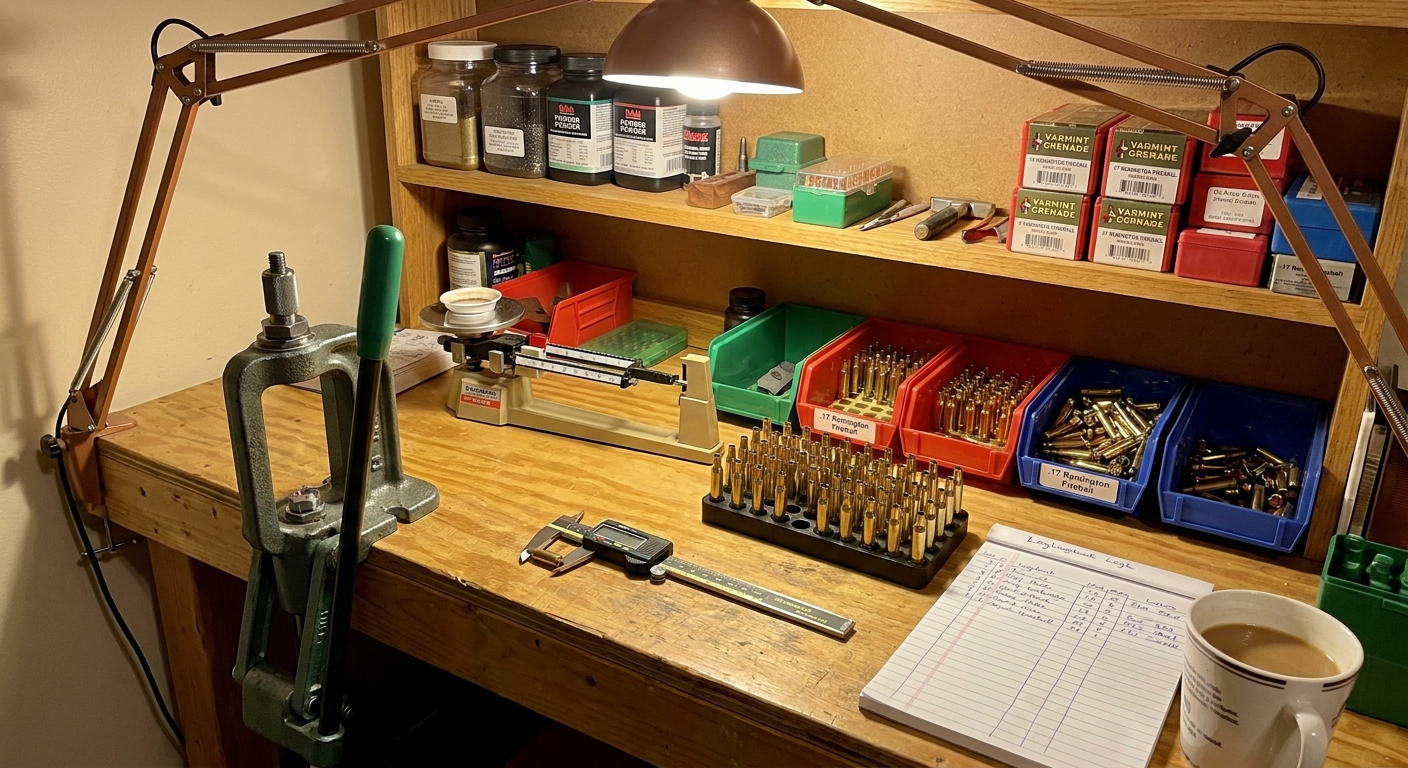
Rifles chambered in .17 Fireball are produced by Remington (Model 700 and XP-100), Savage, and on the custom market. The small case benefits from a quality single-stage press and careful technique more than any fast progressive setup. A digital powder scale or case-activated charge bar is strongly recommended — measuring to the nearest 0.1 grain matters with a 13-grain powder charge.
For anyone already shooting .17 HMR and looking to extend their varmint game into the centerfire world without the cost and barrel wear of the .22-250 or .17 Rem, the .17 Fireball is one of the smartest transitions you can make.