The .223 Remington is Oregon's workhorse varmint and predator cartridge — light, fast, affordable to shoot, and even more affordable when you roll your own. Whether you're stacking jackrabbit in the high desert east of Bend, calling coyotes across the rimrock above Burns, or punching paper at 500 yards on the Madras range, handloading the .223 gives you the precision and economy that factory ammunition simply can't match.
Why Handload the .223 Remington?
Oregon hunters burn through .223 ammo at a rate that makes the wallet hurt — especially during a coyote season that runs year-round with no bag limit. A single afternoon stand setup near the Prineville Reservoir can run 40 to 60 rounds between multiple stands. Handloading drops your per-round cost from $1.00–$1.50 for premium factory to $0.25–$0.40 per round, and you get to tailor the load to your rifle's chamber and your quarry.
Beyond economics, the .223 Rem rewards precision loading. Factory ammo is built for the SAAMI-spec 5.56mm NATO chamber, which is a little looser than many sporting rifles. A hand-tuned load seated close to the lands of your specific chamber can cut group size dramatically — critical when you're making 300-yard shots on eastern Oregon ground squirrels the size of a fist.
Brass Selection and Prep
Start with once-fired brass from a known source. Lapua, Hornady, and Federal are top picks. Avoid mixed headstamps in the same batch — case capacity differences will scatter your groups. Deprime and tumble in crushed walnut media, then run through a Lee or RCBS full-length sizing die to bring everything back to spec. Trim to 1.750" using a Lyman or Hornady trimmer; .223 brass grows fast, and excessive case length causes dangerous pressure spikes.
- Trim-to length: 1.750"
- Maximum case length: 1.760"
- Primer pocket: Small rifle — brush clean each firing
- Anneal every 3–4 firings for consistent neck tension
Powders That Work
The .223 Rem's small case volume means powder choice matters enormously. These are the workhorses Oregon handloaders lean on:
Hodgdon Varget
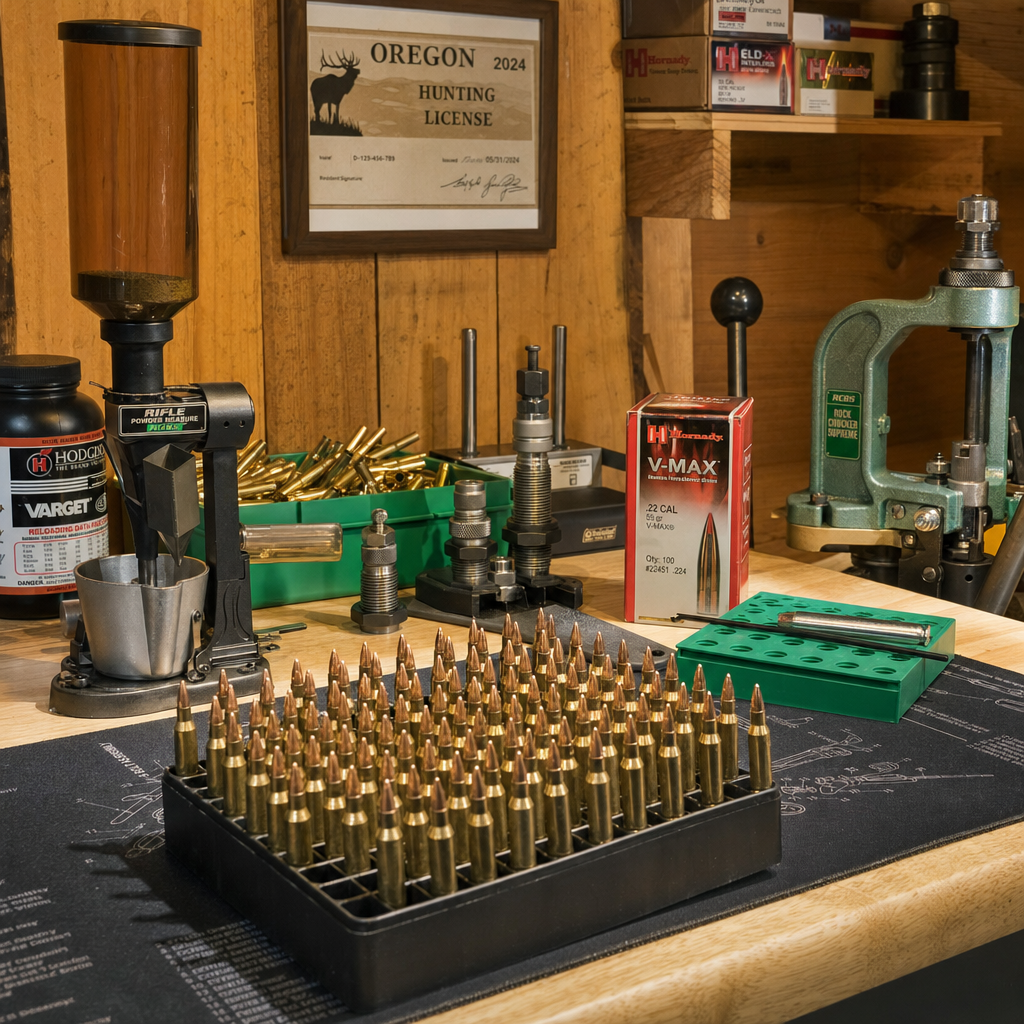
The gold standard. Temperature insensitive, widely available (most reloading shops in Bend, Medford, and Eugene stock it), and delivers excellent velocity with 50–69 grain bullets. Expect 24.0–25.5 gr under a 55 gr V-MAX for right around 3,150–3,240 fps from a 20" barrel. Start 10% below max and work up in 0.3 gr increments, watching for pressure signs.
Hodgdon CFE 223
The "copper fouling eraser" additive in CFE 223 is real — barrels stay cleaner during long varmint sessions. Excellent for 55–62 gr bullets. A 25.0 gr charge under a 55 gr Nosler Ballistic Tip gets into the 3,200 fps neighborhood from a 24" barrel.
Alliant Power Pro Varmint
A newer entrant that's earned a following among Oregon coyote hunters. Meters well through a powder measure (important when you're loading 500 rounds before a weekend in the Owyhee country) and is forgiving across a wide temperature range — critical when morning temps in December eastern Oregon can swing 40°F from dawn to midday.
Bullet Selection by Purpose
Coyotes and Bobcats
You want rapid expansion and maximum upset at ranges from 50 to 400 yards. The 55 gr Hornady V-MAX and the 50 gr Nosler Ballistic Tip are proven standbys. For longer shots over the open rimrock of Malheur County, step up to the 60 gr V-MAX or a 62 gr Sierra BlitzKing — both shoot flat and expand explosively at extended range.
Ground Squirrels and Jackrabbits
Nothing beats a frangible bullet for entertainment in a squirrel field. The 40 gr V-MAX or Berger 40 gr flat-base at screaming velocity (3,500+ fps from a 24" barrel with a modest Benchmark charge) vaporizes targets. Barrel heat is your limiting factor — let the tube cool between strings.
Deer (Where Legal in Oregon)
Oregon does permit .22 centerfires for deer under OAR 635-065-0740 when using expanding bullets, though the .223 is marginal for deer and most experienced hunters skip it. If you do use it, load the 60 gr Nosler Partition or the 62 gr Federal Trophy Bonded for maximum penetration and controlled expansion. Shots under 150 yards only.
Proven Starter Loads
- 55 gr Hornady V-MAX / Varget: Start 23.5 gr → max 25.5 gr | ~3,100–3,240 fps (24" barrel)
- 62 gr Sierra BlitzKing / CFE 223: Start 24.0 gr → max 25.8 gr | ~2,980–3,100 fps
- 40 gr Berger / Hodgdon Benchmark: Start 24.0 gr → max 26.5 gr | ~3,400–3,600 fps
Always start at minimum charges and work up. Consult current published reloading manuals — Hodgdon, Lyman 50th Edition, or Sierra — and never exceed maximum loads. Pressure signs: flattened primers, sticky extraction, case head expansion. Stop immediately if you see any.
Seating Depth and OAL
The .223 Rem's maximum SAAMI cartridge overall length is 2.260". In AR-15 platforms (the most common .223 action in Oregon), you're constrained by magazine length — keep OAL at or under 2.250" for reliable feeding. In bolt guns, you can push bullets closer to the lands; measure your chamber with a Hornady OAL gauge and start 0.020" off the lands, then experiment inward if groups tighten.
Local Resources
Bend's Sportsman's Warehouse and Medford's BiMart carry Varget, CFE 223, and common .223 bullets most of the year. For specialty powders (Benchmark, RL-15), the independent shops in Grants Pass and Roseburg are your best bet when regional stock runs low. Buy in 8-lb jugs when the high desert varmint season gets going — 1-lb jugs disappear fast from June through August.
Final Thoughts
The .223 Remington has earned its place on every Oregon varmint hunter's bench. It's easy to reload, forgiving of minor technique variations, and the components are widely available even in smaller towns east of the Cascades. Master this cartridge and you'll shoot more, spend less, and connect at ranges that factory ammo makes difficult. Get the powder, get the dies, and get your squirrel fields dialed in before February ground squirrel season lights up the rimrock.