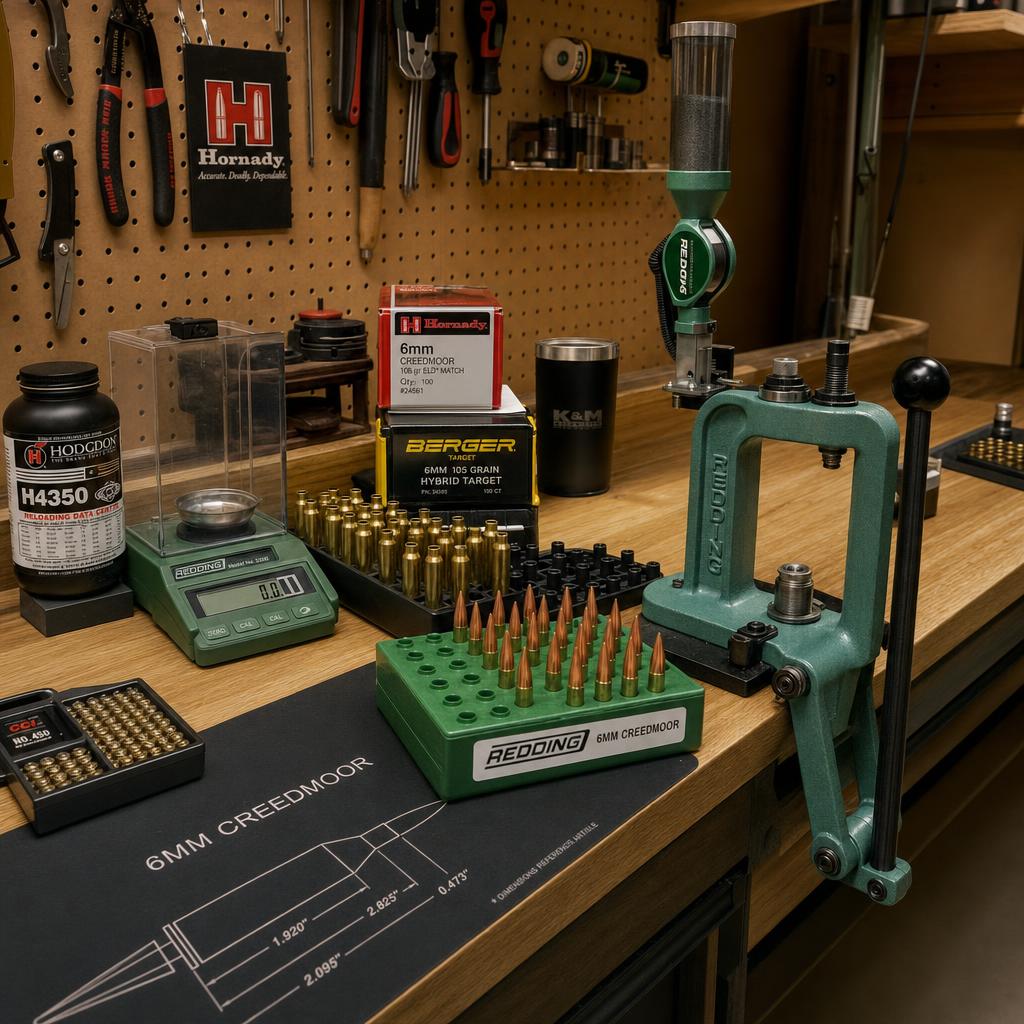
The 6mm Creedmoor has earned a devoted following among Oregon's long-range hunters and precision rifle competitors since its commercial introduction in 2017. Sitting in the same short-action Creedmoor family as the wildly popular 6.5, the 6mm version pushes lighter, higher-BC bullets at higher velocities — giving up some wind resistance and retained energy at distance compared to the 6.5, while gaining a flatter trajectory and significantly less recoil. For Oregon's open mule deer country, Columbia Basin ground squirrel fields, and PRS competition shoots, it's an outstanding choice. Here's how to load for it.
Why the 6mm Creedmoor?
The 6mm Creedmoor is built on a 6.5 Creedmoor case necked down to accept .243-caliber (6mm) bullets. This gives it a meaningful velocity advantage over the .243 Winchester — typically 100–150 fps faster with equivalent bullet weights — while feeding reliably from standard short-action AICS-pattern magazines. Compared to the .243 Win, the 6mm Creedmoor also has a longer, more gradual freebore and a case geometry that's friendlier to seating long, high-BC competition bullets. The result is a cartridge that produces exceptional accuracy in bolt-action platforms and is extraordinarily pleasant to shoot.
For Oregon hunters, the 6mm Creedmoor makes most sense as a dedicated varmint and predator round — ground squirrels, coyotes, rockchucks — or as a long-range deer cartridge where shot distances may exceed 400 yards. It is not an elk cartridge; at 6mm bore diameter, bullet energy and frontal diameter are marginal for elk-sized game, and ODFW's ethical hunting guidelines strongly suggest larger bore cartridges for elk.
Brass Selection and Preparation
Factory 6mm Creedmoor brass is available from Hornady (the cartridge's commercial creator), Peterson, Alpha Munitions, and Lapua. For hunting applications, Hornady brass is economical and adequately consistent. For precision loads aimed at sub-½ MOA accuracy, Peterson or Lapua brass offers better neck and case head consistency right out of the bag.
Preparation steps for new brass before first loading:
- Debur and chamfer: Use a VLD chamfer tool inside and outside the case mouth
- Flash hole deburring: A Sinclair or RCBS flash hole deburring tool removes the small burr left from the brass punching process and improves primer ignition consistency
- Primer pocket uniforming: Especially worthwhile on Hornady brass — a Lyman or RCBS uniformer ensures consistent pocket depth for more uniform primer seating
- Annealing: After the first firing, anneal brass every 2–3 firings to maintain consistent neck tension and extend case life
Bullet Selection
The 6mm Creedmoor's strength is its ability to stabilize long, high-BC 6mm bullets in standard 1:8 twist barrels (some rifles use 1:7.5 for the heaviest projectiles).
For Hunting
- Hornady 87 gr V-MAX: Explosive varmint bullet — ideal for ground squirrels and rockchucks at 3,400+ fps; maximum fragmentation on small game
- Hornady 95 gr SST: Good all-around deer bullet with controlled expansion; widely available and accurate in most barrels
- Nosler 90 gr AccuBond: Premium bonded hunting bullet for deer — excellent penetration and weight retention for cleanly ethical kills at extended range
- Federal 90 gr Trophy Bonded Tip: Factory-loaded option that also works as a handloading component; premium terminal performance for deer-sized game
For Target and Long-Range Competition
- Berger 105 gr Hybrid Target (G7 BC: .275): The PRS shooter's standard — extremely consistent, exceptional BC, sub-½ MOA accuracy in most quality barrels
- Hornady 108 gr ELD-Match: High-BC match bullet with good consistency; excellent option for those not wanting to source Berger
- Sierra 107 gr MatchKing: The classic long-range 6mm bullet — proven track record over decades at F-Class and benchrest; excellent BC and inherent accuracy
Powder Selection
The 6mm Creedmoor's case capacity sits at approximately 47 grains of water — a medium-small case that responds well to medium-burn-rate powders. Best performers:
- Hodgdon H4350: The gold standard for the 6mm Creedmoor — excellent velocity, outstanding consistency across temperature swings (critical for Oregon's elevation changes from high desert to Cascade passes), and widely available
- Alliant Reloder 16: Temperature-stable, slightly slower than H4350 — excellent with heavier bullets (105–108 gr) where it pushes velocities slightly higher than H4350 at safe pressures
- Hodgdon Varget: Classic workhorse powder — excellent with 87–95 gr bullets; extremely temperature-stable and consistent lot-to-lot
- IMR 4451: Enduron-series, temperature-stable; splits the difference between Varget and H4350 for mid-weight bullets
Load Data — Starting Points (Always Begin 10% Below Max)
All data from Hornady and Hodgdon published sources. Always verify with a current reloading manual before loading. Use appropriate safety equipment and never exceed maximum listed charges.
Hornady 105 gr ELD-Match / H4350 in Hornady Brass
- Starting load: 37.5 gr @ ~2,920 fps
- Max load: 40.5 gr @ ~3,050 fps
- COAL: 2.800" (magazine-length) or 0.010"–0.020" off lands for single-feed
- Primer: CCI BR-2 or Federal 210M
Hornady 87 gr V-MAX / Varget in Hornady Brass
- Starting load: 38.5 gr @ ~3,150 fps
- Max load: 42.0 gr @ ~3,400 fps
- COAL: 2.710"
- Primer: CCI 200 or Federal 210
Seating Depth and Accuracy Work
The 6mm Creedmoor rewards attention to seating depth. Most barrels prefer bullets seated 0.010"–0.040" off the lands, but some rifles — particularly those with tighter chambers — shoot best closer to 0.005" or even touching the lands with match bullets. Use a Hornady OAL gauge and modified case to determine your rifle's actual lands-to-base measurement before building your seating depth ladder.
A standard accuracy workup sequence: fire a 3-shot group at your starting charge, increase by 0.3 gr per group, and watch for velocity nodes (a 3–5 fps ES window across 3 shots on a Magnetospeed or LabRadar) and group size simultaneously. Once you find a velocity node with acceptable group size, tune seating depth in 0.005" increments to finish the load.
Real-World Oregon Applications
A 105 gr Berger Hybrid driven at 3,020 fps from a 24" barrel retains over 1,200 ft-lbs of energy at 500 yards and drifts only 9.5" in a 10 mph crosswind at that distance — on par with the 6.5 Creedmoor's performance envelope at shorter ranges. For the eastern Oregon mule deer hunter shooting across sagebrush flats in Harney or Malheur County, or the Columbia Plateau varmint hunter burning barrels on Umatilla County ground squirrel fields in spring, the 6mm Creedmoor is a purpose-built tool that handloading unlocks to its full potential.
If you're already loading for the 6.5 Creedmoor, setting up for the 6mm is straightforward — you'll use the same brass-prep workflow, similar powders, and the same dies (just different sizing and seating dies). The investment in components and time is modest, and the return in performance and shooting enjoyment is substantial.