The .280 Remington has been quietly doing the hard work of Oregon hunters since 1957, and it still doesn't get the credit it deserves. Sitting between the .270 Winchester and the 7mm Remington Magnum in both velocity and recoil, the .280 is one of the most versatile cartridges ever chambered for a hunting rifle — capable of taking deer at 400 yards and anchoring Roosevelt elk at 250 without battering the shooter. If you're handloading for this cartridge, you're working with a case that rewards precision and offers outstanding flexibility across a wide range of bullet weights.
Why the .280 Remington Belongs in an Oregon Hunter's Safe
Oregon hunters deal with a wide range of conditions — Columbia blacktail in the Coast Range brush, mule deer across the open high desert of Wheeler and Harney counties, and Roosevelt elk in the old-growth timber of the Cascades. The .280 Remington handles all of it. The cartridge pushes a 140-grain bullet at around 3,000 fps from a 24-inch barrel, and a 160-grain partition at 2,850 fps — fast enough for long shots on deer, heavy enough to break shoulders on elk.
The case is based on the .30-06 Springfield hull necked down to 7mm (.284 caliber), which means brass is plentiful and quality components from Nosler, Hornady, Norma, and Remington are available at any reloading supplier. The cartridge operates at moderate pressures (60,191 PSI SAAMI maximum), making it easy on barrels and easy to load to consistent velocities.
Brass Preparation
New .280 Remington brass from Nosler or Norma requires minimal prep work. Trim to 2.530 inches (SAAMI spec length 2.540 inches — trim to 2.530 for consistency). After trimming, deburr and chamfer the case mouth. If you're working with fired brass, full-length resize unless your rifle shoots groups so tight that neck sizing is worth the extra effort. The .280 case body is straight enough that full-length sizing is generally recommended for hunting loads used in semi-auto or lever-action platforms, though most .280s are bolt guns.
Use a primer pocket uniformer on new brass and clean primer pockets on fired cases before priming. The .280 Remington uses a large rifle primer — Federal 210M, CCI 200, or Remington 9.5 are all excellent choices for hunting loads.
Powder Selection
The .280 Remington's case capacity sits at around 67–68 grains of water, which makes it well-suited to medium-to-slow burn rate powders. The following are proven performers across a range of bullet weights:
- IMR 4350: The classic .280 powder. Excellent with 140–150 grain bullets. Metered well, temperature stable enough for field use.
- H4350: Highly temperature insensitive, ideal for Oregon's swing from hot summer scouting trips to cold October mornings. Outstanding accuracy node with 140-grain Nosler Partitions and 150-grain Hornady InterLocks.
- Reloder 22 (RL-22): Excellent with heavier 160–175 grain bullets for elk. Pushes the case capacity harder and squeezes out extra velocity for the heavier projectiles.
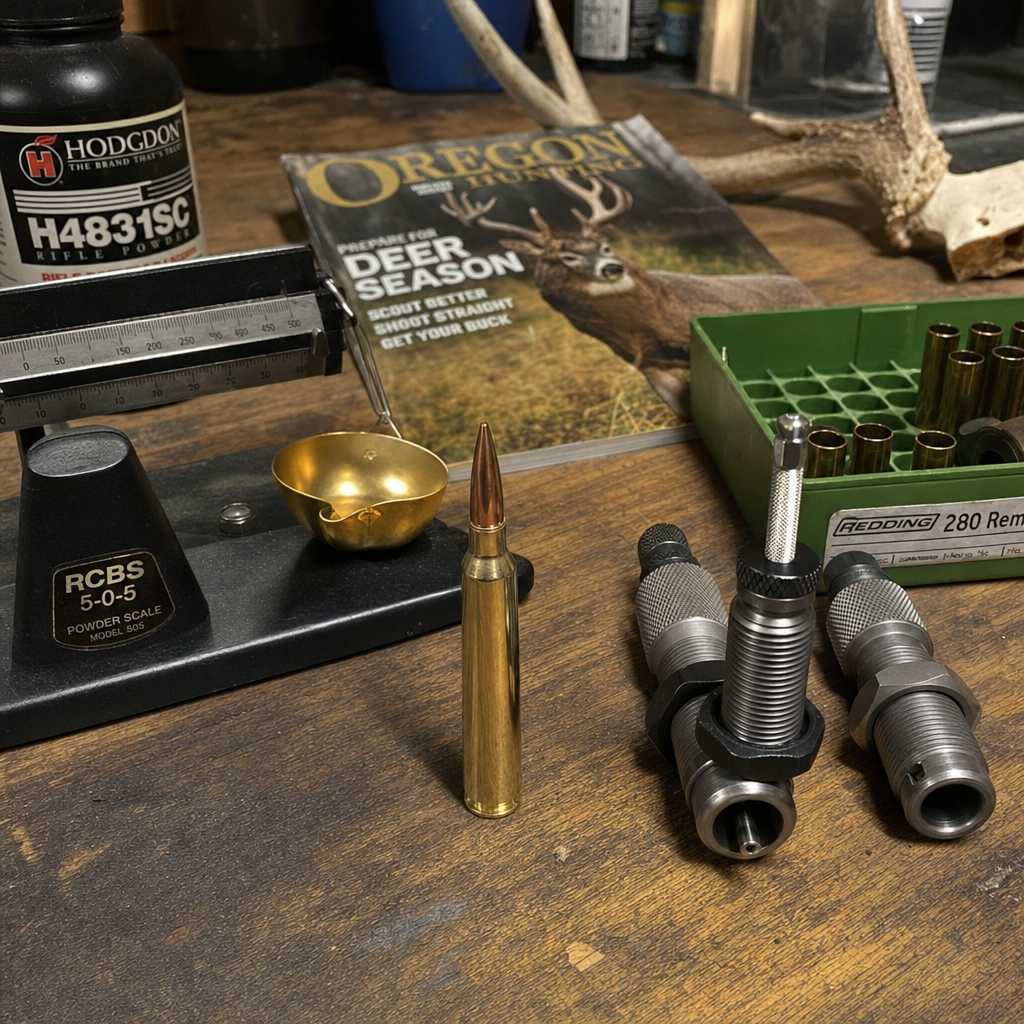
- IMR 4831 / H4831SC: Both work well across the 140–168 grain range. H4831SC meters more consistently than standard H4831.
- Reloder 19: Good middle-ground powder. Works well with 150-grain bullets for a do-everything deer and elk load.
Recommended Loads
The following are starting and maximum charges drawn from Hodgdon and Nosler reloading data. Always begin at the starting charge and work up in 0.5-grain increments while watching for pressure signs (flattened primers, sticky bolt lift, case head expansion). These loads are for reference only — verify against your current edition reloading manual before loading.
140-Grain Nosler Partition (Deer / Versatile Load)
- H4350: 55.0 gr (start) → 59.5 gr (max) | ~2,975–3,050 fps (24" barrel)
- IMR 4350: 53.0 gr (start) → 57.5 gr (max) | ~2,950–3,025 fps
150-Grain Hornady InterBond (All-Around Deer and Elk)
- H4350: 54.0 gr (start) → 58.0 gr (max) | ~2,850–2,950 fps
- Reloder 19: 54.5 gr (start) → 58.5 gr (max) | ~2,875–2,975 fps
160-Grain Nosler Accubond (Elk Load)
- Reloder 22: 54.0 gr (start) → 57.5 gr (max) | ~2,775–2,850 fps
- H4831SC: 54.5 gr (start) → 58.0 gr (max) | ~2,750–2,825 fps
COAL and Seating Depth
The .280 Remington's maximum SAAMI COAL is 3.330 inches, but most factory chambers will accept cartridges seated to 3.340–3.360 inches without issue — verify this with your specific rifle using a comparator tool or the technique of seating a bullet long and using the lands to mark it. Many rifles shoot best with the bullet seated 0.010–0.020 inches off the lands. For magazine-limited rifles (most production bolt guns), you'll be constrained to 3.330 inches regardless.
With 140-grain Partitions seated to 3.320 inches and 59.0 grains of H4350, most quality .280 Remington rifles will produce sub-MOA groups at 100 yards — better than good enough for any shot you'll take on Oregon deer or elk.
A Note on the .280 Ackley Improved
If you're rebarreling or building a custom rifle, the .280 Ackley Improved (AI) is worth serious consideration. Nosler has SAAMI-standardized the cartridge, and factory ammo is available. The AI version pushes the same 140-grain Partition to 3,100–3,150 fps with safe pressures — about 100–150 fps faster than standard .280 with the same powder charges, thanks to the sharper 40-degree shoulder reducing case stretch and improving powder capacity. A .280 AI rifle will safely chamber and fire standard .280 Remington ammo, fireforming the brass in the process — a nice backup when your AI brass runs out mid-trip.
Putting It Together
For Oregon whitetail and blacktail hunting, a 140-grain Partition or AccuBond loaded to 3,000 fps with H4350 is hard to argue with. For Roosevelt elk in the Cascades or the coast range — where shots are often under 200 yards in heavy timber — step up to the 160-grain AccuBond at 2,800 fps with Reloder 22. Either way, the .280 Remington will handle the job cleanly and come back to the bench with brass that loads again and again. This is why it's still earning respect in Oregon elk camps more than 65 years after its introduction.