The .300 Winchester Magnum has earned its place as one of the most popular elk cartridges in the American West, and for good reason. It pushes heavy, tough bullets fast enough to anchor bull elk cleanly past 400 yards while still being shootable by hunters who spend time behind the gun. When you handload it thoughtfully, it becomes something genuinely exceptional.
Why Handload for Elk?
Factory ammunition for the .300 Win Mag is good, but it is a compromise. Manufacturers load to pressures safe in every rifle, use bullet weights that appeal to the broadest market, and price components to maintain margin. When you load your own, you can tune the load to your specific rifle, choose the toughest hunting bullets available, and stretch your performance envelope in ways no box of factory ammo can match.
Brass Selection and Prep
Start with quality brass and treat it consistently. Winchester, Nosler, and Hornady headstamped cases are all solid choices. Lapua .300 Win Mag brass is excellent if you want maximum case life and uniformity, though the price reflects it.
Prep steps for new brass before the first firing:
- Uniform primer pockets with a primer pocket uniformer tool
- Deburr and chamfer case mouths
- Trim to 2.610 inches (SAAMI trim-to length) if needed
- Clean primer pockets with a stiff brush after each firing
After the first firing, full-length resize if hunting in a semi-auto or a different rifle, or neck-size only if you are working up a precision load for a dedicated hunting bolt gun. Anneal every three to four firings to maintain consistent neck tension and extend case life.
Primer Selection
For a belted magnum like the .300 Win Mag, use large rifle magnum primers. Federal 215M Gold Medal Match and CCI 250 are the two most widely recommended. The Federal 215M offers slightly better consistency in temperature extremes, which matters in elk country where September morning temps can swing 40 degrees from dawn to noon. Seat primers 0.003-0.005 inches below flush, never proud of the case head.
Powder Selection
The .300 Win Mag has a large case capacity, and it rewards slow-burning powders that fill the case efficiently. The top performers for 180-200 grain hunting bullets:
- Hodgdon H1000: The go-to for 200-210 grain bullets. Excellent temperature stability (Extreme Extruded series), high density fills the case well, and consistently delivers top velocity with good accuracy. Starting load with 180 gr bullets: 74.0 gr, max: 78.0 gr (always verify with your manual).
- Reloader 22 (RL-22): Outstanding performer with 180 grain bullets. Slightly faster than H1000, which gives you a velocity edge. Less temperature stable than Hodgdon Extreme powders, but many hunters accept that tradeoff for the velocity gain.
- IMR 7828 SSC: The short-cut version meters easily and performs well with 180-200 gr projectiles. A solid all-around choice if you shoot a variety of bullet weights.
- Hodgdon Retumbo: Designed for large overbore magnums. Shines with 200-210 grain bullets at max case fill. Exceptional velocity and energy retention at range.
Bullet Selection: Build for the Job
This is where elk handloads separate themselves from deer loads. Elk are big, dense-boned animals, and a bullet that performs brilliantly on mule deer may blow up without penetrating to vitals on a quartering bull at close range. You want controlled expansion and deep penetration.
- Nosler Partition 180 gr: The classic. Dual-core design ensures the front expands reliably while the rear drives through. At .300 Win Mag velocities, it is one of the most field-proven elk bullets ever made.
- Federal Trophy Bonded Bear Claw 180 gr: Bonded construction, high weight retention, outstanding on shoulder shots. Available as a component through various sources.
- Hornady ELD-X 200 gr: High BC, excellent terminal performance down to lower impact velocities at long range. The Heat Shield tip prevents BC degradation in flight. A top pick for 300-500 yard shots.
- Barnes LRX 180 gr: All-copper construction with no lead core to shed. Nearly 100% weight retention, consistent four-petal expansion. Requires slightly lower seating depth and often needs a reduced starting load compared to jacketed lead-core bullets.
A Proven Elk Load
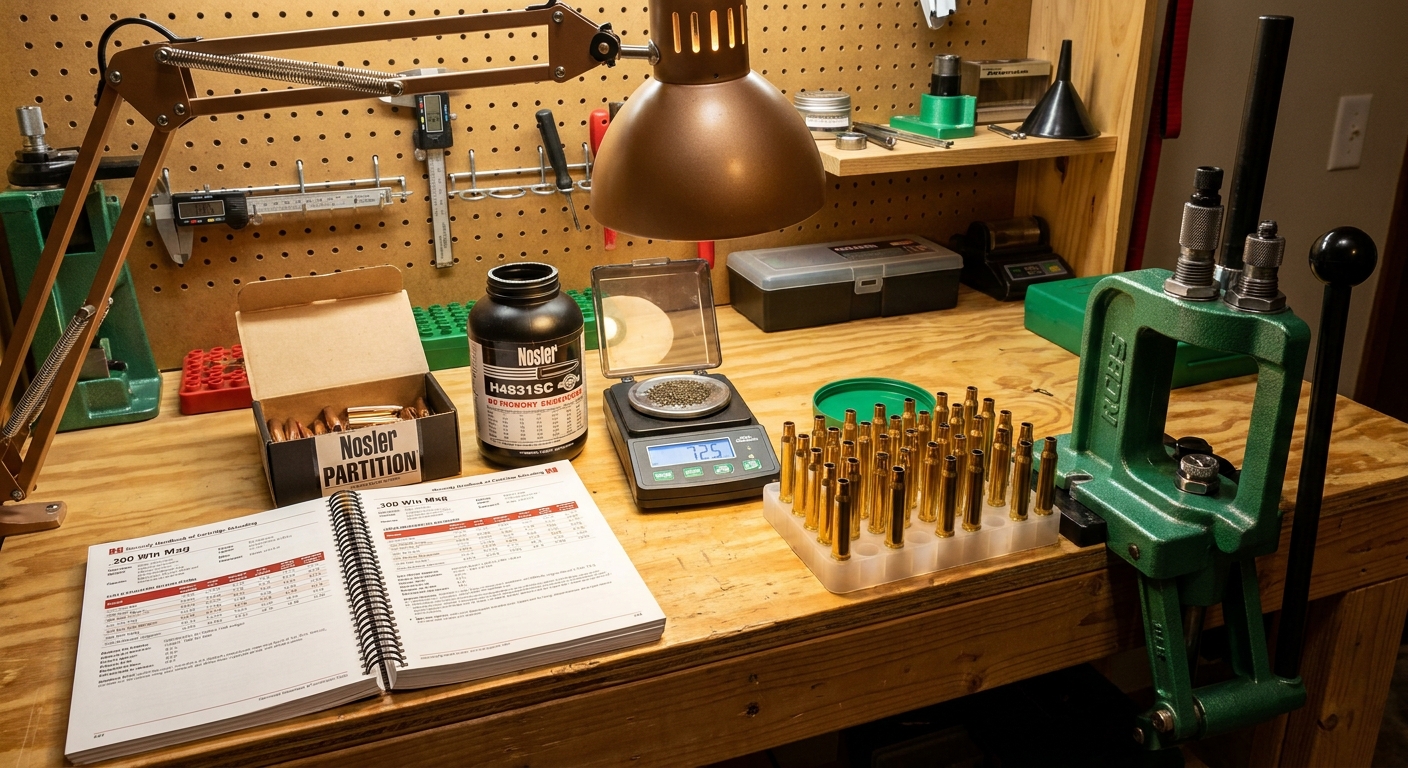
One load that has accounted for multiple Oregon bull elk in units like Wallow, Starkey, and the Blue Mountains: Nosler brass, Federal 215M primer, 76.0 grains of H1000, Nosler Partition 180 gr seated to 3.340 inches overall length. In most rifles with a 26-inch barrel, this produces 2,950-3,010 fps with sub-MOA accuracy. Always start 10% below published maximum and work up in 0.5-grain increments while checking for pressure signs.
Load Development Process
Work up on paper at 100 yards first. Look for:
- Flat primers that are still slightly rounded at edges (not cratered or flattened hard)
- Smooth bolt lift with no stickiness
- Consistent velocity within 15-20 fps standard deviation
- Groups tightening as you approach your target load
Once you have a load that shoots under 1 MOA at 100 yards and shows no pressure signs, confirm it at 300 and 400 yards. Know where your bullet is at distance before elk season, not during it.
Final Thoughts
A well-built .300 Win Mag handload is one of the most capable tools an Oregon elk hunter can carry into the mountains. Put in the bench time before the season, verify your work at distance, and you will walk into the field knowing your rifle is loaded with exactly the right combination of speed, weight, and toughness to anchor a bull cleanly. That confidence is worth every hour at the reloading bench.