Why Reload Waterfowl Shells?
Reloading pistol and rifle cartridges is second nature to most serious shooters, but shotshell reloading — particularly for non-toxic waterfowl loads — remains a niche that few handloaders explore. That's a missed opportunity. Custom 12-gauge loads for duck and goose hunting can match or exceed the performance of premium factory shells at a fraction of the per-shell cost, and they allow you to dial in patterns and velocities that off-the-shelf ammunition simply doesn't offer.
The challenge with waterfowl reloading is the regulatory requirement for non-toxic shot. Lead shot has been federally banned for migratory waterfowl hunting since 1991, meaning you must work with bismuth, steel, tungsten-based composites (TSS, Heavyweight, HeviShot), or other approved materials. Each of these payloads behaves very differently from lead in terms of density, hardness, and pressure, which changes everything about how you build a recipe.
This guide focuses on 12-gauge loads using the two most common non-toxic options for hand-loaders: steel (the affordable workhorse) and bismuth (the premium performer that shoots through any choke).
The Equipment You Need
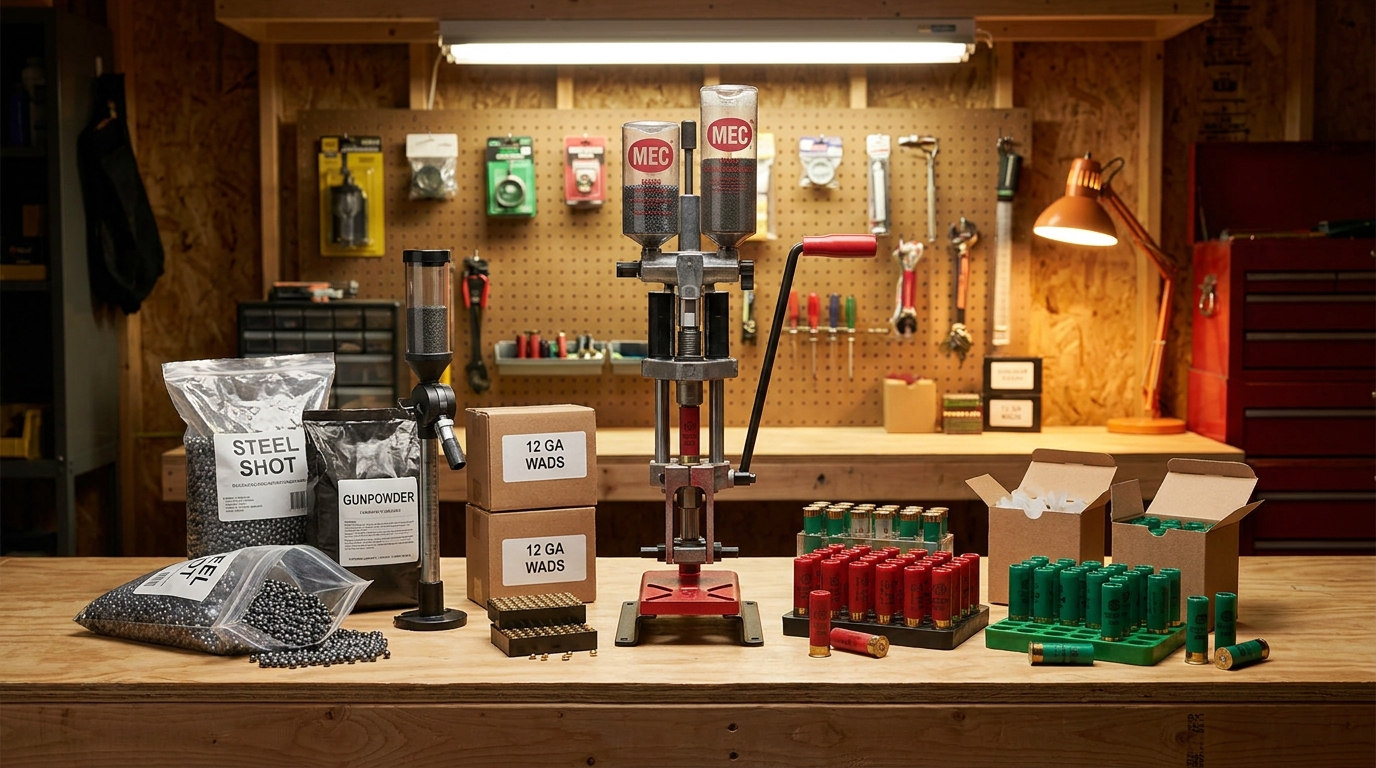
Shotshell reloading requires dedicated equipment — your rifle or pistol press won't work here. The two most popular presses for 12-gauge are the MEC 600 Jr. (manual, single-stage, about $150) and the MEC 9000 series (progressive, semi-automatic feeding). For moderate-volume duck hunters loading 500 to 1,500 shells per season, the MEC 600 Jr. is all you need. The 9000 makes sense if you're loading 3,000+ rounds per year.
Beyond the press, you need:
- Hulls: The hull is the most critical component in shotshell reloading — more so than in metallic cartridges. Winchester AA, Remington STS, and Federal Gold Medal hulls are the industry standards for reloading. Do not reload once-fired cheap promotional shells. They will fail.
- Wads: Steel shot requires a steel-shot wad with a thick, hard cup that protects the bore from pellets. Standard wads will cause pellet marking in your barrel. Use wads specifically rated for steel — Federal 12S4, Ballistic Products WAA12SL, and similar are well-tested.
- Primers: Fiocchi 616, Winchester 209, Federal 209A, and CCI 209M are the standard 209 shotshell primers. Match the primer to the recipe — don't substitute without re-working the load.
- Powder: Fast-burning shotshell powders dominate 12-gauge waterfowl loads. Alliant Steel, Hodgdon Longshot, Hodgdon Titewad, and Winchester Super-Field are proven choices. Alliant Steel is purpose-designed for steel loads and is widely available.
- Shot: Buy in bulk. Steel shot is sold by the 25-lb bag. Bismuth is sold in smaller quantities at a significant premium — expect to pay $35 to $55 per pound, compared to $0.60 to $1.00 per pound for steel.
Understanding Non-Toxic Shot Characteristics
Steel Shot
Steel is roughly 30 percent less dense than lead. To achieve comparable downrange energy, you need a larger pellet (typically two shot sizes up from the lead equivalent) and higher velocity. A steel #2 load at 1,400 fps approximates a lead #4 load at 1,250 fps in terms of retained energy at 40 yards. This drives the design of most steel recipes: larger pellets, faster powder, higher velocity.
Steel is hard — harder than your barrel steel in most guns. It should not be used through tight full or extra-full chokes. Use Steel, Modified, or Improved Cylinder designations only. Most modern shotguns made after 1990 are proofed for steel; vintage firearms with Damascus or soft steel barrels require bismuth or softer alternatives.
Steel shot cups must contain the pellets through the bore. Use purpose-built steel wads. The crimp on steel loads is typically a fold crimp, same as lead loads, but the payload depth may require a longer or shorter hull depending on shot weight.
Bismuth Shot
Bismuth is approximately the same density as lead (9.6 g/cc vs. 11.3 g/cc for lead) and is considerably softer and more brittle. This means you can use bismuth through any choke, including full and extra-full — it won't damage your barrel or choke tubes. Bismuth shoots almost identically to lead in terms of pattern and pellet drop, making it the ideal choice for hunters with vintage guns or fixed-choke doubles.
Because bismuth is softer, it requires a protective wad cup — but it's less demanding than steel. Many standard wads work with bismuth. Ballistic Products publishes extensive bismuth recipes using their BPGS and Flex wads. Follow published recipes precisely; bismuth's brittleness means it can fracture under excessive pressure, degrading patterns.
Bismuth reloads typically cost $0.80 to $1.40 per shell depending on pellet size and payload — still well below the $2.50 to $4.00 retail price of premium bismuth factory loads.
Proven 12-Gauge Steel Load Recipes
Note: These recipes are drawn from published reloading manuals. Always verify against a current Alliant, Hodgdon, or Ballistic Products manual before loading. Never exceed published data.
1-1/8 oz Steel #2 at 1,375 fps (Versatile Duck Load)
- Hull: Winchester AA or Federal Gold Medal (2-3/4")
- Primer: Winchester 209
- Wad: Federal 12S4 or WAA12SL
- Powder: Alliant Steel — 28.5 grains
- Shot: 1-1/8 oz steel #2
- Crimp: 6-point fold
1-1/4 oz Steel #BB at 1,450 fps (Canada Goose Load)
- Hull: Remington STS (3")
- Primer: Federal 209A
- Wad: Ballistic Products BPGS-3 or equivalent 3" steel wad
- Powder: Hodgdon Longshot — 34.0 grains
- Shot: 1-1/4 oz steel BB
- Crimp: 6-point fold
Pattern Testing: The Non-Negotiable Step
Every shotshell reload — especially non-toxic loads — must be pattern tested before hunting season. The goal is 70 percent pattern efficiency at 40 yards (the industry standard for waterfowl loads), meaning 70 percent of your pellets fall within a 30-inch circle at 40 yards.
Set up a large paper target at 40 yards and fire three shots. Count pellet strikes in a 30-inch circle. Calculate percentage based on total pellets in the payload. If you're below 70 percent, try tightening your choke one step, adjusting crimp pressure, or switching wads. If you're above 80 percent, you're in excellent shape.
Pattern density matters more than raw pellet count for clean kills. A tight, even pattern beats a sparse one at any velocity.
Oregon Pacific Flyway Context
Oregon duck hunters on the Pacific Flyway primarily target mallards, wigeon, pintail, teal, and diving ducks like canvasback and ringneck. For puddle ducks at typical Willamette Valley, Klamath Basin, and Columbia River hunting distances — 20 to 45 yards — a 1-1/8 oz load of steel #2 or #3 at 1,350 to 1,400 fps is entirely sufficient. For Canada geese on the Columbia River and Klamath, steel BB or BBB in a 3-inch shell at 1,400 fps or better is the minimum.
Bismuth in #4 or #2 excels for late-season puddle ducks at extended ranges where steel's lower density becomes a limitation. It's also the right choice for hunters running older doubles or fixed-full-choke guns that shouldn't see steel.
Start reloading your waterfowl shells now — season opens early September for teal, and having three or four cases of proven handloads ready before the October opener is one of the most satisfying positions a duck hunter can be in.