The 20-gauge shotgun occupies a sweet spot that many Oregon upland hunters have discovered over decades of chasing chukar up canyon walls and pheasants through eastern Oregon river bottoms. It's light enough to carry all day, and in the hands of a competent shooter, it's plenty of gun for any bird you'll find in the Pacific Northwest. Reloading your own 20-gauge shells extends that advantage further: you control the shot charge, the payload weight, and the pattern density, and you'll cut your per-shell cost roughly in half compared to premium factory loads.
Why Reload 20-Gauge?
Factory 20-gauge ammunition has improved dramatically in recent years, but reloads still hold advantages that matter to serious bird hunters. You can tune your load to your specific gun's choke — a Skeet-choked Browning Citori patterns very differently than a Modified-choked over-under, and a custom reload lets you optimize shot string and pattern density accordingly. You can also adjust payload weight for different species without paying the premium price of specialty factory loads.
The economics are straightforward. A box of premium 20-gauge upland loads runs $25 to $35. Reloaded shells, once your component costs are amortized, come in around $8 to $12 per box depending on shot cost — which fluctuates with lead prices. If you shoot 500 shells a year in practice and field use, you'll recover the cost of a quality press in the first season.
Equipment You Need
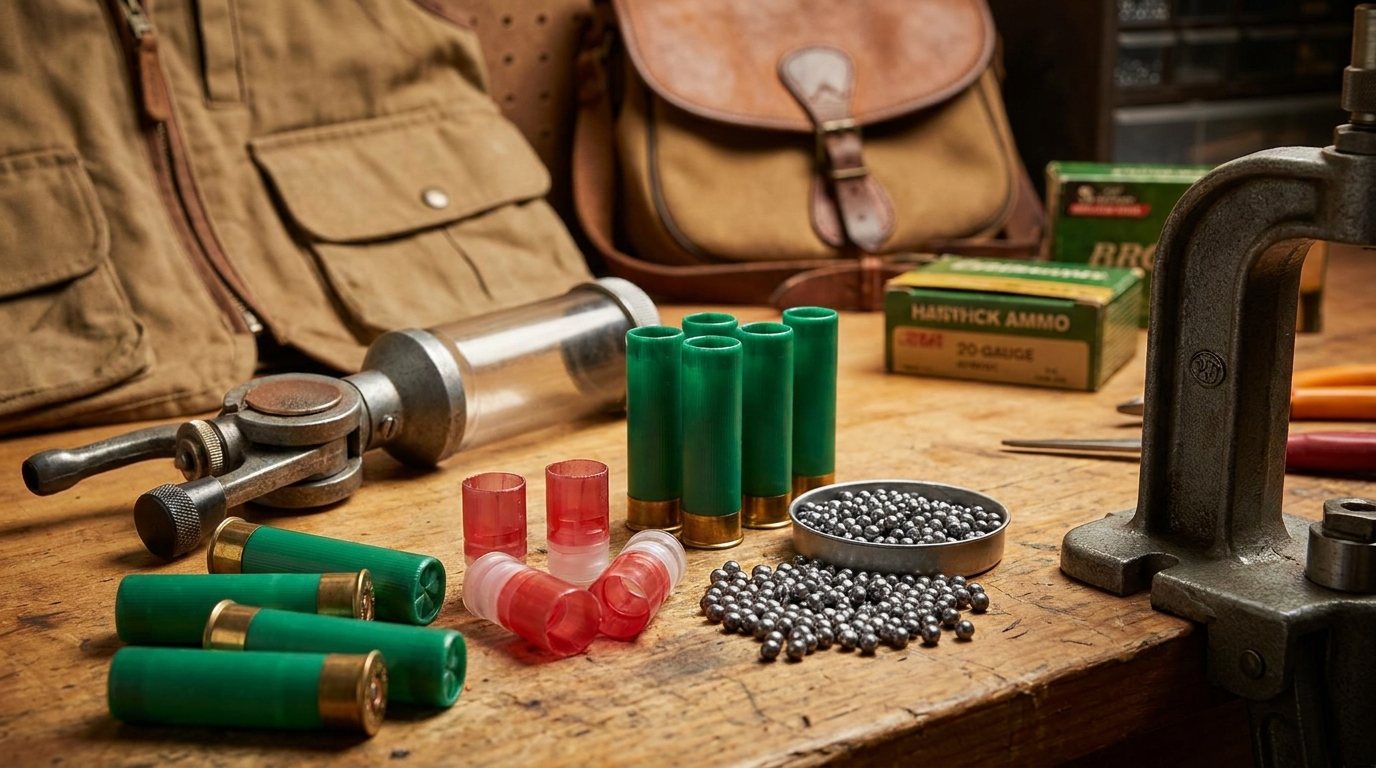
Shotshell reloading requires a dedicated press — rifle and pistol dies won't work. Entry-level options include the Lee Load-All II (under $60) which handles 12, 16, and 20-gauge, and the MEC 600 Jr. Mark V, which is the most popular single-stage shotshell press in the country. For higher volume, the MEC Sizemaster or Grabber progressive presses are excellent. Start with a single-stage if you're new to shotshell reloading — the Lee Load-All II is a fine learning press that produces consistent shells.
You'll also need a hull trimmer (if your hulls need sizing), a shot dipper or shot bottle, and a powder scale. The press handles most of the work — sizing the hull, seating the primer, dropping powder and shot, and forming the crimp — but you'll want a scale to verify your powder charges until you're confident in your bushing selection.
Components
Hulls
Hull choice matters more in shotshell reloading than most beginners realize. High-quality hulls crimp and resize consistently across multiple loadings; cheap promotional hulls often don't. The best 20-gauge hulls for reloading are:
- Winchester AA 20-Gauge: The gold standard. Eight-pointed crimp, thick brass head, low brass or high brass versions available. Most published load data uses AA hulls.
- Federal Gold Medal 20-Gauge: Excellent consistency, used in most Federal target load data.
- Remington STS/Nitro 27: Good performance, especially if you shoot Remington factory loads and are collecting once-fired hulls.
Pick up once-fired hulls at clay target ranges — most shooters just leave them. Rinse in warm water, let dry completely, and inspect for cracked case heads or split mouths before reloading.
Primers
20-gauge uses the same 209 shotshell primer across most loads. Winchester 209, CCI 209, Federal 209A, and Cheddite 209 are the most common. Don't mix primers and load data — if a recipe calls for Win 209, use Win 209. Primer substitution changes pressure, and published data is specific to the primer listed.
Wads
The wad seals the powder gases and cushions the shot column. For 20-gauge upland loads:
- WAA20 (Winchester): Matches Win AA hulls perfectly, widely available, broad load data support.
- CB0178-20 (Claybuster): An inexpensive WAA20 substitute that patterns well and is easy to find online.
- Rem Fig-8 (Remington): Designed for Rem hulls, tighter shot cup for better patterning in many guns.
- BP20 (Ballistic Products): If you want tight patterns for longer shots — chukar at 40 yards — the BP20 with a stiff shot cup is worth experimenting with.
Powder
20-gauge upland loads work well with fast-to-medium burn rate powders. Top choices:
- Hodgdon Clays / International Clays: Extremely clean-burning, consistent, excellent for light-to-medium upland loads. 7/8-oz to 1-oz payloads.
- Alliant Green Dot: A longtime favorite for 20-gauge, meters well, reliable ignition across temperature ranges.
- Alliant Unique: More versatile, slightly higher velocity potential, excellent for heavier 1-oz loads.
- Hodgdon Universal: Good choice for 7/8-oz and 1-oz loads, widely published data.
Shot
Lead shot sizes for Oregon upland birds:
- #8 or #7.5: Mountain quail, valley quail, close-range grouse in heavy cover
- #7.5 or #6: Ruffed grouse, blue grouse, medium-range work
- #6: Pheasant (minimum), chukar at moderate ranges
- #5 or #6: Pheasant (standard), chukar at long ranges, late-season roosters in heavy cover
Hard magnum shot patterns tighter than soft shot — worth the slight premium for cleaner kills at extended range. Lead shot hardness is measured as antimony content; look for 5% to 6% antimony for upland hunting lead.
Sample Load Data (Always Verify Against Current Manufacturer Data)
The following is for reference only. Always cross-reference with a current reloading manual (Lyman Shotshell, Hodgdon Annual, Alliant Powder) before loading. Start at minimum charge weights and work up.
- Light Quail Load: Win AA hull, Win 209 primer, WAA20 wad, 17.0 gr Hodgdon Clays, 7/8 oz #8 shot — approx. 1,200 fps
- Standard Pheasant Load: Win AA hull, Win 209 primer, WAA20 wad, 19.0 gr Alliant Green Dot, 1 oz #6 shot — approx. 1,220 fps
- Chukar Canyon Load: Win AA hull, Win 209 primer, WAA20 wad, 21.0 gr Alliant Unique, 1 oz #5 shot — approx. 1,260 fps
Pattern Testing Your Loads
Before you take your handloads afield, pattern them at the range. Tape a 30-inch circle on a paper target at 40 yards and fire one shell. Count pellets inside the circle, compare to the total estimated pellet count for your shot charge (1 oz of #6 lead = approximately 225 pellets). A full choke should put 70% or better inside the circle; Modified 60% or better; Improved Cylinder 45-50%.
Test multiple loads and choke combinations. You'll likely find that one particular wad-powder-shot combination patterns better in your specific barrel than others — this is the individualized advantage that reloading offers.
Final Notes
Keep your shotshell reloading data in a dedicated notebook separate from your rifle and pistol load data. Label every batch clearly — hull type, powder, charge, wad, shot size, date loaded. The 20-gauge community is smaller than 12-gauge, which means slightly fewer published recipes, but Hodgdon's online Reloading Data Center, the Lyman Shotshell Handbook (5th Ed.), and Alliant's published load guides cover the most popular component combinations thoroughly.
Get your press running before September. Oregon's upland seasons for mountain quail, dusky grouse, and early chukar open fast, and there's no better way to head into a long day in the canyon than with shells you loaded yourself.