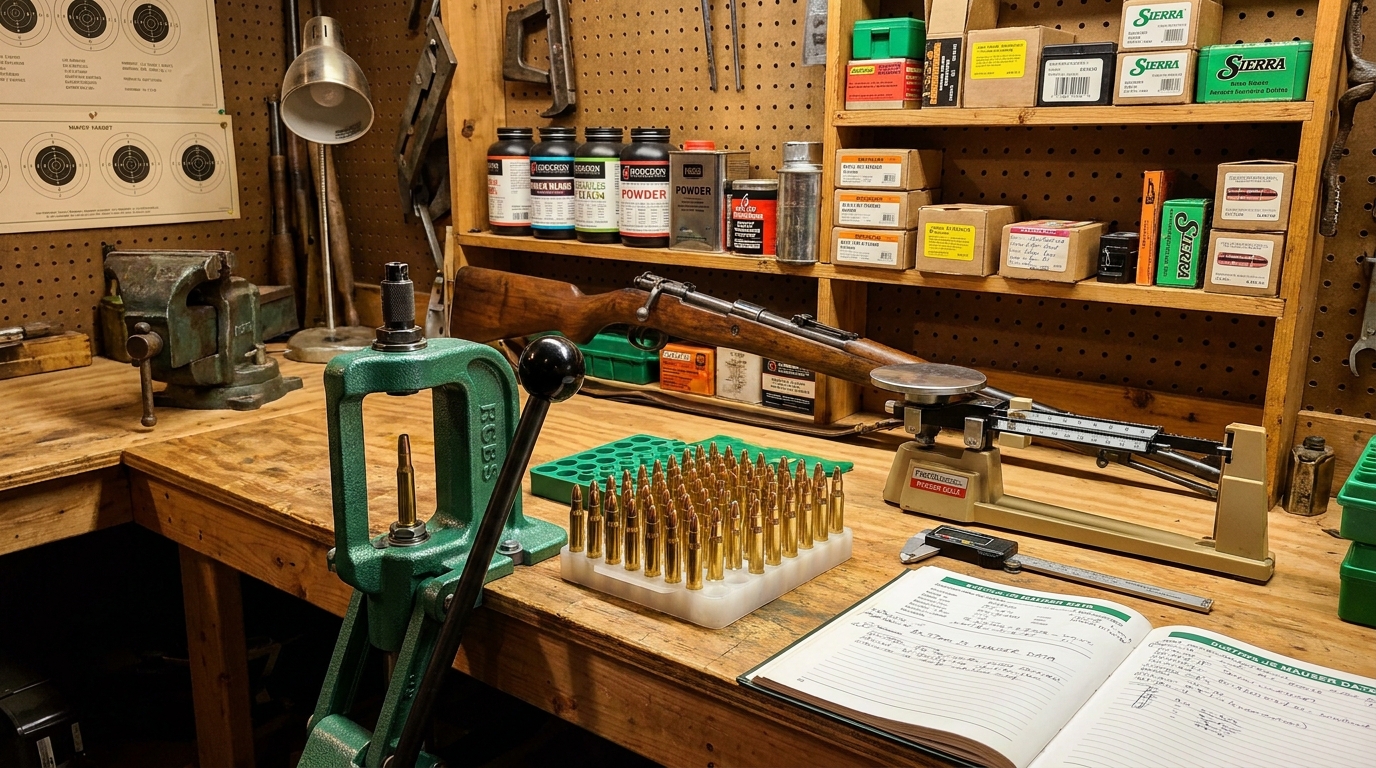
Walk into any gun show or estate sale in Oregon and you’ll likely find a K98 Mauser, a Yugo M48, or some other 8x57 IS surplus rifle for a few hundred dollars. The cartridge these rifles fire — the 8mm Mauser, officially designated 8x57 IS — is one of the most widely produced military rifle cartridges in history and one of the most frequently overlooked by American hunters and handloaders. That’s a mistake worth correcting.
Properly loaded, the 8x57 IS drives a .323-inch diameter bullet at velocities that rival the .30-06 Springfield and, in heavy bullet configurations, approach the performance of the .300 Winchester Magnum. It’s a legitimate deer, elk, and bear cartridge that deserves more respect than the budget surplus bin suggests.
The Caliber Confusion: Know What You Have
Before you load a single round, understand the historical caliber issue. Two versions of the 8mm Mauser exist: the 8x57 J (original German military version, .318-inch bore) and the 8x57 IS (the standard modern version, .323-inch bore). Virtually all production rifles chambered after World War I use the IS specification. Older pre-WWI Mausers, some Turkish rifles, and certain imported arms may be J-bore guns.
Slugging your bore — driving a soft lead slug through the barrel and measuring the recovered slug with a micrometer — is the definitive test. If you have a .318-inch bore, use .318-inch bullets or have the rifle rebarreled. Firing .323 bullets in a .318 bore produces dangerous pressure spikes. Most handloading data is written for .323-inch IS rifles; that’s what we’re covering here.
Components
Brass
Quality 8x57 IS brass is available from Nosler, Hornady, Prvi Partizan (PPU), and Sellier & Bellot. PPU and S&B are the most economical and work well. Nosler brass is premium-grade with tight tolerances. Avoid reformed surplus military brass — the case walls tend to be inconsistent and primer pocket dimensions vary.
Military surplus brass often has crimped primer pockets. If you use it, run a primer pocket swager or reamer before seating new primers. A Lee or RCBS pocket swager handles this quickly in bulk.
Primers
The 8x57 IS uses large rifle primers. Standard large rifle primers work fine for most hunting loads; match primers are worth using if you’re pushing accuracy at long range. Federal 210, CCI 200, and Winchester WLR are all proven choices. Magnum primers are generally unnecessary unless you’re loading with certain ball powders in cold weather conditions.
Powder
The 8x57 IS is a medium-capacity case (approximately 57-58 grains water capacity) that works best with medium to medium-slow burning powders. Top choices include:
- IMR 4064 — The classic 8mm Mauser powder. Consistent, accurate, and widely available. Works exceptionally well with 150- to 196-grain bullets.
- Varget — Temperature-insensitive and accurate. Slightly less capacity than IMR 4064, but excellent performance across a wide bullet weight range.
- IMR 4895 — Burns slightly faster than 4064. Useful for lighter bullet weights (150-170 grains) where top velocity is the goal.
- H4350 — Works well with heavier 196- to 220-grain bullets for deep-penetration hunting loads.
- Reloader 15 — Accurate and efficient; good choice for 170- to 196-grain loads.
Bullets
This is where the 8mm Mauser becomes genuinely interesting. The .323-inch bore diameter offers bullet selection ranging from 150 to 220 grains, giving the handloader a versatile range for everything from deer at 200 yards to black bear in heavy timber.
- 150-grain Sierra Pro-Hunter — Affordable, accurate, excellent for deer. Drives fast and shoots flat.
- 170-grain Hornady InterLock SPBT — The all-around standard for 8mm Mauser hunting. Controlled expansion, good BC, and proven terminal performance on deer and elk.
- 196-grain Hornady InterLock — Heavy and tough; ideal for black bear and elk at moderate ranges. Penetrates deeply and holds together.
- 200-grain Nosler Partition — Premium construction for the serious hunter. Outstanding performance on large game; the .323 Partition is one of the best controlled-expansion bullets made.
- 220-grain Sierra GameKing — For the largest game at close range. Subsonic at standard velocities from a 24-inch barrel, but driven to 2,400+ fps with appropriate powder.
Load Data (Start Low, Work Up)
Always begin at 10% below maximum listed loads and work up in 0.5-grain increments, watching for pressure signs. The following are starting and maximum reference points from published sources — verify against your own loading manual before proceeding:
- 170-grain / IMR 4064: Start 44.0 gr (2,450 fps), Max 48.0 gr (2,620 fps)
- 170-grain / Varget: Start 42.0 gr (2,400 fps), Max 46.0 gr (2,580 fps)
- 196-grain / IMR 4064: Start 40.0 gr (2,200 fps), Max 44.0 gr (2,380 fps)
- 150-grain / IMR 4895: Start 45.0 gr (2,650 fps), Max 49.5 gr (2,850 fps)
Note: Factory-loaded 8mm Mauser ammunition sold in the U.S. is often downloaded significantly due to concerns about old J-bore rifles in the hands of unknowing shooters. Your handloads, built for a verified IS-bore modern rifle, can safely exceed factory-spec velocities when developed carefully.
Pressure Signs to Watch
Flattened or cratered primers are your first warning. Difficult extraction — especially a sticky bolt lift after firing — is a definitive stop sign. Inspect the case head for bright extraction marks from the bolt face. Any of these symptoms means you’ve exceeded safe pressure for your specific rifle; back off 2 grains and retest.
Accuracy Expectations
A good K98 or M48 military action, properly headspaced and with a sound bore, is capable of 1.5 to 2.5 MOA with quality handloads — well inside acceptable hunting accuracy for shots to 300 yards. Sporterized Mauser actions on quality aftermarket stocks can push 1 MOA or better. The limiting factor is almost always the military barrel’s aging rifling, not the cartridge.
Bottom Line
The 8mm Mauser is a legitimate big-game cartridge hiding behind a military surplus reputation. If you have one of the millions of Mauser-action rifles chambered in 8x57 IS, don’t let it collect dust — handload it properly, shoot it regularly, and take it hunting. For deer, elk, and black bear in Oregon’s mixed terrain, a 196-grain Partition at 2,380 fps out of a vintage Mauser is a combination that has taken more game than most American hunters will ever realize.