Walk into a Cowboy Action Shooting match for the first time and you'll immediately notice something different about this crowd: they're smiling. Not the polite, sporting-event smiles you see at a PRS match or an IDPA stage — genuinely, ear-to-ear, this-is-the-most-fun-I've-had-in-years smiling. Cowboy Action Shooting, sanctioned by the Single Action Shooting Society (SASS), is one of the most accessible, inclusive, and flat-out enjoyable shooting sports in the Pacific Northwest, and it's drawing new participants every season.
What Is SASS / Cowboy Action Shooting?
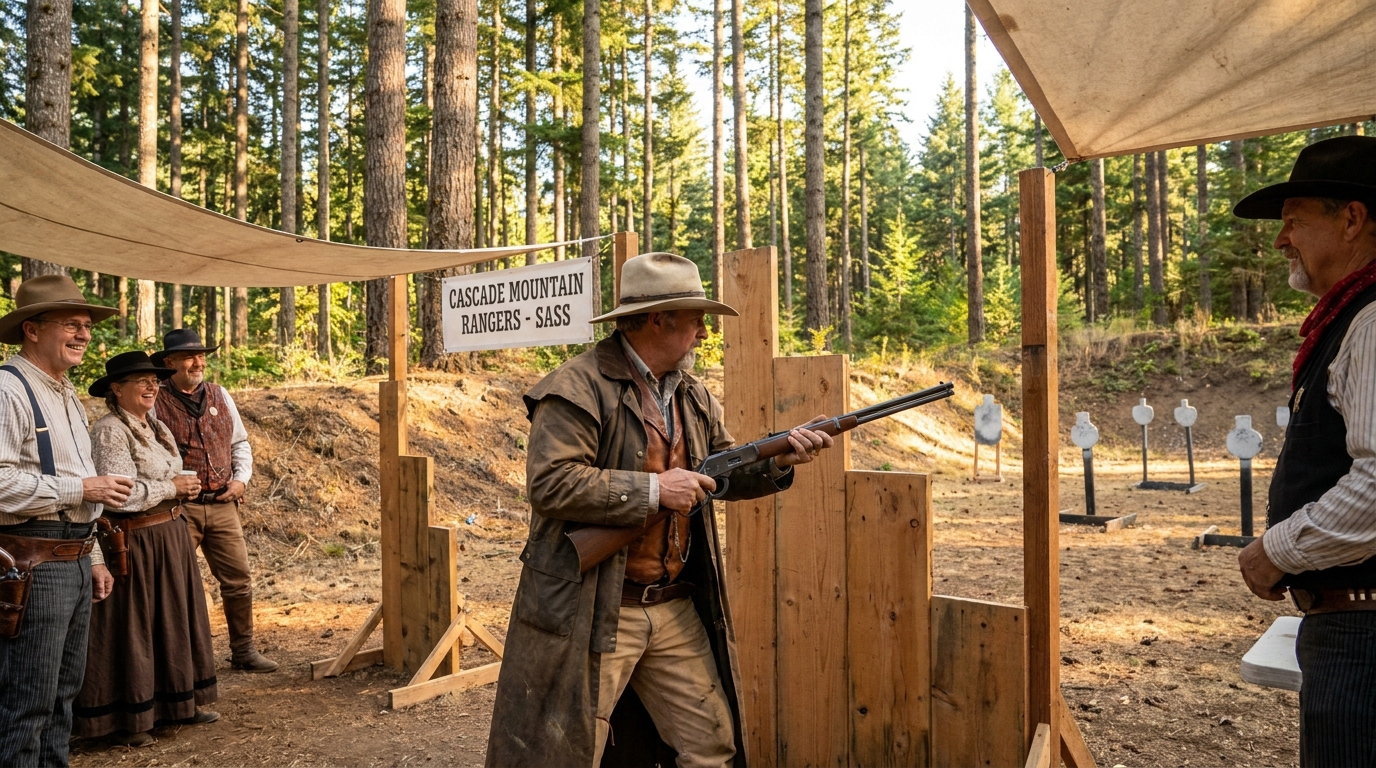
The Single Action Shooting Society was founded in 1987 in California and has grown to more than 80,000 members worldwide. The sport simulates the firearms of the American frontier era — the 1860s through the early 1900s — using period-appropriate guns on steel targets in staged scenarios. Matches are run in character: each competitor adopts a unique alias (your cowboy name, registered with SASS), dresses in period costume, and shoots each stage against the clock.
Targets are steel — knockdown or stationary — and scoring is based on time with penalties added for misses and procedural errors. Stages are written like little theater pieces: "You ride into Tucson to find four outlaws at the saloon. Take out the bartender's shotgun from the bar, then clear the street with your rifle..." The flavor writing is half the fun.
The Guns
SASS requires three categories of firearms, all designed to approximate the guns of the Old West:
Single-Action Revolver (Two Required)
The backbone of the sport. You carry two revolvers and shoot them alternately or in sequence depending on the stage instructions. All revolvers must be single-action — hammer must be manually cocked before each shot — and must be styled after pre-1899 designs.
- Ruger Vaquero (Standard and Montado): The most popular entry-level choice. Robust, accurate, widely supported by gunsmiths. Available in .357 Magnum, .44-40, and .45 Colt.
- Ruger New Vaquero: Slightly smaller frame, fits smaller hands better. Popular with newer shooters.
- Uberti / Cimarron 1873 SAA Clone: Closer to the original Colt feel, lighter, excellent for Traditional and Classic Cowboy categories. Slightly less durable than Ruger for high-volume competition use.
- Original Colt SAA: Legal, historical, expensive. Most competitors shoot clones.
Start with .357 Magnum revolvers — you'll load them with .38 Special ammunition, which is soft-shooting and inexpensive. .45 Colt is the romantic choice but ammo costs more.
Lever-Action Rifle
Chambered to match your revolvers — one of the great pleasures of the sport is running the same cartridge through both handgun and long gun.
- Winchester Model 1873 (Uberti Clone): The quintessential Cowboy Action rifle. Elegant, historically accurate, available in .357/.38 and .45 Colt. The Italian-made Uberti and Cimarron versions are excellent.
- Winchester Model 1892 (Rossi or Uberti): Stronger action, smoother cycling, slightly more modern. Very popular in competition.
- Marlin 1894: The American-made alternative. Discontinued by Marlin but used Marlins appear regularly at gun shows. The new Ruger-manufactured Marlin 1894 is excellent.
- Henry Rifle (Original Henry): Required for the Frontiersman category. No forestock, tube-loaded from the front.
Shotgun
Shotgun stages typically involve two targets, two shots. You want fast and simple.
- Side-by-Side Double Barrel: The most popular choice. Break it open, reload two shells, close, continue. Stoeger Coach Gun is the affordable entry-level workhorse — under $500 and virtually indestructible.
- Exposed-Hammer Double Barrel: Required for some categories. Adds a historical touch and a small skill element.
- Model 1897 Pump (Winchester or clone): Legal in most categories, faster for some shooters. Requires working an external hammer.
- Model 1887 Lever-Action Shotgun: Legal and impressive to watch, slower to operate.
Ammunition
Cowboy Action Shooting uses pistol-caliber ammunition at relatively mild velocities — most SASS rules require rifle rounds to make 1,000 fps and revolver rounds to make 700 fps minimum. This means light loads, which means gentle recoil, which means beginners aren't getting punished every stage.
Many competitors reload their own ammunition, and Cowboy Action is one of the best gateways into reloading — the loads are simple, the components are inexpensive, and the volume of shooting makes the savings substantial. A standard 200-round match day in .38 Special with cast lead bullets costs under $30 to reload.
Categories and Costumes
SASS has over a dozen shooting categories based on age, gun type, and shooting style — Traditional, Modern, Gunfighter (shooting both revolvers simultaneously), Duelist (one revolver at a time), Classic Cowboy, Senior, Ladies, and more. New shooters typically start in Traditional or Modern until they find their preferred style.
The costume requirement is real and part of the appeal. Pick an era and a persona — lawman, gambler, outlaw, frontier woman, mountain man — and build an outfit that fits. It doesn't need to be expensive: a cowboy hat, boots, vest, and period belt/holster rig from an outfitter like El Paso Saddlery or Kirkpatrick Leather is a perfectly legal and legitimate competition outfit. The community will help you figure it out at your first match.
Pacific Northwest SASS Clubs
The Pacific Northwest has an active Cowboy Action community. Clubs hold monthly matches, annual themed events, and often welcome first-time shooters with dedicated orientation stages.
- Oregon Trail Regulators (Portland area): One of the most active Oregon clubs, shooting at the Tri-County Gun Club in Sherwood.
- Rogue Valley Vaqueros (Medford/Grants Pass): Southern Oregon's club, shooting at Tri-City Sportsmen's Club near Central Point.
- Willamette Valley Vigilantes (Salem area): Active club with regular monthly matches.
- Snake River Posse (Northeast Oregon/Idaho border): Covers the Baker City and Ontario area, good for eastern Oregon shooters.
Check the SASS Wire (the official SASS online forum) for current club listings — clubs occasionally move ranges or change match schedules.
Getting Started: Your First Match
Contact a local club before your first match. Most clubs have a new-shooter orientation process — you'll shoot a few stages with an experienced cowboy coaching you through stage procedures, safety protocols, and the "Spirit of the Game" that defines the sport's culture. Don't worry about having perfect gear on day one. Most clubs have loaner guns for first-timers, and the community is genuinely enthusiastic about helping newcomers find their footing.
You don't need to be fast to enjoy Cowboy Action Shooting. The top competitors in Oregon can clear a six-target stage in under 20 seconds. Most casual competitors take 35-50 seconds. Nobody cares as long as you're safe, in character, and having fun. And you will be having fun — that much is guaranteed.