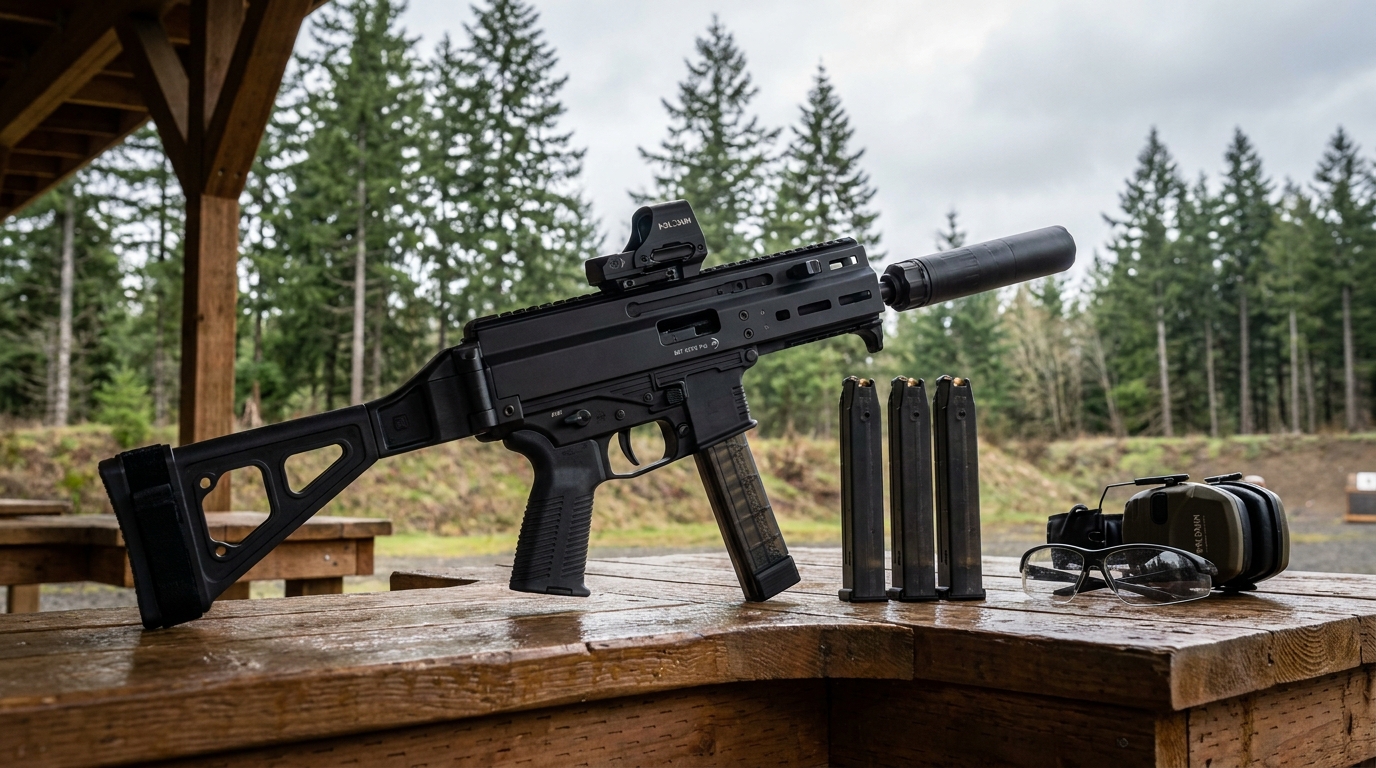
Pistol caliber carbines have had a long and complicated relationship with the American shooting public — dismissed by serious rifle guys as half-measures, then quietly adopted by competitive shooters who kept winning matches with them, and now firmly mainstream as home defense tools, training platforms, and all-around range rifles. In the Pacific Northwest, where a home defense firearm might need to reach across a rural property, be handed to a less-experienced family member, or serve double duty as a suppressor host, the 9mm PCC is hard to argue against.
What Is a Pistol Caliber Carbine?
A pistol caliber carbine is a long-gun platform chambered in a handgun cartridge — most commonly 9mm Luger, but also .40 S&W, .45 ACP, and .357 Sig in various configurations. The rifle form factor — longer barrel, shoulder stock, longer sight radius — wrings additional performance from pistol cartridges that most people never access when shooting a handgun. A 9mm 115-grain round that runs 1,150 fps from a 4-inch pistol barrel will push 1,350–1,400 fps from a 16-inch carbine barrel. That's a meaningful velocity increase that improves expansion reliability and extends effective range.
The Pacific Northwest Case for a 9mm Carbine
Oregon and Washington present some specific use cases that make the PCC category especially practical:
- Suppressor compatibility: Oregon allows suppressor ownership, and 9mm is one of the most effective suppressed calibers available. A 9mm PCC with a subsonic load (147-grain or heavier) and a quality suppressor is hearing-safe without a booster — something that's harder to achieve with centerfire rifle calibers. Rural homeowners who don't want to torch their hearing at 2 AM will appreciate this.
- Ammunition interchangeability: If you carry a 9mm handgun — Glock 17/19, Sig P320, Smith M&P — a 9mm PCC can share magazines in some configurations (CMMG Banshee/Resolute with Glock-pattern mags, CZ Scorpion with Scorpion mags). One ammo supply for two platforms simplifies logistics.
- Reduced recoil: The 9mm carbine's reciprocating mass and shoulder stock make it dramatically easier to shoot well than a handgun for inexperienced users. For rural property owners whose partner or adult child needs a home defense tool they can run effectively, this matters.
- Indoor range use: Most indoor ranges in Oregon — Tigard's Tigard Indoor, Bend's Cascade Shooting Facility, Portland's Rangemaster — allow 9mm PCCs where they restrict higher-velocity rifle calibers. If your indoor range options are limited, a PCC keeps you in the game.
Platform Comparison: The Main Players
AR-Platform PCCs (CMMG Banshee/Resolute, Palmetto Dagger, Aero EPC)
For shooters already familiar with the AR ergonomic system, AR-pattern 9mm carbines offer the shortest learning curve. Controls are identical to a standard AR-15. Quality varies widely by price point — a budget AR PCC under $600 will function reliably but won't be as refined as a CMMG or a Foxtrot Mike. Most AR 9mm builds use a blowback operating system, which is slightly heavier-recoiling than delayed blowback designs but extremely reliable.
CZ Scorpion EVO 3
The Scorpion is the top-selling dedicated 9mm PCC for a reason. It's a purpose-built platform with a proven track record, excellent ergonomics, and an outstanding aftermarket for stocks, braces, and trigger upgrades. The folding stock makes it compact enough to store in a vehicle safe. Factory triggers are serviceable but benefit from an aftermarket upgrade — Cajun Gun Works' Scorpion trigger kit is the standard recommendation and runs about $125. The only downside is that you're buying into CZ's proprietary magazine ecosystem rather than a more universal standard.
Ruger PC Carbine
Ruger's PC Carbine is the most affordable quality option in the category, retailing around $600–$700. It's takedown-capable (the rifle breaks into two halves for storage in a compact case), accurate, reliable, and accepts both Ruger and Glock-pattern magazines via interchangeable magazine wells. The factory trigger is one of the better stock triggers in the PCC market. For a pragmatic home defense and range rifle without frills, it's hard to beat.
Kel-Tec Sub-2000
The Sub-2000 folds in half lengthwise for extreme compactness — it fits in a standard backpack when folded. It's not a precision shooter's rifle, but for a truck gun or get-home-bag option, nothing else matches its form factor. The Gen 3 model addressed most of the early reliability complaints. Accepts Glock 17 magazines in G17-compatible configuration.
Optics for the 9mm PCC
A quality red dot is the correct optic for a pistol caliber carbine used for home defense or competition. The Aimpoint Acro P-2 or Trijicon MRO work on the hunting/defense end. For competition or range use where cost matters more, the Holosun 510C or 407C are outstanding values. Magnified optics are largely unnecessary — the 9mm's rainbow trajectory limits practical precision shooting past 150 yards, and a 1x red dot allows faster target acquisition inside that distance.
Ammunition Selection
For home defense use from a 16-inch barrel, 124-grain +P hollow points (Federal HST, Hornady Critical Duty, Speer Gold Dot) deliver excellent performance. The longer barrel increases velocity enough that standard-pressure 147-grain JHPs — the preferred subsonic load for suppressed use — also expand reliably. Run a 50-round function test with your chosen defensive load before trusting it.
For training and range work, any quality 115-grain or 124-grain FMJ in bulk will do. Federal American Eagle and Blazer Brass are reliable and consistently available at Oregon retailers and online.
Competition: USPSA PCC Division
If you want to get the most out of a 9mm carbine, shoot it in competition. USPSA's PCC division is one of the fastest-growing shooting sports segments in the Pacific Northwest. Local matches at Tri-County Gun Club (Sherwood, OR), Cascade Practical Shooters (Bend, OR), and Wolverine Supplies (Vancouver, WA) run dedicated PCC stages. The division rewards fast transitions, accurate movement shooting, and efficient reloads — skills that translate directly to defensive shooting competence.
The Bottom Line
The 9mm pistol caliber carbine isn't a rifle, and it isn't a handgun — it's a genuinely useful tool that occupies a real niche for Pacific Northwest shooters who want a reliable home defense long gun, a suppressor-friendly platform, a competition rifle, or a low-recoil trainer that shares ammo with their carry gun. Any of the platforms above will serve you well. Pick the one that fits your ecosystem — ergonomics, magazines, and budget — and shoot it enough to be competent with it. That's the whole game.