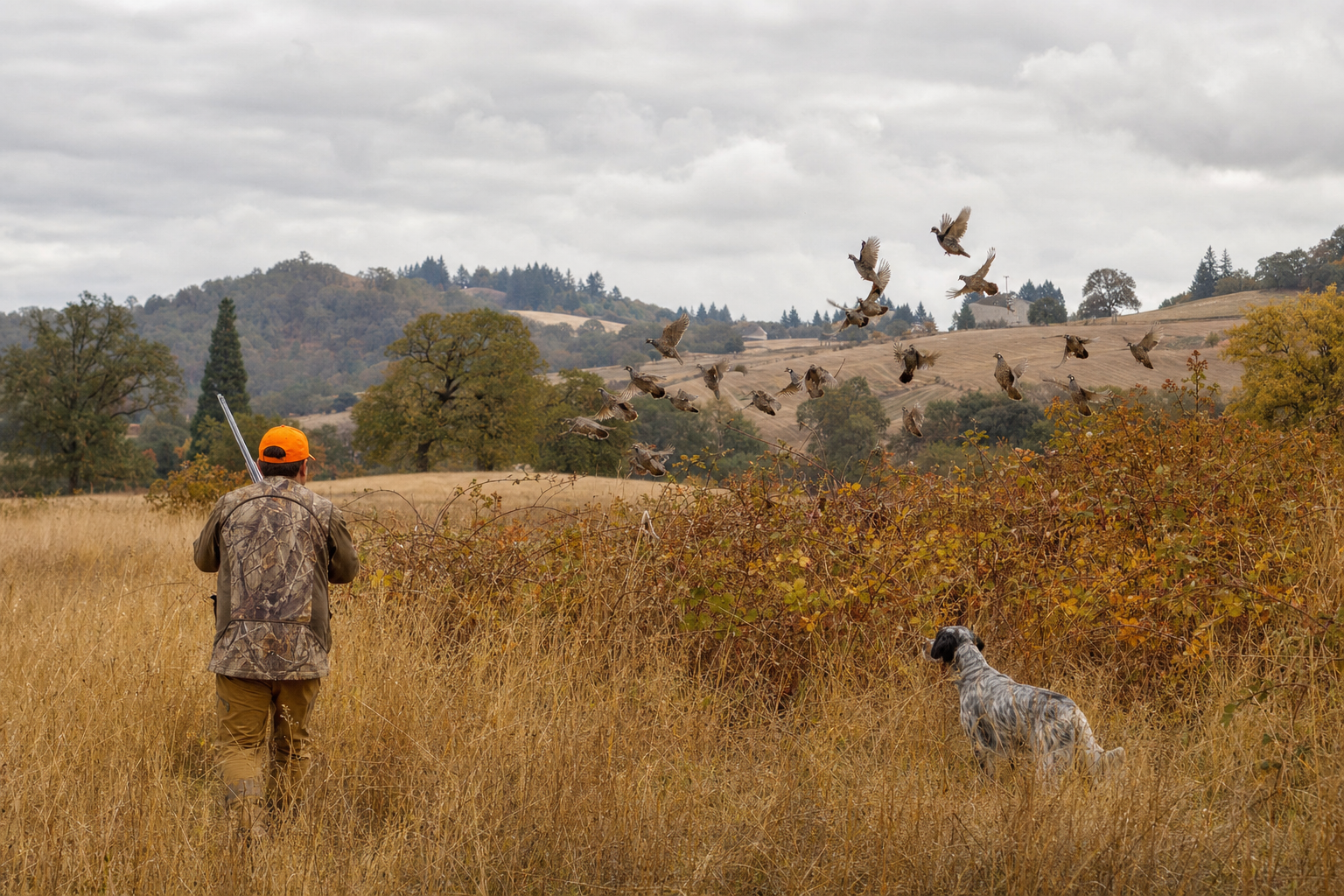
The California quail — officially the state bird of California but very much at home across the length of Oregon — might be the most underrated upland bird hunt in the Pacific Northwest. They're abundant, they flush hard, they're legal to hunt from mid-September through January, and unlike pheasant or chukar, you don't need sprawling empty miles of desert or expensive guided access to find them. A good quail covert in Yamhill County or the foothills east of Salem can produce multiple coveys in a half-day walk, and you can be back in town before dinner.
Locally called valley quail — a name that suits them perfectly — California quail thrive in the brushy, transitional habitat that defines the western edge of the Willamette Valley. Blackberry thickets, brushy fence lines, overgrown hedgerows, mixed grass-and-brush terrain near agriculture: this is quail country, and Oregon has plenty of it.
Where to Find Oregon Valley Quail
The core of Oregon's valley quail range runs through the Willamette Valley from the Columbia River south to the Umpqua Basin, with populations also thriving on the eastern flanks of the Cascades, throughout the Rogue Valley, and in brushy draws across much of the interior Pacific Northwest.
Top Public Access Areas
- Willamette Mission State Park (Marion County): The floodplain cottonwood and brushy understory along the river holds solid coveys. Walk the park's outer boundaries near brushy edge habitat.
- Yamhill County farm fields: The mix of grass seed crops, vineyard hedgerows, and overgrown corners between fields makes this some of the most productive quail habitat in western Oregon. Many landowners will grant permission if asked respectfully — knock doors, not gates.
- Sauvie Island (Columbia County): The island's brushy fields and Wildlife Area lands hold valley quail in addition to its famous waterfowl. Early season before the heaviest bird pressure is ideal.
- Umpqua Basin: The dryer climate and more open brushy terrain around Roseburg and south toward Grants Pass hold excellent quail populations, often with less hunting pressure than the Valley.
- Rogue Valley (Jackson County): Medford-area brush and oak savanna holds valley quail through the entire season with warmer, more huntable conditions late into winter.
Understanding Valley Quail Behavior
California quail are gregarious and predictable — two qualities that make hunting them both learnable and repeatable. They move in coveys of 10 to 40 birds (sometimes more) and follow established daily routines tied to food, water, and cover.
Coveys roost in dense brush at night and move out to feed in the morning, typically hitting agricultural fields, seed patches, or oak acorn-drop areas in the first two hours of daylight. By midday, they retreat to heavy cover — blackberry, brush piles, tall grass — where they loaf and dust-bathe. The afternoon feeding movement brings them out again around 3 p.m. before they head back to roost.
Hunt the feeding-to-cover transition in the morning and the cover edge in the afternoon. Walking the margin between heavy brush and open ground — that 10-to-30-yard strip — puts you in the flush zone repeatedly.
Guns, Chokes, and Loads for Valley Quail
Valley quail are small, fast, and rarely offer long shots in the tight cover they prefer. This is a short-range game shot at 15 to 30 yards over the dog, rarely beyond 35.
Recommended Setups
- 20-gauge over/under or side-by-side: The classic quail gun. Light, fast, and plenty of payload for close-range birds. An open IC/Mod choke combo handles everything you'll encounter.
- 12-gauge field gun: Perfectly effective with 1-oz loads of #7.5 or #8 shot. If you already own a 12-gauge pheasant gun, run lighter loads and don't overthink it.
- 28-gauge: For the sporting crowd. Challenging but very doable at quail ranges. Use #7.5 or #8 in 3/4-oz loads.
- Shot size: #7.5 is the workhorse. #8 for short-range covey flushes in heavy cover. Avoid #6 — it's overkill on a 6-oz bird and won't improve your shooting.
- Chokes: Improved Cylinder or Skeet for the first barrel; Modified for the second. Open patterns win in brushy cover.
Dogs for Valley Quail
You can hunt valley quail without a dog — they're not impossible to find on foot — but a good bird dog turns a decent quail hunt into a great one. The covey behavior means you're often relocating running birds through heavy cover, and a dog that can stay on the scent cone and point is invaluable.
Pointing breeds — English setters, Brittanys, vizslas — are the traditional choice and work beautifully on valley quail. Flushing breeds (springers, cockers) work well too, especially in the thick blackberry habitat where a tight-working flusher stays ahead of the gun more consistently than a wide-running pointer.
After a covey flush, mark where singles and pairs land and hunt those birds individually. Single quail hold much tighter than covey birds and offer the closest, cleanest points of the day.
Season Dates and Regulations
Oregon's valley quail season typically opens in mid-September and runs through the end of January, though dates vary by zone. The West Zone (Willamette Valley, coast ranges) generally mirrors the East Zone season. Check myodfw.com for the current year's specific dates and zone boundaries before you go.
The daily bag limit is 10 birds, with a possession limit of 20 — numbers that reflect how healthy Oregon's valley quail populations are when habitat is good. License requirements: a valid Oregon hunting license. No upland bird validation is required for valley quail (unlike pheasant), which simplifies the paperwork.
Habitat Access Tips
- Walk fence lines and hedgerows: Quail love the protected corridor of a brushy fence line. Walk parallel to it, not on it, to keep birds from running ahead and flushing wild.
- Work toward cover, not away from it: Quail pushed away from their heavy brush will flush early and far. Push them toward the cover and they'll hold tighter as they near sanctuary.
- Find water: In drier fall conditions, quail concentrate near any reliable water source — stock tanks, creeks, irrigation ditches. A water source near good cover is almost always worth hunting.
- Note covey locations and return: Valley quail coveys are site-faithful. A covey flushed from a particular blackberry patch on Oct 1st will likely be using the same area on Nov 15th if not overhunted. Keep a notebook or mark waypoints — these spots pay dividends all season.
Field Care and the Table
Valley quail are excellent table birds — mild, tender white meat that compares favorably to any upland species. Breast them in the field or at home: the tiny legs are worth saving too but require more work. Keep birds cool immediately, especially on warmer October days. A breathable game vest with a mesh back panel is preferable to a solid-back bag that traps heat against the birds.
Quail season in Oregon's Willamette Valley is an accessible, affordable, and often overlooked hunting opportunity right in the backyard of half the state's population. You don't need a four-wheel drive, a pack frame, or a week off work. You need a license, a shotgun, a pair of boots, and a morning free. The birds are out there.