Coyotes are everywhere in Oregon — from the sage flats of Harney County to the timber edges of the Willamette Valley — and hunting them is one of the most skill-intensive, year-round pursuits available to Oregon hunters. Whether you're trying to protect livestock, sharpen your off-season rifle skills, or simply chase the thrill of calling a wild canid into bow range, predator hunting is addictive. Here's what you need to know to get started and start filling tags.
Why Hunt Coyotes in Oregon?
Oregon has no closed season and no bag limit on coyotes. You don't even need a hunting license to kill them on private land as a landowner or with the landowner's permission, though a hunting license is required on public land. That open access makes coyote hunting an ideal activity between big game seasons — and a great way to stay sharp with your rifle, rangefinder, and field judgment.
Beyond sport, coyotes take a serious toll on Oregon's deer fawns, pronghorn kids, upland bird nests, and domestic livestock. Landowners across Eastern Oregon, the Willamette Valley, and the coast are almost universally happy to grant permission to hunters willing to work their ground. Knock on doors, be polite, and you'll find more country than you can cover.
Best Times and Locations
Coyotes can be called year-round, but fall and winter are prime. September is an excellent month — pups born in spring are now half-grown and still unsophisticated, responding aggressively to prey-in-distress calls. They're establishing new territories and hungry. By November and December, the adults are in breeding behavior, and both male and female coyotes respond well to howling sequences and coyote challenge calls.
Top public land areas in Oregon include:
- Sheldon-Hart Mountain region (Lake and Harney Counties) — vast sagebrush flats with high coyote densities and long shooting lanes
- Boardman-Irrigon area (Morrow County) — Columbia River Basalt country with agriculture and adjacent BLM ground
- Southern Willamette Valley (Lane and Linn Counties) — ag edges, brushy draws, and timber interfaces where coyotes push into open ground at dusk
- Ochoco National Forest edges — mixed ponderosa and meadow terrain where coyotes follow deer herds into open parks
Electronic Callers: The Modern Standard
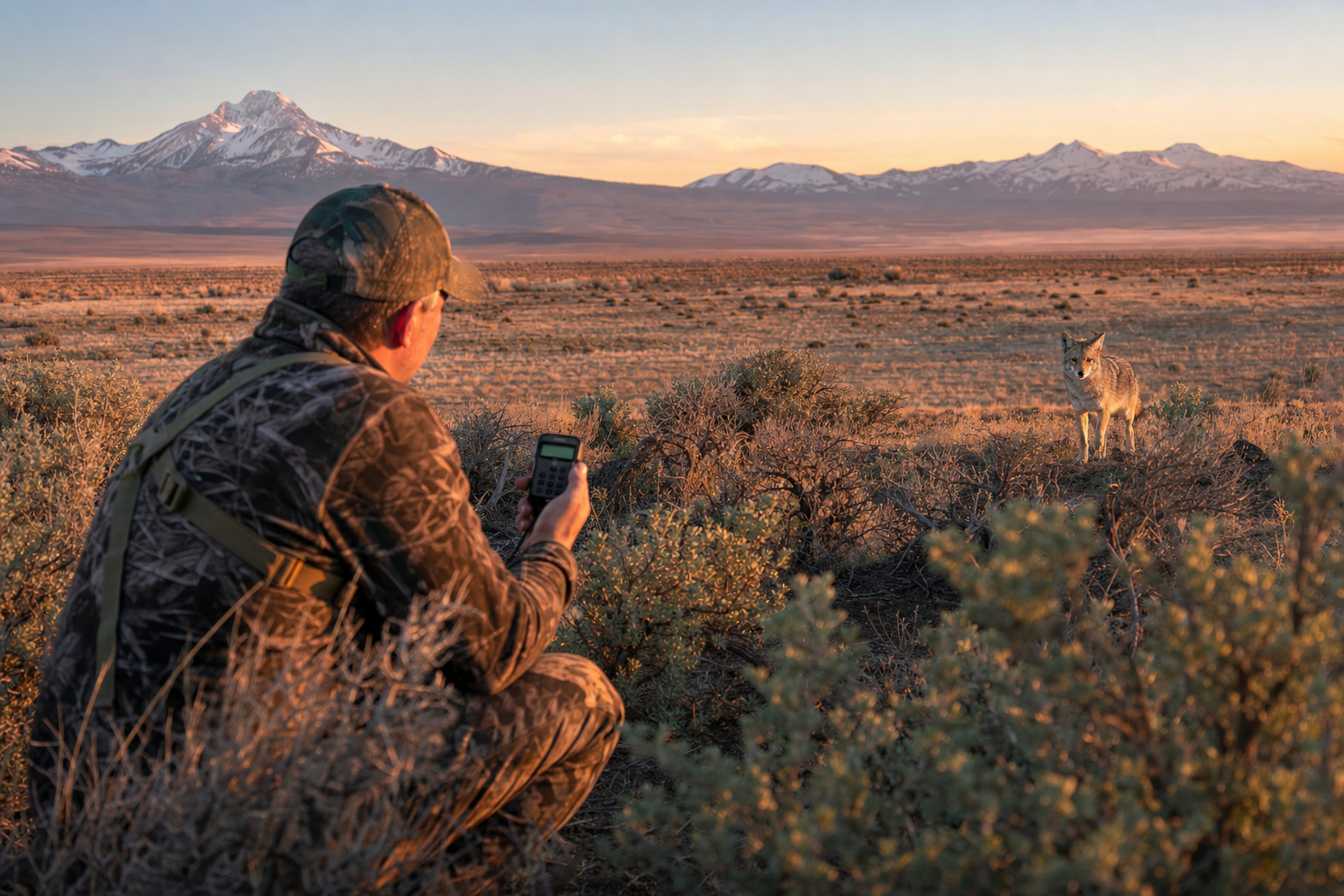
A quality electronic caller is the single biggest upgrade you can make to your coyote setup. Units like the FoxPro Shockwave or Lucky Duck Revolution project loud, realistic sound with a remote control that lets you adjust volume and switch sounds without moving. Place the caller 30–50 yards downwind of your position so approaching coyotes focus on the sound source rather than you.
Start with a jackrabbit distress or cottontail in distress sequence — these are the most universal triggers. Run it loud for the first two minutes to reach coyotes at distance, then back off volume as if the rabbit is weakening. If nothing shows in 10–12 minutes, try a few coyote pup distress calls or a lone howl series. If that doesn't work in another 5 minutes, move. Coyotes commit fast or not at all.
Mouth Calls Still Work
Don't overlook a simple Primos Jackrabbit or Flambeau hand call. Mouth calls are quieter than electronics in calm conditions, and some hunters swear pressured coyotes respond better to them. Learn to do a ki-yi distress (the high, frantic squeal of a coyote pup in trouble) — it's one of the most aggressive triggers you can use.
Stand Setup and Wind
Wind kills more setups than anything else. Coyotes live and die by their nose. Always approach your stand from downwind, and position yourself so approaching coyotes must come from upwind or crosswind of your location. Use terrain — ridgelines, creek banks, and brushy edges — to break your silhouette. Don't skyline yourself on a ridgetop.
Sit absolutely still. A coyote at 200 yards may look directly at you, and the slightest movement ends the stand. Wear a good face mask and gloves. If hunting open desert, a layout blind is worth its weight — they let you move your rifle without being detected.
Rifle and Cartridge Choices
Most Oregon coyote hunters run flat-shooting varmint cartridges:
- .223 Remington / 5.56 — The most popular choice. Cheap to reload, accurate, and devastating with a 55-grain Ballistic Tip at 3,240 fps. Minimal pelt damage at moderate ranges.
- .22-250 Remington — Reaches out to 400+ yards with authority. The classic predator round for wide-open eastern Oregon stands.
- .243 Winchester — Doubles as a deer round and cleanly takes coyotes at any range. 55-grain V-MAX loads hit over 4,000 fps from a standard 26-inch barrel.
- .204 Ruger — Screaming fast with minimal wind drift. Excellent for Harney County flats where crosswinds are brutal.
A quality variable scope in the 3-9x or 4-14x range covers all situations. A bipod keeps you steady on longer shots, and a rangefinder takes guesswork out of fast-approaching dogs at unknown distances.
Calling Sequence and Patience
A standard coyote stand runs 20–30 minutes maximum. Many hunters give up too soon; others stay too long and get winded. The sweet spot:
- Minutes 1–3: Open with loud distress calls to cover maximum distance
- Minutes 4–8: Soften and slow the sequence — dying rabbit behavior
- Minutes 9–12: Switch to pup distress or a lone howl; add a coyote decoy if you have one
- Minutes 13–20: Stay quiet, watch for a sneaky approach from behind or the side
- Minute 20–25: Close with a challenge howl series, then leave
Walk out slowly. Coyotes that won't commit will often sit at the edge watching. If you spook one on the way out, move to a completely different drainage rather than trying to call the same area again the same day.
Nighttime Calling in Oregon
Oregon allows nighttime coyote hunting statewide with no special permit required. A green or red light headlamp doesn't blow out coyote eyes the way white light does. Run your electronic caller from a tripod and watch for eye shine at the edge of your light cone. A suppressed .22-250 or suppressed .223 at night is one of the most effective combinations going — coyotes often come back for a second or third shot if the first one misses without the report spooking the group.
Final Thoughts
Oregon coyote hunting rewards preparation, patience, and practice. Learn to read the terrain, run a clean stand, and stay downwind — those three things alone will put you ahead of 80% of hunters in the field. With year-round open access, no bag limit, and an abundance of willing private land, there's no excuse not to be calling year-round. Get out there and run some stands.