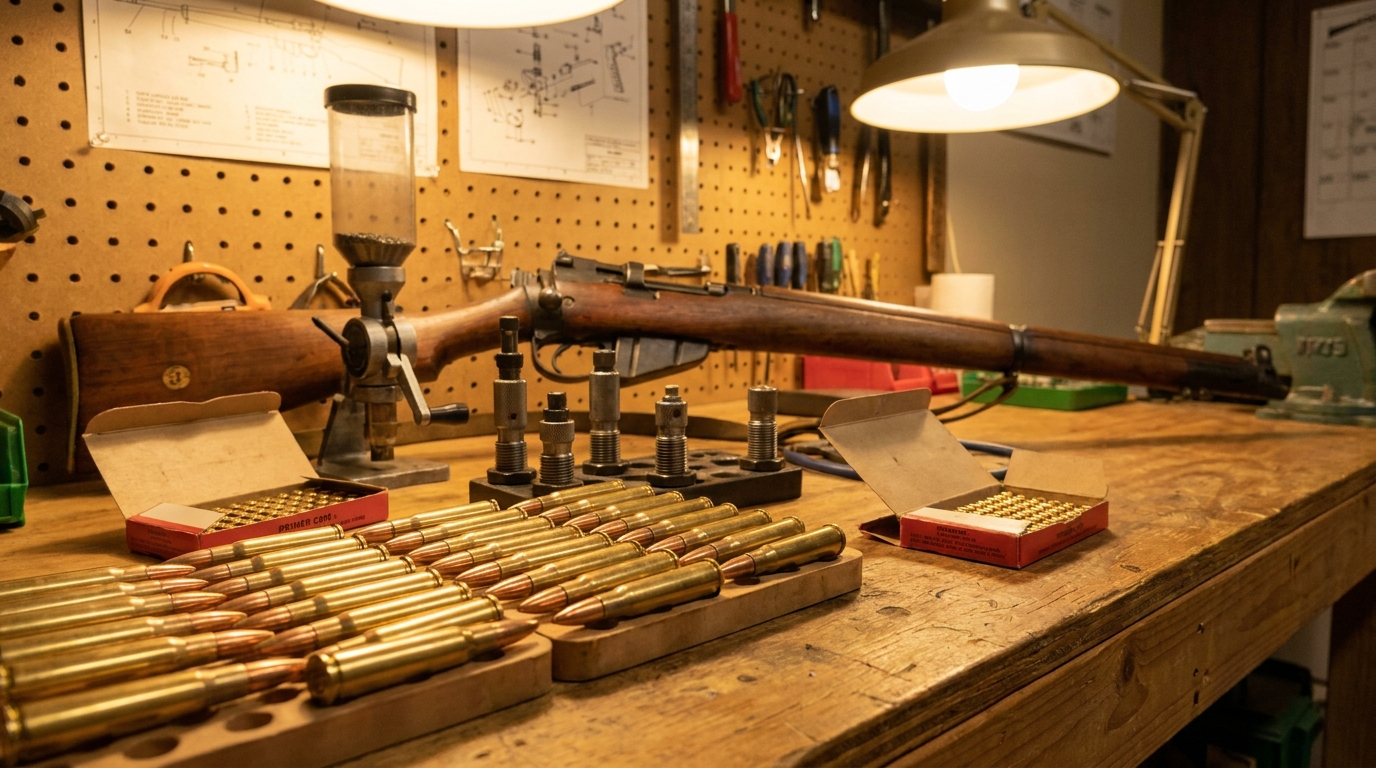
The .303 British cartridge has been in continuous service since 1888 — first in British military Lee-Metford and later Lee-Enfield rifles, and eventually in the hands of hunters across Canada, Australia, New Zealand, and the Pacific Northwest. Surplus No. 4 Mk I and No. 4 Mk II Lee-Enfields remain among the most affordable, reliable, and accurate military bolt-actions ever produced. For the handloader, the .303 British rewards attention and delivers excellent accuracy at modest velocities with a wide selection of .312–.313" diameter bullets.
Understanding .303 British Brass
New .303 brass is available from Hornady, Nosler, and Starline. Starline in particular produces excellent quality .303 brass at reasonable cost. Military surplus brass exists in abundance but presents challenges: Berdan priming is common, and case dimensions vary by country of origin and era of production. For serious handloading, stick with new boxer-primed brass and sort by headstamp. Case capacity varies slightly between manufacturers, so work up loads from scratch rather than copying recipes from a different brand's brass.
Case Preparation
- Full-length resize for semi-auto or mixed rifles; neck-size only for a dedicated bolt gun
- Trim to 2.205" (SAAMI spec length) after resizing — .303 cases stretch noticeably
- Deburr and chamfer case mouths for consistent bullet seating
- Primer pockets: large rifle primers are standard — CCI 200 or Federal 210 work well
Bullet Selection
The .303 British uses .311–.312" diameter bullets, slightly larger than the .308" diameter used by the .30-06 and .308 Winchester. Don't substitute .308" bullets — accuracy suffers and pressure can be unpredictable in older worn bores. Quality options include:
- Hornady 150-grain SP (.312"): The go-to hunting bullet for deer-sized game. Affordable, widely available, and accurate.
- Sierra 174-grain HPBT (.312"): The match bullet for the .303. Superb accuracy for target shooting vintage Enfields.
- Woodleigh 215-grain Soft Nose (.312"): For those using the .303 on black bear or larger game — deep penetration and controlled expansion.
- Hornady 123-grain SP (.312"): A lighter bullet that achieves higher velocity for varmint applications or timber deer at close range.
Powder Selection
The .303 British has a large case volume for its bore diameter, making medium-to-slow powders the best fit. IMR 4064, Varget, and H4895 are standout performers across a range of bullet weights. Reloader 15 is another excellent option that shoots exceptionally well with 150–175 grain bullets.
Load Data (Start Low and Work Up)
Always begin 10% below maximum and increase in half-grain increments. These are reference starting points only — consult a current Hornady, Lyman, or Sierra manual for verified data specific to your brass and components.
- 150 gr Hornady SP + IMR 4064: Start 42.0 gr (~2,550 fps); Max ~45.5 gr (~2,750 fps)
- 174 gr Sierra HPBT + Varget: Start 40.0 gr (~2,350 fps); Max ~43.5 gr (~2,500 fps)
- 123 gr Hornady SP + H4895: Start 43.0 gr (~2,700 fps); Max ~46.5 gr (~2,900 fps)
Accuracy Expectations
A well-maintained No. 4 Lee-Enfield with a good bore will shoot 1.5–2.5 MOA with quality handloads — perfectly adequate for deer hunting to 200 yards. Modern bolt-actions chambered in .303 British can achieve sub-MOA performance with careful loading. The key with vintage Enfields is understanding that the chamber spec is generous by design for battlefield use. This means bullet jump is significant — experiment with seating depth to find your rifle's sweet spot.
Pressure Signs to Watch
Older military brass and well-worn Lee-Enfield chambers can mask pressure signs. Watch for: primer cratering or flattening, sticky bolt lift, or brass that's difficult to extract. The .303 operates at 45,000 PSI maximum average pressure — respectably high, but vintage actions are strong. Don't push it. Accurate and reliable loads are well within safe pressure limits.
The Bottom Line
Reloading for the .303 British is straightforward with quality components. The Lee-Enfield is one of history's finest battle rifles and remains a capable hunting arm with handloaded ammunition. Whether you're keeping a family heirloom in the field or hunting deer and bear with a surplus rifle that cost $300 at a gun show, the .303 British rewards the handloader with consistent, affordable performance that factory ammo — increasingly scarce and expensive — can't match.