If you've been reloading for more than a year, you've probably noticed something about your brass after five or six firing cycles: the case necks feel stiffer, neck tension on bullets becomes inconsistent, and sometimes — particularly in magnum cartridges — you start seeing small cracks at the neck or shoulder. That's work-hardened brass telling you it needs annealing. Ignore it long enough and you're splitting necks, wasting components, and chasing accuracy problems that have nothing to do with your powder charge or bullet seating depth.
What Annealing Actually Does
Annealing is the process of heating brass to a specific temperature range — roughly 700–800°F at the neck and shoulder — and then quenching or allowing it to air cool. This heat treatment relieves the internal stress that builds up in brass each time it's fired and sized. When brass is new, the crystal structure at the molecular level is relatively uniform. Each firing work-hardens the metal, rearranging that structure and making the brass progressively more brittle and less elastic. Annealing resets the crystal structure, restoring the softness and ductility that makes brass perform consistently.
The key distinction most handloaders miss: you want to anneal the neck and shoulder only. The case head — the thick brass at the base that holds pressure against the bolt face — must remain hard. If you anneal the case head, you've compromised the structural integrity of your brass and created a dangerous condition. Proper annealing technique targets heat to the neck and shoulder while protecting the head.
Signs Your Brass Needs Annealing
- Increased neck tension: Seating bullets requires noticeably more force than with fresh brass, and the effort feels inconsistent from case to case
- Neck cracks: Small splits at the case mouth or at the neck-shoulder junction, typically after 4–8 firings in high-pressure cartridges like magnums
- Inconsistent runout: Work-hardened necks spring back unpredictably after sizing, contributing to bullet runout and eroded accuracy
- Inconsistent velocity spreads: When necks don't grip bullets with uniform tension, bullet release pressure varies shot to shot, widening your extreme spread and standard deviation
- Shoulder geometry inconsistencies: Hard shoulders don't bump as uniformly during sizing, leading to variable headspace and inconsistent bolt closure feel
Annealing Methods: From Simple to Precise
The Salt-and-Torch Method (Entry Level)
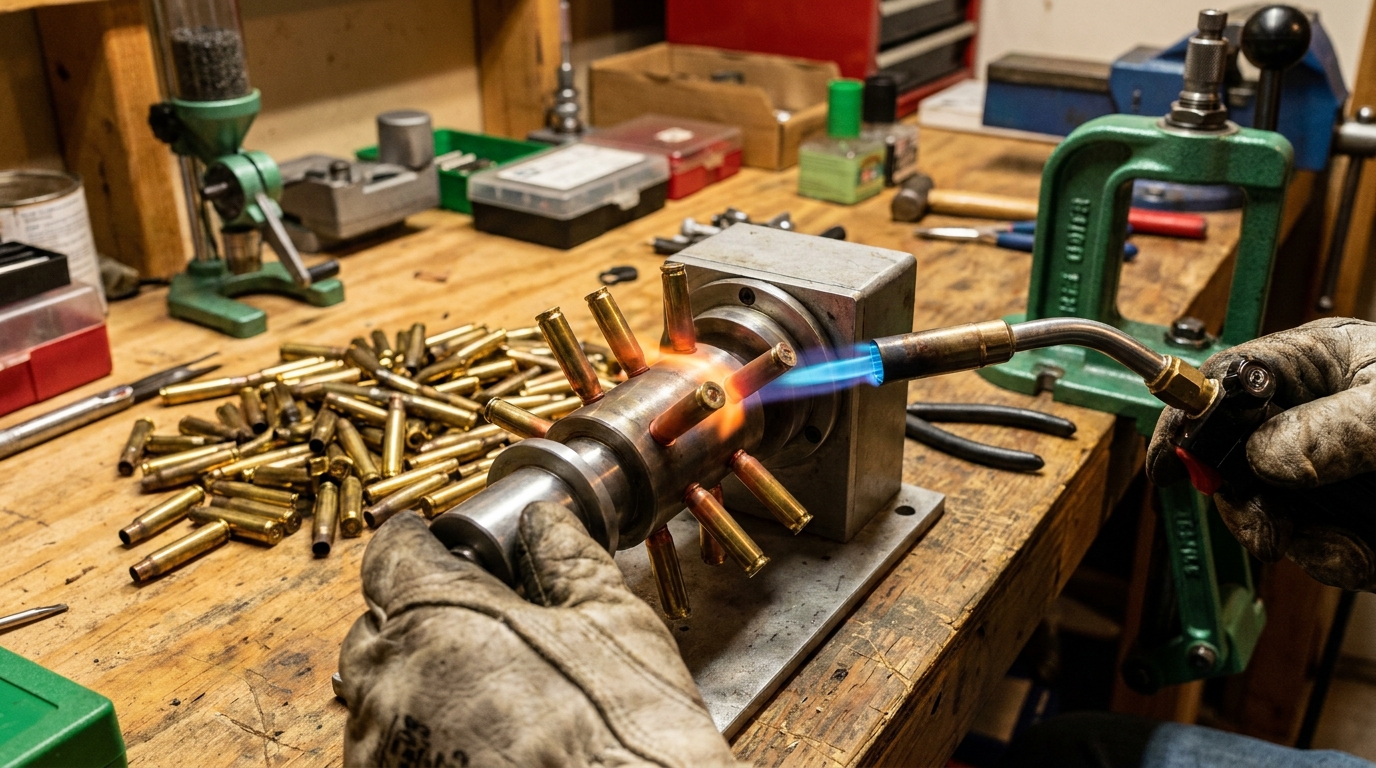
Fill a shallow pan with about an inch of water. Fill another container with dry salt or sand. Heat each case neck with a propane or butane torch until the neck glows a dull red-orange color in low light, then immediately quench in the water. The salt bath helps regulate heat exposure time as you develop your technique. This method works, but it's imprecise and slow when processing large batches.
Annealing Machine (Preferred)
Dedicated annealing machines — the AMP Annealer, Annealeez, Giraud, and several others — automate the process with far more consistency than hand-torching. Cases rotate through a flame head for a controlled dwell time, with the case head seated in a heat-sink holder to protect the base. The better machines allow you to dial in precise dwell times in fractions of a second and will process 200+ cases per hour without operator attention.
The AMP (Annealing Made Perfect) annealer represents the current top of the class for precision reloading. It uses induction heating — no open flame — and provides an Aztec readout that tells you the actual anneal state of your brass. It's expensive (around $700), but for serious precision rifle or competition shooters processing thousands of cases per year, the consistency and repeatability justify the cost.
Induction Annealers (Mid-Range)
A number of mid-range induction units have appeared in the $150–300 range. They lack the AMP's Aztec feedback system but offer consistent, repeatable heat delivery for the price. For hunters and recreational precision shooters who anneal once per season and don't need competition-level documentation, these units are excellent value.
How Often Should You Anneal?
A reasonable schedule for most centerfire rifle cartridges:
- Standard hunting cartridges (.308, .30-06, .243, etc.): Every 4–5 firings for match-grade consistency; every 6–8 firings to prevent neck splits and maximize case life
- Magnum cartridges (.300 Win Mag, 7mm Rem Mag, 6.5 PRC, etc.): Every 3–4 firings — higher pressures work-harden brass faster
- Heavy-volume cartridges used in competition (6mm Creedmoor, 6.5 Creedmoor, etc.): Many competitive shooters anneal every firing for absolute consistency in neck tension and shoulder geometry
- Pistol brass: Pistol cases work-harden slowly and rarely benefit from annealing until 15–20+ firings, if at all, for most applications
What to Expect After Annealing
Fresh-annealed brass feels noticeably different during sizing and bullet seating. Necks size down smoothly and release the expander ball with less drag. Bullet seating force drops and becomes uniform across the batch. Cases that ran inconsistent neck tensions before annealing will show tighter standard deviations in velocity — sometimes dramatic improvements. Five-shot groups that were opening up as brass aged will often tighten back to near-new-case performance.
Don't expect miracles if other aspects of your load development are sloppy. Annealing is a precision technique that rewards precision technique. It works best when paired with consistent case prep — trimming to the same length, uniform flash hole deburring, and consistent powder charges. Think of it as removing one variable from the consistency equation, not fixing all variables at once.
A Note on Case Head Protection
This bears repeating: the case head must not be annealed. On manual torch methods, hold the case upright so heat travels up toward the neck and away from the head. On machine annealers, the case head seating cup acts as a heat sink — ensure cases are seated fully into the holder every cycle. Annealed case heads are dangerous and those cases should be retired immediately.
The payoff for getting this right is substantial: brass life that extends well beyond normal, consistency that shows up on paper, and the satisfaction of understanding exactly why your loads perform the way they do. Annealing isn't glamorous, but it's one of the highest-leverage improvements a serious handloader can make.