November is a sleeper month for Oregon turkey hunters. While most hunters are focused on deer and elk rifles, a solid population of Merriam's and Rio Grande wild turkeys are moving through Cascade foothills, oak savanna edges, and Willamette Valley agricultural margins — often with almost no hunting pressure. If you're willing to shift gears after big game season, the state's fall turkey season offers one of the most underrated opportunities in Oregon's upland calendar.
Oregon Fall Turkey Season Overview
Oregon's fall turkey season runs statewide from September through the end of November, with an either-sex limit that makes it more flexible than the spring tom-only season. Hunters can take one turkey per season in fall. Both shotgun and archery equipment are legal, and in most units, rifles are permitted as well — a detail that opens up longer shots in open terrain. ODFW issues a general fall tag that covers most of the state; check current regulations for any unit-specific restrictions before heading out.
Where to Find Turkeys in November
Willamette Valley Foothills
The western foothills of the Willamette Valley — particularly around Polk, Benton, and Linn counties — hold strong Rio Grande turkey populations on private land edges and public BLM parcels. By November, birds have moved down from summer elevations and are keying heavily on mast crops. White oak stands near Corvallis and the low hills east of McMinnville produce excellent scratch sign in the duff. Look for turkey tracks in soft soil near water and roosting trees with large horizontal limbs.
Cascade Foothills: Santiam and McKenzie Drainages
The Merriam's population along the western Cascades from Detroit Lake south through the McKenzie River drainage is huntable on a mix of USFS and BLM ground. Elevation matters — birds push to 2,000–3,500 feet in summer but drop into fir and mixed oak zones by October and November. Areas around the South Santiam Highway corridor (US-20) and the McKenzie Highway (OR-126) offer accessible public land parking areas with legal hunting nearby. Focus on south-facing slopes with oak canopy and grassy openings.
Eastern Oregon: Blue Mountains and High Desert Edges
Merriam's turkeys thrive in the ponderosa pine and bunchgrass country of northeastern Oregon. Grant, Union, and Wallowa counties all have established flocks. The Umatilla National Forest and Wallowa-Whitman National Forest both hold birds, and fall hunting pressure here is minimal. Turkeys in this region roost in large ponderosa pines along creek drainages and feed in adjacent agricultural fields and grasslands. By November, travel to lower elevations is well underway.
November Tactics That Actually Work
Pattern the Roost
Fall turkeys are creatures of habit. Find where they roost — look for droppings, feathers, and scratch marks beneath large trees near water — and you've found your hunting spot. Set up 150–200 yards from the roost before first light and wait. November flocks tend to move predictably from roost to feeding areas along defined travel corridors.
Use a Locator Call Sparingly
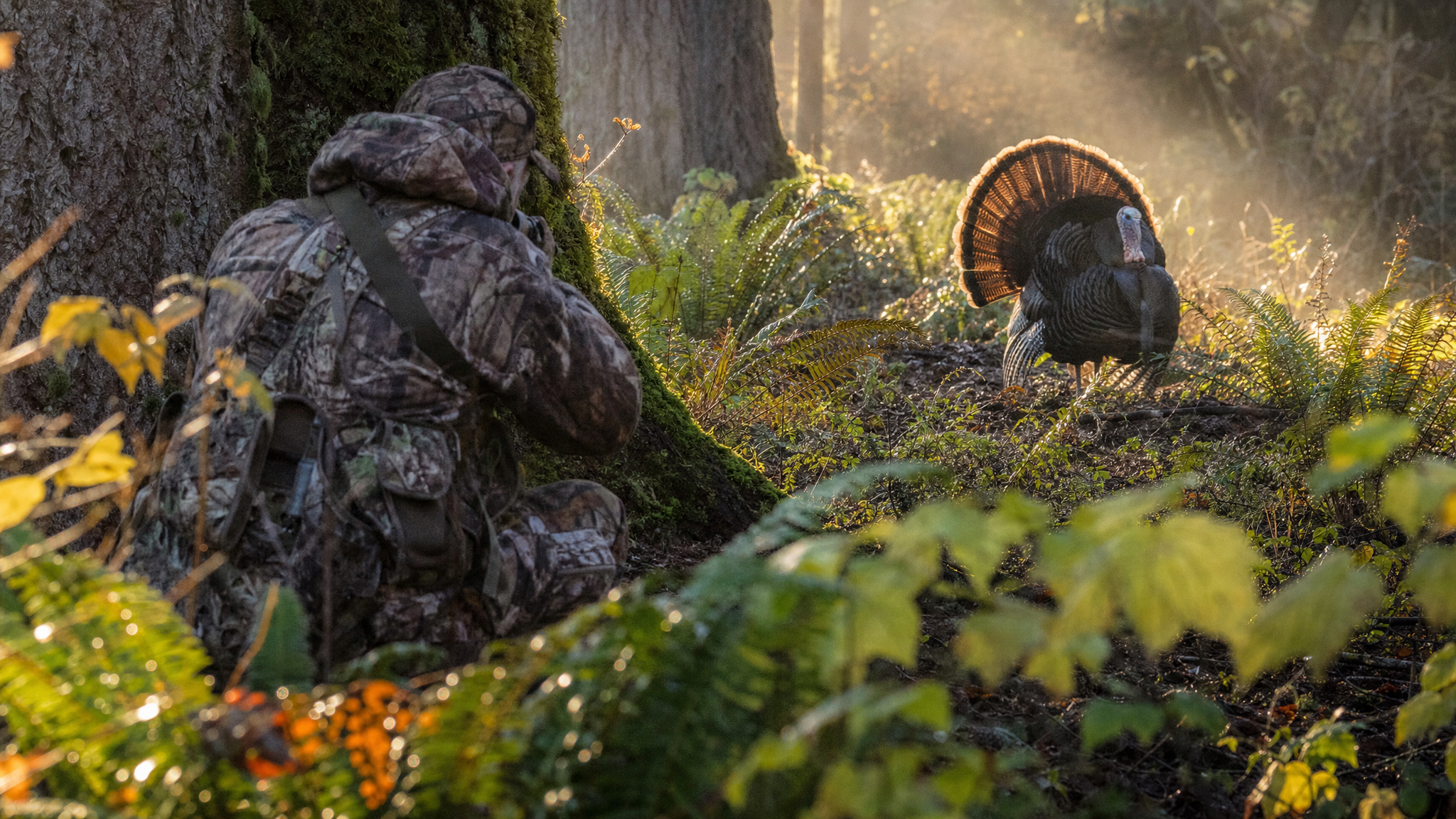
Unlike spring gobblers driven by breeding instincts, fall birds aren't looking for mates. Aggressive calling can push them away. Instead, use soft assembly yelps and kee-kees — the contact calls that scattered flocks use to regroup. If you can break up a flock by running into them and scattering the birds, sit tight and begin calling. The birds will often return to reassemble right where you're calling from.
Run-and-Gun for Scattered Flocks
Locating and scattering a fall flock is one of the most effective tactics available. Push hard into a roosted or feeding group, scatter them in multiple directions, then immediately set up and begin kee-kee runs and lost yelps. Younger birds (jakes and jennies) are especially vulnerable to this method and will come back aggressively within 15–30 minutes.
Gear and Shotgun Selection
- Shotgun: 12 or 20 gauge with a full or extra-full turkey choke. TSS (Tungsten Super Shot) loads in #9 shot have revolutionized effective range — 50+ yard shots are realistic with the right setup. Federal Heavyweight TSS or BOSS loads are proven performers.
- Rifle option: In many Oregon units, a .22 WMR or .17 HMR is legal and effective for head shots at moderate range. A .223 or .243 works at longer distances in open terrain.
- Camo: Full camo including face mask or paint. Turkeys have exceptional vision and will pick out a shiny forehead or hands at 60 yards without difficulty.
- Calls: Box call for locating, slate call for soft assembly yelps, mouth diaphragm call for hands-free calling at close range.
Processing and Table Fare
A fall wild turkey — especially a mature bird — is a different animal from the spring tom. Hens and young-of-the-year birds (jenny and jake) are excellent table fare with proper field care. Field dress the bird immediately, cool it quickly, and age in a refrigerator for 2–3 days before processing. The breast meat is lean and mild; the legs and thighs are best braised low and slow. Many hunters consider a wild turkey brined and roasted over a November fire among the best wild game meals Oregon has to offer.
Licensing and Regulations
Oregon fall turkey requires a base hunting license plus a fall turkey tag, available from ODFW online or any license vendor. The season runs through November 30. No pre-draw is required for most of the state — tags are over-the-counter. Check ODFW's current regulations for the specific unit you're hunting, as a handful of areas have additional restrictions. Land access in the Willamette Valley can be limited; the ODFW Access and Habitat program provides a list of private lands open to public hunting statewide.
November turkeys won't get the glory of a bugling bull or a bright Chinook, but for hunters willing to put in the scouting, they offer a genuine late-fall prize — and a freezer full of some of the finest wild game Oregon's woods can produce.