The Klamath Basin sits on one of the most important waterfowl corridors in North America. Straddling the Oregon-California border, this network of lakes, marshes, national wildlife refuges, and agricultural fields funnels millions of ducks and geese through the Pacific Flyway each fall. For waterfowl hunters willing to do the homework, the Klamath Basin offers some of the most spectacular shooting in the western United States.
The Basin at a Glance
The Oregon portion of the Klamath Basin centers on Klamath Falls and includes Upper Klamath Lake — the largest freshwater lake in Oregon at roughly 64,000 acres — along with Agency Lake, Klamath Marsh National Wildlife Refuge to the north, and the Lower Klamath National Wildlife Refuge on the Oregon-California border. The Lower Klamath NWR, the nation's oldest federal waterfowl refuge established by President Theodore Roosevelt in 1908, remains a centerpiece of Pacific Flyway duck production and migration staging.
Target Species
Puddle Ducks
Mallards are the bread-and-butter bird of the Klamath Basin, with populations that swell dramatically as northern birds push south in October and November. Green-winged teal arrive early in the season, often in impressive numbers by mid-September. Wigeon, pintail, and shovelers round out the puddle duck mix. Pintails — once far more numerous — still appear in significant concentrations during peak migration, typically in late October through November.
Divers
Canvasbacks, redheads, lesser scaup, and ring-necked ducks are all present in huntable numbers on the deeper water of Upper Klamath Lake and Agency Lake. Canvasbacks in particular stage in impressive flocks on these large, open-water systems before pushing south. Hunting divers on the big lake requires a seaworthy boat and attention to weather — afternoon winds can turn Upper Klamath Lake into a rough, dangerous chop quickly.
Canada Geese and White-Fronted Geese
Cackling Canada geese, which breed on Alaskan tundra, funnel through the Klamath Basin in October by the tens of thousands, staging on harvested grain fields before continuing south. Greater white-fronted geese — specklebellies — travel with them and are considered by many hunters the finest-eating goose on the Pacific Flyway. Snow geese and Ross's geese appear in smaller numbers but can provide exciting action when they commit to decoys.
Public Land Access
Lower Klamath NWR
The Lower Klamath NWR operates a hunting program on designated units, with access managed through a quota system on some areas and open access on others. The refuge provides excellent waterfowl hunting in managed marsh habitat and flooded grain fields. Units are accessible primarily by boat via the extensive canal system. Check the current refuge hunting regulations at fws.gov, as unit boundaries and access rules change periodically.
Klamath Wildlife Area (ODFW)
The Oregon Department of Fish and Wildlife's Klamath Wildlife Area encompasses several managed units around Agency Lake and Upper Klamath Lake. These areas include the Wood River Wetland, the Agency Lake unit, and other managed marshes that provide accessible hunting with good infrastructure. A Combined Angling and Hunting License plus a valid duck and goose stamp are required. Some areas operate on a first-come, first-served basis for blind assignments.
Tactics for Klamath Basin Waterfowl
Scouting is Everything
The Klamath Basin is large, and bird concentrations shift with weather, water levels, and agricultural activity. Spend the afternoon before your hunt glassing fields and marsh edges for feeding and roosting activity. Ducks and geese will reveal exactly where they want to be — your job is to get in their path the following morning. Pay attention to flight lines between roost water and feeding areas, as these corridors are often surprisingly predictable.
Decoy Spreads
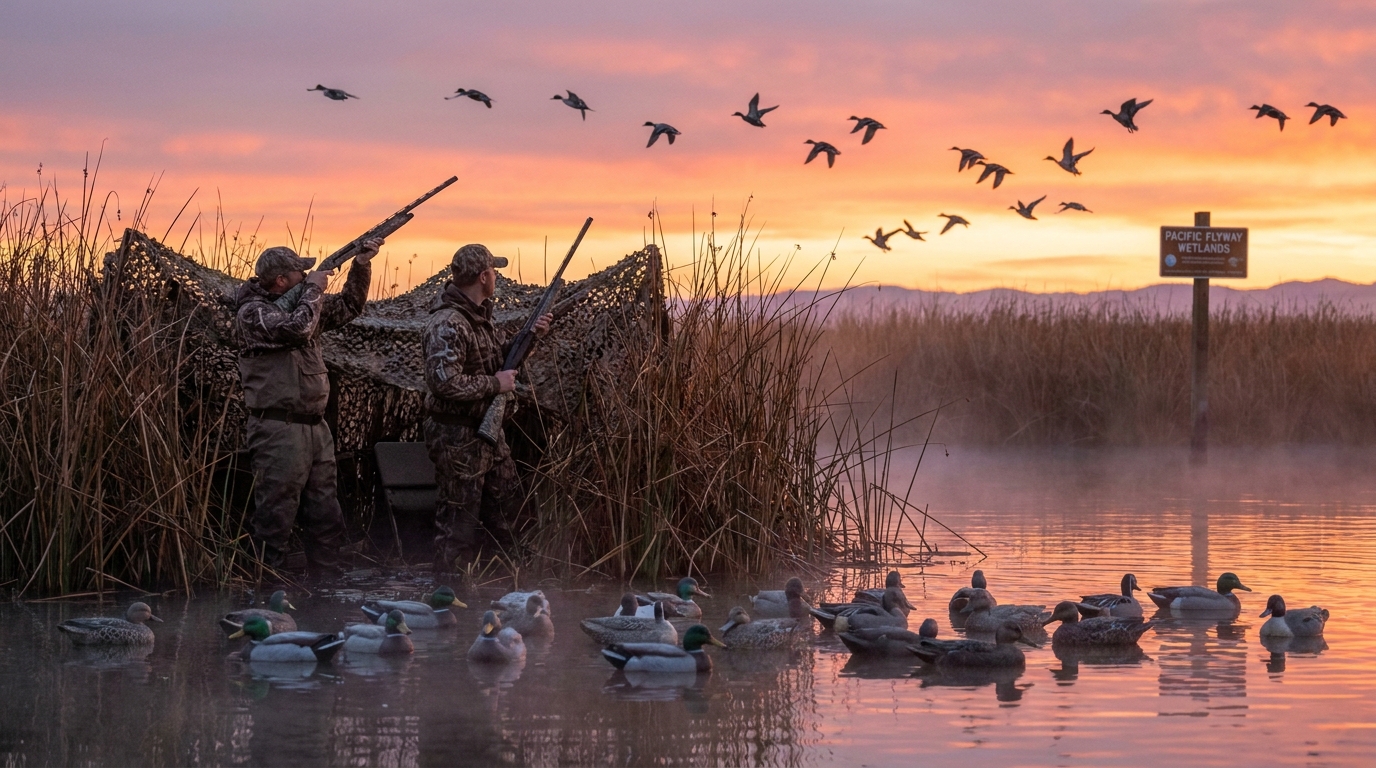
In open marsh hunting scenarios, a large, spread-out decoy set beats a small, tight cluster. Puddle ducks landing in the Klamath marshes are often working large concentrations of birds, and a spread of 36 to 60 decoys with realistic landing zones looks natural. For field hunting Canada geese, full-body decoys in family groups with adequate spacing between clusters produce the most convincing results. Leave generous landing lanes — birds commit when they have a clear final approach.
Calling
Mallards in the Klamath Basin respond well to aggressive calling when birds are actively working the marsh. A feeding chuckle and a standard hail call are your bread and butter. Geese require a different skill set — the cluck and moan of feeding Cacklers is distinctly higher-pitched than the classic honk most hunters learn first. Carry a short-reed call and practice the faster, higher cackle to match the birds you'll encounter in October.
Logistics and Planning
Klamath Falls serves as the hub for basin hunting trips. The city has adequate lodging, several sporting goods stores, and restaurants that cater to hunters. Cell service can be spotty in some refuge areas — download offline maps before you go. A quality pair of chest waders is essential, as most productive marsh hunting involves wading through soft-bottomed tule edges. Neoprene or insulated breathable waders are appropriate given the cold morning temperatures that define November in the basin.
The Klamath Basin is not a well-kept secret — it draws hunters from across the Pacific Northwest. But it's large enough to absorb hunting pressure, and hunters willing to scout thoroughly and hunt the transitions between roost and feed will consistently find birds. There are few more visceral experiences in Oregon waterfowling than watching a flock of pintails lock up into a Klamath marsh spread at first light.