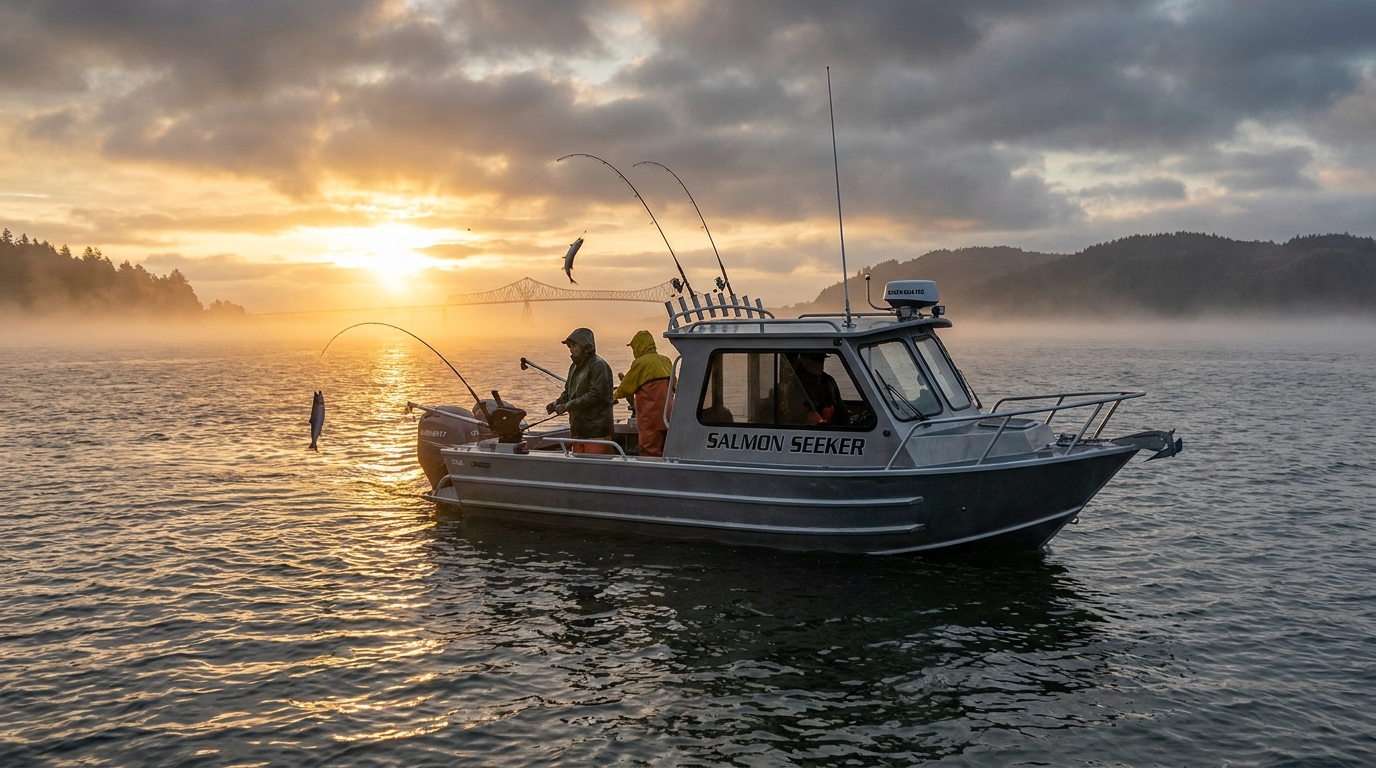
When the calendar flips to August, salmon anglers across Oregon and Washington turn their attention to one stretch of river above all others: the lower Columbia between Buoy 10 at the river's mouth and the Highway 395 bridge near Pasco. The Buoy 10 season is the largest recreational salmon fishery in the United States by angler participation, and for good reason — the early August timing coincides with the peak of the fall Chinook and coho returns before they've had time to color up or spread far upriver.
The fishery typically opens August 1 and runs through late August or early September, with regulations adjusting in real time based on run counts at Bonneville Dam. ODFW and WDFW manage it jointly, so check myodfw.com and the Washington regulations before you head out — rules can change mid-season based on returns.
Understanding the Fishery
The name comes from Buoy 10, a large navigational marker sitting at the Columbia's mouth near Astoria. From there upstream to the Tongue Point area and beyond, anglers target fall Chinook (bright, ocean-fresh fish averaging 15–30 lbs) and coho (smaller, acrobatic, and outstanding table fare). The mix shifts as the season progresses — early August typically sees more Chinook, while coho numbers build through August into September.
The Columbia at its mouth is a massive, tidal-influenced system. Ocean swells push into the estuary, tides run strong, and boat traffic is heavy. This is not a fishery for underpowered or poorly equipped boats. Plan for 2–4 foot swells on exposed days and strong tidal currents that can complicate anchoring and presentation.
Key Areas and Access Points
Most anglers fish from the Astoria waterfront east toward Tongue Point and the deeper channel water near the Oregon shore. The Washington side offers productive water near Chinook, Washington and the flats off Baker Bay. Baker Bay is particularly popular for its calmer water and good coho action early in the season.
Oregon bank anglers have limited options at the river's mouth, but the Fort Stevens State Park boat ramp at Hammond provides excellent access to the lower estuary. The Astoria Warrenton Crab and Fishing Docks area is another popular launch point. On the Washington side, Port of Chinook at Ilwaco offers full marina services and easy access to Baker Bay and the main river mouth.
Gear and Tactics
The most common approach at Buoy 10 is backtrolling or back-bouncing diving plugs and spinners while anchored or on a controlled drift. Kwikfish in sizes K15 and K16, wrapped with sardine-scented UV tape or fresh anchovies, account for enormous numbers of Chinook. Colors that consistently produce include chartreuse, clown (orange and chartreuse), and metallic green.
For coho, trolling herring behind a flasher — the classic "Coho Special" rig — remains the standard approach. Run a chrome or glow-UV flasher 24–32 inches ahead of a plug-cut or whole herring on a 4/0 to 5/0 hook rig. Target 20–40 feet of water on the flats and over channel edges.
Brad's Killer Fish and Mag Lip 4.5 plugs have also gained a devoted following at Buoy 10 in recent years, particularly during high water or off-colored tidal pushes when visibility drops.
Lead weights run 4–8 oz depending on current strength. Use a quality monofilament or fluorocarbon leader of 25–40 lb test — lighter in clear water, heavier during strong tides.
Reading the Tide and Timing Your Trip
Tidal movement is everything at Buoy 10. Fish are most active during moving water — the 2–3 hours on either side of low tide and high tide. Slack water can kill the bite entirely. Many guides fish the first and last light periods during favorable tidal windows. Arrive early, know your tide tables, and do not expect miracles on a dead neap slack.
The best weeks historically are the second and third weeks of August when returns are typically at their peak and fish are still bright from the ocean. Once the counts at Bonneville Dam show the bulk of the run has passed, the fishery often winds down or regulations tighten.
Regulations, Licenses, and Tags
You'll need a valid Oregon or Washington fishing license, a combined angling tag, and a Columbia River Endorsement. If you're an Oregon resident fishing from an Oregon boat, an Oregon license covers you on the Oregon side of the river. Washington residents and boats need Washington licenses. Read the joint regulations carefully or contact ODFW Region 1 in Astoria before your trip.
Lodging and Extras
Astoria and Warrenton have solid lodging, gear shops, and canneries that will vacuum-pack and freeze your catch for the drive home. Book lodging early — Buoy 10 opener weekend fills up months in advance. There's a reason guides from as far away as Eastern Oregon trailer their boats to the lower Columbia every August. When the fish are in and the tide is moving, Buoy 10 delivers salmon fishing that's hard to match anywhere in the Pacific Northwest.