Every July, the Rogue River estuary at Gold Beach transforms into one of the most productive Chinook salmon fisheries on the entire Oregon coast. While most anglers chase spring Chinook on the Willamette or Columbia, the Rogue's summer run — peaking from mid-July through late August — gets far less pressure and produces fish that will test the limits of any rod, reel, and angler willing to show up.
Understanding the Rogue Estuary Summer Chinook Run
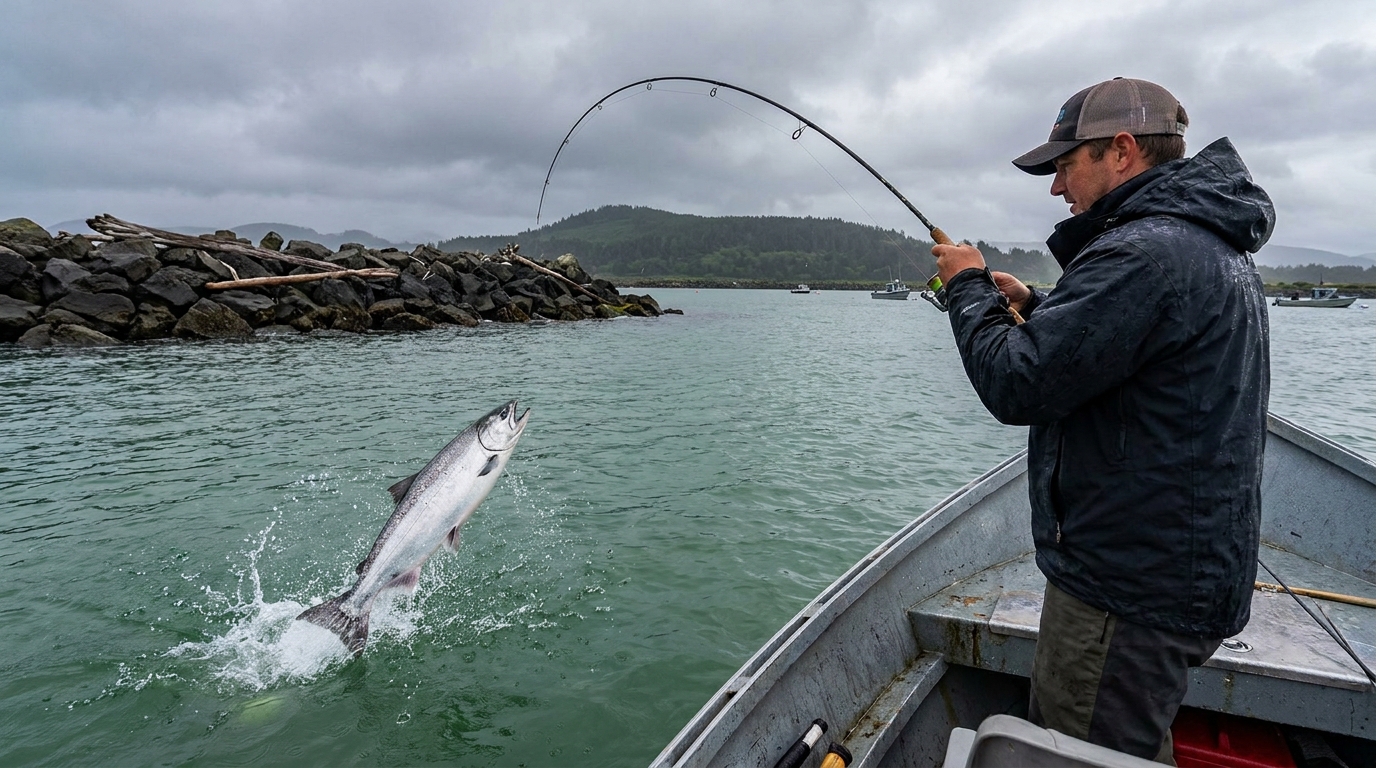
The Rogue River's summer Chinook are distinct from the spring run. These fish have been staging offshore for weeks, building up fat reserves before entering freshwater. By the time they hit the estuary, they're broad-shouldered, chrome-bright, and decidedly aggressive. Average fish run 15 to 25 pounds, and it's not unusual to tangle with 35-plus-pound brutes within sight of the Highway 101 bridge.
The run begins building in late June, peaks in mid-to-late July, and provides quality fishing through mid-August depending on water temperatures and ocean conditions. Warm La Niña years tend to push fish in earlier and harder. Cold upwelling years extend the productive window into September.
Gold Beach Estuary Geometry — Know the Water Before You Fish It
The Rogue estuary is roughly three miles of productive water from the jetties to the Highway 101 bridge. The key structural features:
- The Jetty Hole: The deepest water in the system. Fish stack here on incoming tides, resting after pushing through the surf zone. This is your first stop every morning.
- The North Channel: The primary migration corridor. Fish move upriver through this deeper channel, especially on the push of an incoming tide.
- The Gravel Bars: Scattered throughout the mid-estuary, these bars concentrate bait and force fish into defined lanes. Side-drifting along bar edges at dawn and dusk can be deadly.
- The Hatchery Hole: Just below the ODFW trap site, this deep pool produces consistent action on fish that hesitate before committing to the hatchery ladder. Best fished in the afternoon as tides push.
Tides Are Everything
If you take one piece of advice from this guide, let it be this: fish the tide, not the clock. Incoming tides — especially the two hours before and after the push — move fish. Outgoing tides push bait out of the estuary, triggering feeding behavior from staging fish.
The best scenario is a moderate incoming tide (4-6 foot swing) arriving at first light. Fish position themselves at the leading edge of the tide push, working upriver. A big incoming tide at noon is still fishable, but you'll work harder for the same results you'd get at dawn on a morning incoming.
Check tidesandcurrents.noaa.gov and look at the Port Orford gauge — it's the closest official station and closely matches Gold Beach timing with about a 20-minute lag.
Proven Tactics for Gold Beach Chinook
Back-Bouncing
The Rogue estuary's bread-and-butter technique. Run a 3- to 5-ounce banana sinker on a sliding setup above a 36-inch leader and a size 4/0 Gamakatsu Octopus hook. Anchor above a known holding lie, lower your bait to the bottom, then slowly lift and drop your rod tip — letting the rig tick downstream to cover water methodically. Roe packed with borax is the standard bait, but fresh sand shrimp produce well on slack tides when fish are less aggressive.
Side-Drifting
Running a jet sled or drift boat along the channel edges while keeping your drift rig just above the bottom covers serious water. Most guide boats on the Rogue favor this method during peak season because it lets you contact fish throughout the water column rather than waiting for them to come to you. Use lighter plugs (3-4 oz) and fresher bait when water temperatures push above 58°F — fish become more lethargic and won't chase as hard.
Casting Spinners from the Bank
The Rogue is genuinely fishable from the bank if you know where to stand. The south jetty rock provides access to the Jetty Hole, and bank fishermen regularly land Chinook here using Blue Fox Vibrax spinners in #5 and #6 sizes. Cast upstream and across, let the spinner sink, then work it back with a medium retrieve that keeps the blade thumping. Chrome and chartreuse are the go-to colors in the estuary's slightly turbid summer water.
Trolling Plugs
Mag Lips and Kwikfish in size K16 and K15 produce well when fished just above the bottom in the main channel. Standard colors: metallic green/chartreuse, hot pink, and flame. Wrap your plugs with a half-fillet of sand shrimp to add scent attraction — this simple modification regularly doubles hookup rates.
Regulations and License Requirements
Always check current ODFW regulations before fishing. The Rogue estuary typically falls under the lower Rogue regulations zone, which runs from the mouth to the Lobster Creek Bridge. Chinook retention rules change year to year based on run forecasts. In recent seasons, anglers have been allowed 2 adult Chinook per day with a seasonal limit of 20. Check myodfw.com for current season-specific rules before launching.
A current Oregon fishing license with a Combined Angling Tag is required. If you're fishing from a boat, ensure your vessel meets USCG requirements — the bar at the Rogue mouth can be rough, and Gold Beach Coast Guard monitors conditions closely.
Local Logistics
Gold Beach is a self-sufficient fishing town. Rogue Outdoor Store on Jerry's Flat Road carries everything you need — bait, hardware, and local intel from staff who fish the river regularly. Several guide services operate out of the Port of Gold Beach; if you're new to the estuary, half a day with a guide will compress years of learning into a morning.
Boat launch at the Port of Gold Beach is free and well-maintained. Arrive early in July — ramp space fills quickly by 5:30 AM on productive tide days.
The July run on the Rogue estuary is one of Oregon's best-kept salmon secrets. If you've been sleeping on Gold Beach, this is the season to go.