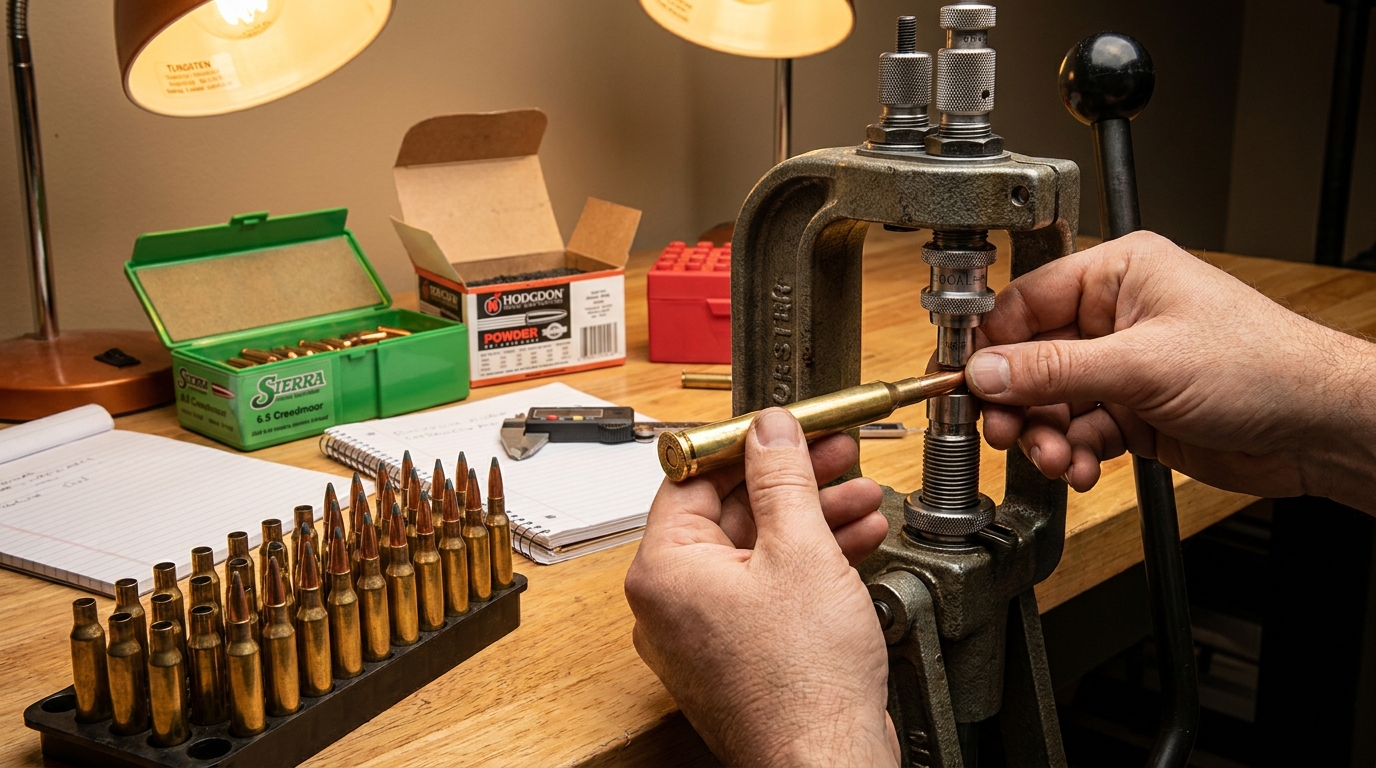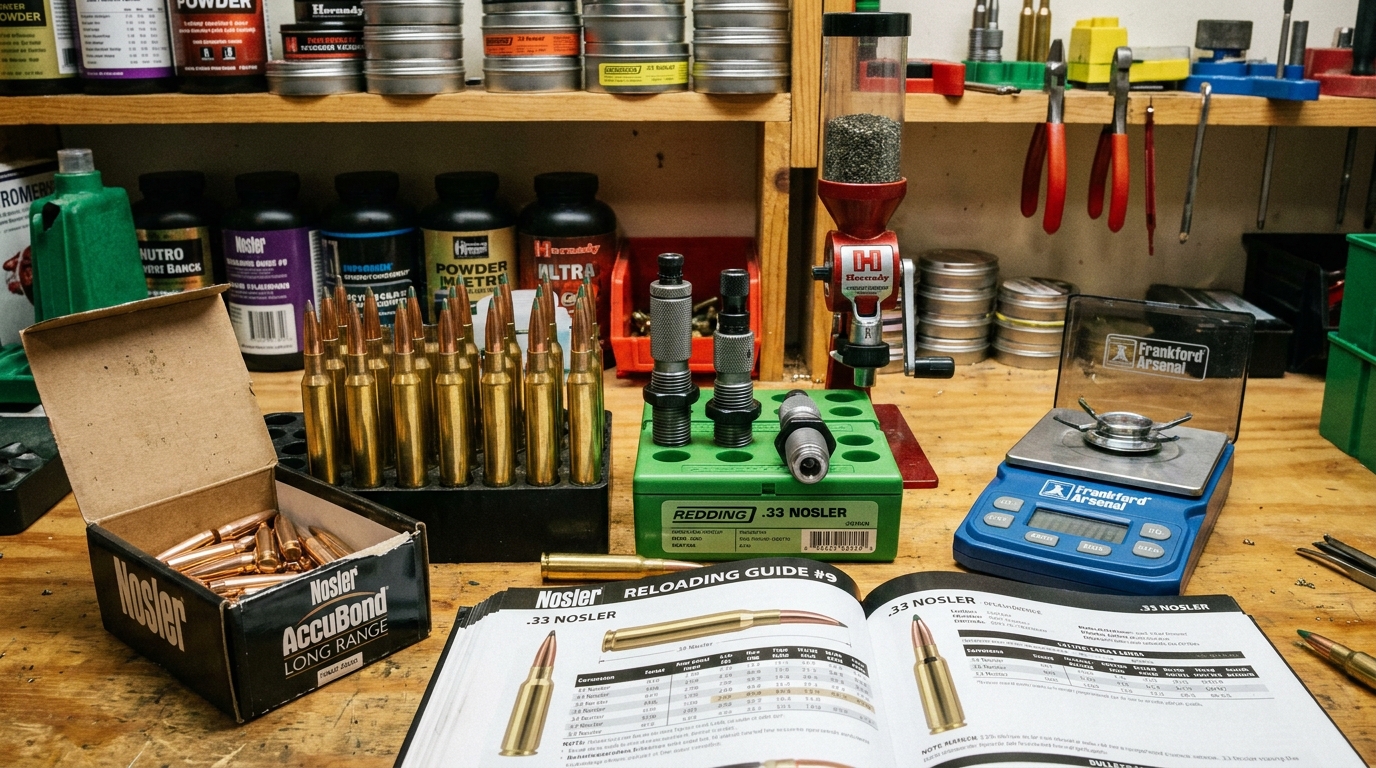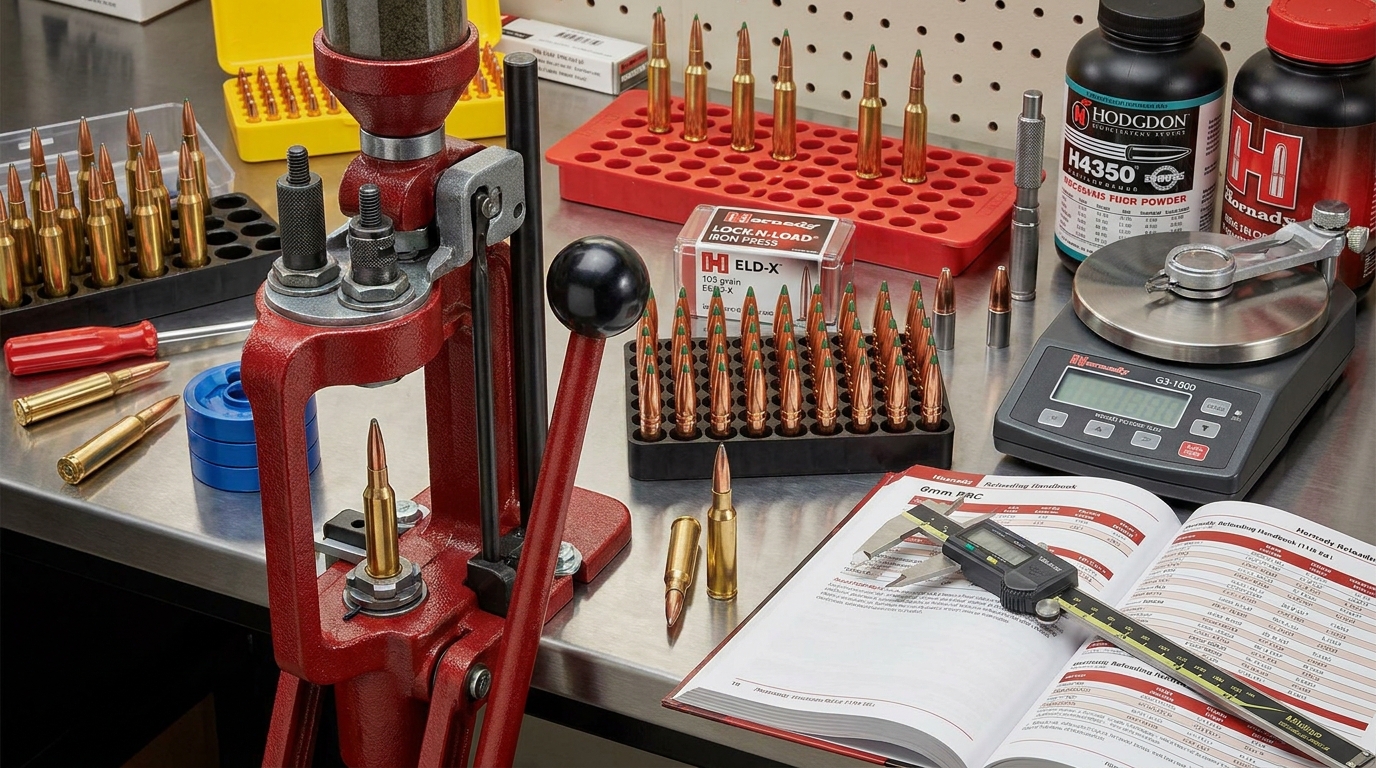
When Hornady introduced the 6mm PRC (Precision Rifle Cartridge) in 2018, the response in long-range shooting circles was immediate. Here was a cartridge that pushed high-BC 6mm bullets — the 103 gr ELD-X, the 108 gr ELD-M — to velocities that opened up genuine 1,000-yard capability in a standard short-action rifle. For handloaders in the Pacific Northwest who want a cartridge that bridges PRS competition and open-country deer and elk hunting, the 6mm PRC deserves serious attention.
The parent case is the 6.5 Creedmoor necked down to .243-inch. That geometry delivers a strong, consistent shoulder for headspacing and excellent neck thickness for consistent bullet grip. Case capacity sits around 52 grains of water — large enough to drive a 103 ELD-X at 3,050–3,100 fps from a 24-inch barrel, compact enough that it meters powder efficiently without the extreme charge weights of larger magnums. Recoil is mild. Follow-through is easy. Spotting your own hits through the scope becomes routine.
Brass Selection
Start with Hornady brass — it's the most available and most consistent lot-to-lot option for 6mm PRC. Lapua does not currently produce 6mm PRC brass, making Hornady the default for most handloaders. Peterson Cartridge also makes 6mm PRC brass with tighter tolerances — worth the price premium if you're building a dedicated precision hunting rifle and want every consistency advantage the case allows.
Prep new brass before the first load: anneal, uniform primer pockets, and debur flash holes. The 6mm PRC's large rifle primer pockets are consistent from Hornady brass, but a quick pass with a primer pocket uniformer will tighten your standard deviations measurably. Run every case through a case gauge after sizing to confirm headspace — scrap anything that doesn't gauge correctly.
Primer Selection
Standard large rifle primers are correct for the 6mm PRC. Federal 210M (Gold Medal Match) and CCI BR2 are the benchmarks for precision work. Hornady uses Federal 210M in their factory Match ammunition, and handloaders consistently achieve sub-5 fps standard deviation with this combination and suitable powders. Winchester LR primers work well for practice loads at lower cost. Avoid magnum primers — the 6mm PRC doesn't need them, and magnum ignition typically elevates pressure and velocity spreads in this case.
Powder Selection
The 6mm PRC's performance window aligns with medium-to-slow powders in the 4350–4831 burn rate range. The top performers for Pacific Northwest hunting conditions:
- Hodgdon H4350: The universal 6.5 Creedmoor standard transfers directly to the 6mm PRC. Charges from 44.0–46.5 grains with 103–108 gr bullets produce excellent accuracy and velocity. Temperature-stable, widely available in Oregon and Washington gun shops, and the first powder to test when developing a load.
- Hodgdon H4831SC: The short-cut version meters more consistently than standard H4831 and produces slightly higher velocities. Charges from 46.0–48.5 grains push the 103 ELD-X to 3,050–3,100 fps in a 24-inch barrel — ideal for hunting loads where the extra velocity extends the point-blank range advantage on open-country deer and pronghorn.
- Alliant Reloder 26: Among the most temperature-stable options available. In the 46–48 grain range, Reloder 26 produces remarkably flat velocity spreads across Oregon's dramatic temperature swings — from August high-desert heat to September mountain mornings below 30°F. Harder to find but worth stocking when available.
- IMR 4451 (Enduron series): Excellent temperature insensitivity and outstanding lot-to-lot consistency — a useful characteristic when building a load you'll shoot for multiple hunting seasons. Works well in the 44–46 grain range.
Bullet Selection for Hunting
The 103 grain Hornady ELD-X is the hunting bullet this cartridge was designed around. It offers a G1 BC of .512 and G7 BC of .262 — high enough to maintain supersonic flight well past 1,300 yards in standard conditions. The Heat Shield tip prevents deformation during magazine cycling and long transport in a pack, preserving ballistic consistency. Terminal expansion at extended ranges is handled better by the ELD-X's design than traditional non-bonded cup-and-core bullets, making it the right choice for shots at 400–700 yards on deer-sized game.
For elk at extended ranges, consider the Nosler 90 gr AccuBond or the 95 gr Berger Hybrid Hunter for shots where terminal performance on heavy-boned animals is the priority. Both work well in the 6mm PRC at slightly higher velocities than the 103 gr loads.
Load Development Process
Start 3% below maximum published data and work up in 0.5 grain increments. Watch for pressure signs: cratered primers, sticky extraction, and ejector swipes on the case head. The 6mm PRC typically shows velocity plateau and optimal grouping at similar charge weights — when your ladder test shows diminishing velocity returns and groups are tightening, you're likely in the accuracy node. Confirm with a 5-shot group at 100 yards and a 3-shot cold-bore group at 300 yards.
COAL: Seat the 103 ELD-X at 0.010–0.015 inches off the lands for initial development, then adjust based on your chamber's preference. The 6mm PRC's magazine length limit (approximately 2.955 inches in standard AICS-pattern magazines) may constrain you below the lands in some factory rifles — measure with a dummy round before loading your first batch.
Estimated Starting Loads — 103 gr ELD-X, Hornady Brass, Fed 210M
- H4350: Start 44.0 gr (~2,900 fps est.) — Max ~46.5 gr (~3,050 fps est.)
- H4831SC: Start 46.0 gr (~2,950 fps est.) — Max ~48.5 gr (~3,100 fps est.)
- Reloder 26: Start 46.0 gr (~2,950 fps est.) — Max ~48.0 gr (~3,080 fps est.)
These are estimated starting points only. Always verify against current Hornady, Hodgdon, or Alliant published data and use your own chronograph and pressure observation to finalize any hunting load.
The Bottom Line
The 6mm PRC handloads into an exceptionally capable open-country cartridge. For Pacific Northwest hunters glassing mule deer on eastern Oregon rimrock or setting up on pronghorn near Hart Mountain, it delivers the flat trajectory and high-BC wind resistance that long shots require — with recoil mild enough to allow rapid follow-up and scope-spotting to confirm the hit. If you're already set up for 6.5 Creedmoor reloading, your dies, press, and technique transfer directly. Pick up a set of Redding Type S dies, a box of 103 ELD-X, and a pound of H4350. You'll have a load worth shooting by the end of your second bench session.