The 6mm BR Norma is one of the most technically refined cartridges ever developed. Born from benchrest competition and refined over decades by some of the most obsessive precision shooters in the world, it has earned a devoted following among Pacific Northwest handloaders who want to push their rifles — and their technique — to the absolute limit. If you're chasing sub-half-MOA groups, load development for varmints at distance, or simply want to understand what a truly optimized cartridge looks like, the 6mm BR is worth your time.
What Is the 6mm BR Norma?
The BR in 6mm BR stands for Bench Rest. The cartridge was developed in the 1970s by benchrest competitors working from the .308 Winchester case, eventually standardized by Norma with their 6mm BR Norma specification. It features a short, fat case design with a relatively large case head for the bore diameter, very low body taper, and a 30-degree shoulder. These dimensional choices minimize case stretching and maximize consistency — two pillars of precision shooting.
The 6mm BR operates at modest pressure (typically 52,000 PSI) with a case capacity of approximately 36.5 grains of water. It is not a velocity cartridge. Its appeal lies entirely in its extraordinary case-to-bore efficiency and the remarkable consistency it delivers across strings of shots.
Pacific Northwest Applications
Oregon shooters have found two primary homes for the 6mm BR: long-range benchrest and varmint hunting on the high desert ground squirrel circuit. For benchrest, it's competitive at 100 and 200 yards, where its inherent accuracy dominates. For varmint hunting, it's a supremely capable 400-yard tool in a bolt action with a fast twist barrel. It won't burn barrels the way the .22-250 AI or .243 Winchester will on high-volume shooting days, which matters when you're punching through a colony on the Harney County flats.
Brass and Components
Norma is the gold-standard brass source for the 6mm BR, and for good reason — the Norma cases are uniform, consistent, and respond well to annealing. Lapua also manufactures excellent 6mm BR brass that many benchrest competitors prefer. Expect to pay more per piece than for common hunting cartridges, but these cases will last for 15 to 25 firings with proper preparation, making the per-round cost reasonable over time.
Brass Preparation
For maximum performance, full case preparation is essential:
- Anneal new cases before first firing (or after every 5–8 firings thereafter)
- Uniform primer pockets to consistent depth
- Deburr flash holes from the inside
- Weigh cases and sort to within 1 grain water capacity for competition use
- Neck turn cases to uniform wall thickness if chambered with a tight neck
Bullet Selection
The 6mm BR thrives with long, high-BC 6mm bullets in the 95–115 grain range. A 1:8 or 1:7.5 inch twist barrel is needed for the heavier, longer projectiles. Standard choices include:
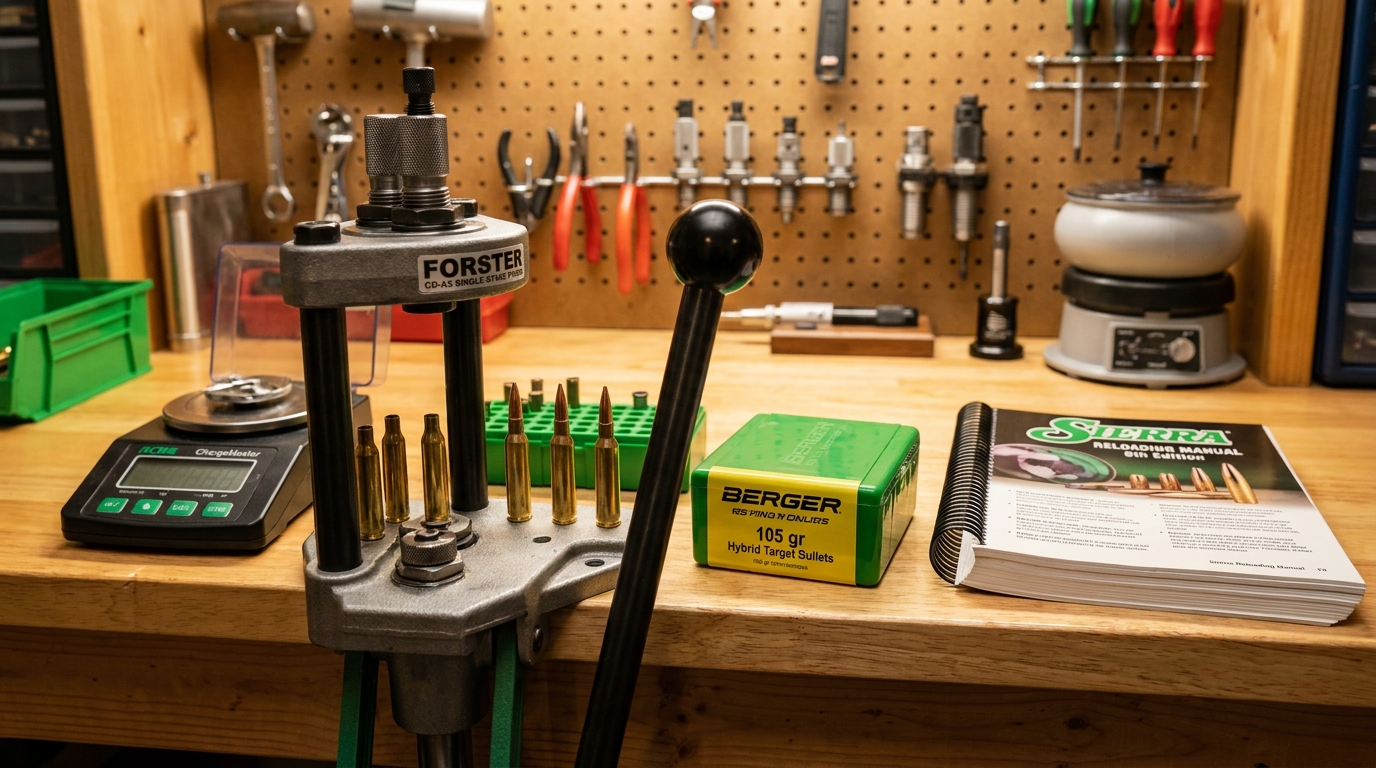
- Berger 105 gr Hybrid Target — the most popular benchrest bullet; BC ~0.530, extraordinary consistency
- Hornady 108 gr ELD-M — excellent all-around precision bullet with good BC at 0.536
- Sierra 107 gr MatchKing — time-proven benchrest and long-range bullet; BC ~0.527
- Lapua Scenar 105 gr — premium competition bullet with excellent quality control
- Nosler 95 gr Ballistic Tip — for varmint use, great expansion, stable at normal 6mm BR velocities
Powder Selection
The 6mm BR's modest case capacity makes powder selection straightforward. The goal is finding a powder that fills the case to approximately 95–98% without compressed charges while producing consistent velocities. Temperature stability matters enormously for hunting loads used in Oregon's wide swing from summer varmint heat to fall hunting cold.
- Hodgdon H4895 — the classic 6mm BR powder; excellent metering, good temperatures stability, typically 30.0–31.5 gr with 105–108 gr bullets
- Varget — very consistent lot-to-lot, excellent temperature stability for hunting use; 29.5–31.0 gr with heavier bullets
- Vihtavuori N140 — preferred by many benchrest competitors for its exceptional uniformity; 29.0–30.5 gr range
- Hodgdon 4831 SC — for heavier 107–115 gr bullets at slightly higher velocities
- IMR 4064 — a solid budget option with good performance
Primers
Small rifle primers are standard for the 6mm BR. In competition loading, Federal 205M (Match) and CCI BR-4 (Benchrest) are the first choices. For hunting loads, standard Federal 205 or CCI 450 (small rifle magnum) primers are appropriate. Primer consistency is critical — weigh, inspect, and discard any that look irregular.
Starting Load Data (Always Verify with Current Sources)
The following is reference data only. Always start 10% below maximum and work up carefully while watching for pressure signs. Consult current published load data from Hodgdon, Vihtavuori, or Sierra before loading.
- Berger 105 gr Hybrid / H4895: Start 29.5 gr, max ~31.0 gr — expect 2,800–2,900 fps in a 26-inch barrel
- Sierra 107 gr MatchKing / Varget: Start 29.0 gr, max ~30.5 gr — expect 2,750–2,850 fps
- Nosler 95 gr BT / H4895: Start 30.5 gr, max ~32.0 gr — expect 2,950–3,050 fps
Seating Depth: The Critical Variable
The 6mm BR is particularly responsive to seating depth tuning. Most precision rifles with tight chambers prefer bullets seated to 0.010–0.020 inch off the lands (jamming into the rifling). Finding your rifle's precise freebore length with a comparator tool and then experimenting with 0.005 inch increments of seating depth is where groups go from half-MOA to quarter-MOA. This is tedious, meticulous work, and it's exactly the kind of work that makes 6mm BR handloaders the precision obsessives they are.
Is the 6mm BR Right for You?
The 6mm BR rewards handloaders who are willing to invest in brass prep, careful load development, and quality components. It won't give you the velocity of a 6 Creedmoor or the versatility of a .243 Winchester for hunting. What it will give you is a window into what truly optimized precision reloading looks like — and groups at 100 yards that will make you look at everything else differently.