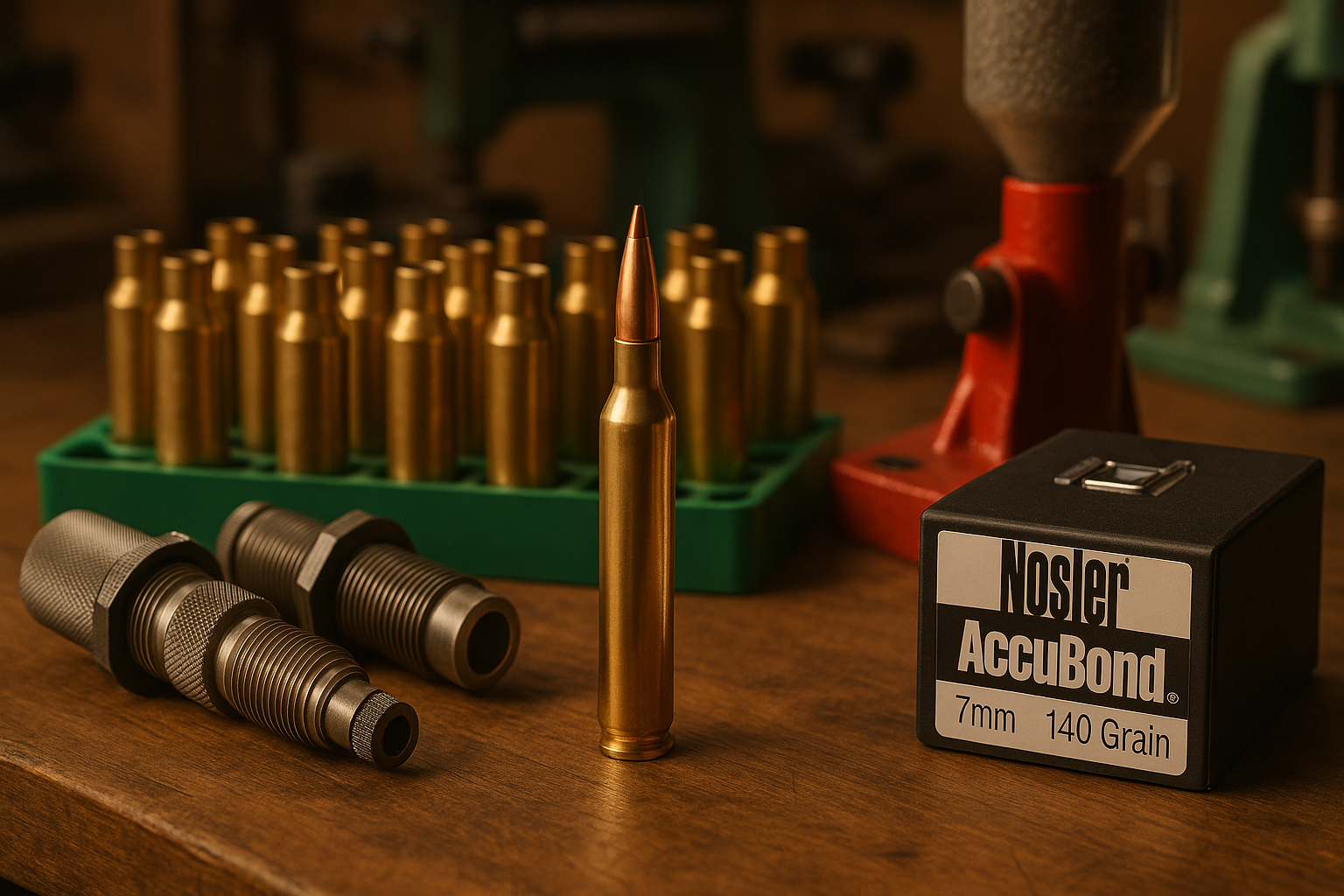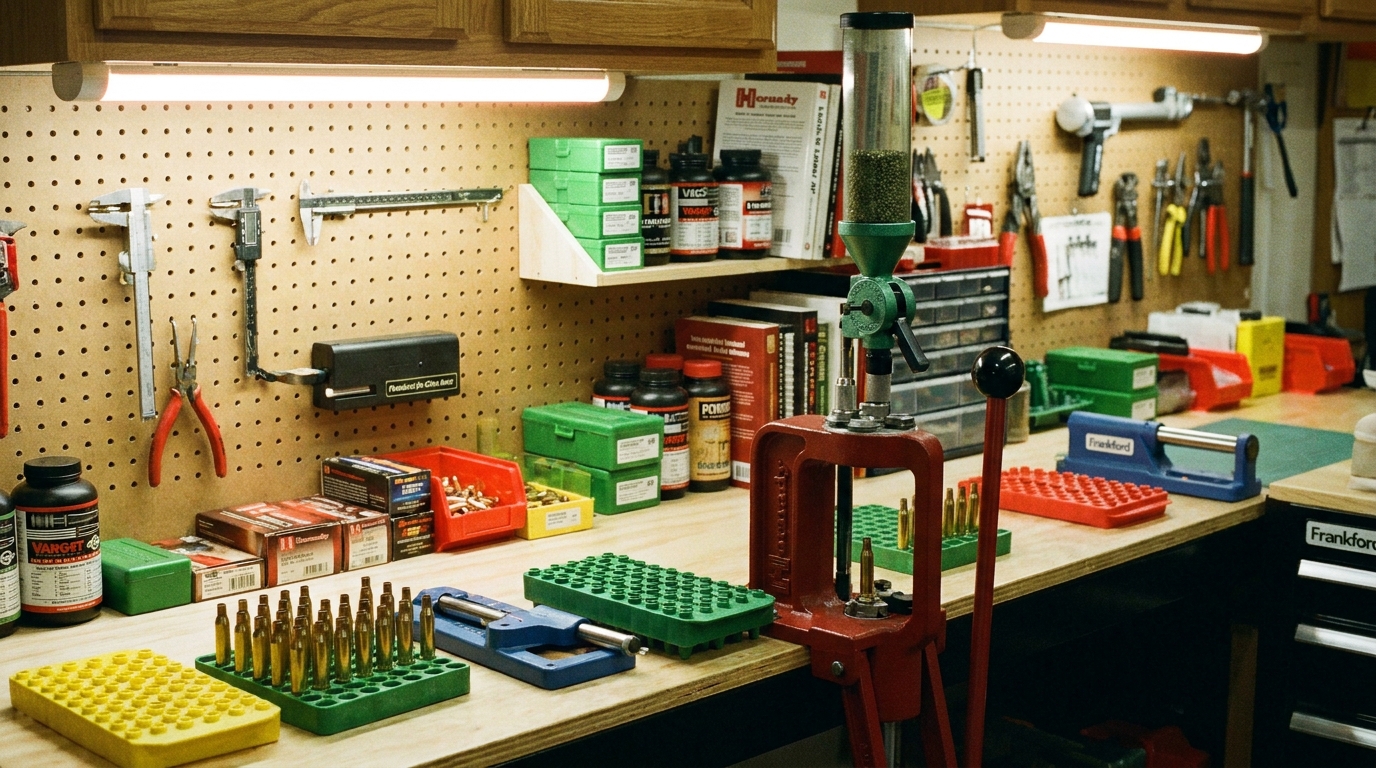
If there is one cartridge every serious reloader should master, it's the .308 Winchester. Since its introduction in 1952, the .308 has become the most widely used centerfire rifle cartridge in North America — chambered in everything from bolt-action hunting rifles to precision target guns to semi-automatic service rifles. For Oregon and Pacific Northwest hunters, it's a legitimate all-around round for blacktail deer, mule deer, black bear, and elk at practical hunting distances. For target shooters, it dominates everything from 100-yard benchrest to 1,000-yard High Power competition. Reloading the .308 gives you access to an enormous library of proven load data, near-perfect component availability, and the ability to tune loads to a specific rifle with precision that factory ammunition can't match.
Why Reload the .308 Winchester?
Factory .308 ammunition is plentiful and reasonably accurate, but it's also built to function across a wide range of chambers and rifles. When you reload, you're building a cartridge tuned specifically to your rifle's chamber dimensions, throat length, and twist rate. The difference in accuracy between a good factory load and a properly developed handload in the same rifle can be dramatic — groups that print 1.5 MOA with factory ammo frequently shrink to sub-MOA with the right handload.
Cost savings are significant for high-volume shooters. Quality factory .308 ammunition runs $1.50 to $3.00 per round. A reloaded .308 round using quality components costs $0.50 to $0.90 per round once brass is amortized. For a shooter putting 500 rounds a year downrange, the press pays for itself within the first season.
Brass Selection and Prep
The .308 Winchester is one of the most forgiving cases to work with. Brass from Federal, Lapua, Nosler, and Hornady all produce excellent results. For hunting loads where cost matters more than ultimate precision, mixed once-fired brass from quality manufacturers works fine. For precision target loads, segregate brass by manufacturer and lot number — consistency in case weight and capacity translates directly to consistent muzzle velocity.
Case Prep Steps
- Full-length resize: For semi-autos and mixed bolt rifles, full-length size on every firing. For a single bolt gun, neck-size only after first firing to extend brass life.
- Trim to length: SAAMI spec for .308 Win is 2.005" maximum, trim to 2.000". Check every 3–4 firings with a case gauge or digital calipers.
- Primer pocket uniforming: Particularly important for Crimped military brass (LC headstamp). Use a primer pocket swager or reamer to remove the crimp before repriming.
- Flash hole deburring: A one-time step on new brass that removes manufacturing burrs and improves primer ignition consistency.
- Case mouth deburring and chamfering: Prevents bullet shaving on seating and ensures smooth chambering.
Powder Selection for .308 Winchester
The .308 Win case capacity works best with medium-to-slow burning powders in the IMR 4064, Varget, and H4895 burn rate range. These powders fill the case efficiently, meter consistently through most powder measures, and deliver excellent velocity and accuracy across a wide range of bullet weights.
Top Powders for .308 Winchester
- Hodgdon Varget: The gold standard for .308 Win accuracy loads. Temperature insensitive, excellent metering, proven in virtually every .308 rifle. Works best with 155–175 grain bullets. Start at 42.0 gr, max around 44.5 gr with 168 gr bullets (always verify in your manual).
- IMR 4064: A classic powder with decades of proven .308 data. Slightly faster burning than Varget, works well with 150–165 grain hunting bullets. Excellent for deer and elk loads.
- Hodgdon H4895: Versatile and forgiving, particularly excellent with lighter 150-grain hunting bullets at moderate velocities. Also works for reduced-power practice loads at 60% of max charge.
- Reloder 15: A go-to for competitive shooters running 155-grain Palma bullets at long range. Slightly slower than Varget, pushing higher velocities with heavier bullets.
- Hodgdon CFE 223: Copper Fouling Eraser technology makes this a popular choice for high-volume shooters. Good metering and consistent ignition.
Bullet Selection by Application
Hunting Loads — Oregon Deer and Black Bear
For blacktail and mule deer at typical Oregon hunting distances (under 300 yards in timber, to 400+ yards in open country), a 150 to 165-grain controlled-expansion bullet is the working sweet spot. The Nosler Partition 165 gr, Sierra GameKing 165 gr, and Federal Trophy Bonded 165 gr all have long track records on Pacific Northwest deer. For black bear, step up to 165–180 grain bonded bullets that hold together through heavy shoulder bone.
Elk Loads
The .308 Winchester is a marginal but viable elk cartridge at reasonable ranges — 250 yards and under with good shot placement. Use premium controlled-expansion bullets of 165–180 grains: the Nosler Partition 180 gr, Swift A-Frame 180 gr, or Federal Trophy Bonded 180 gr. Drive them as fast as your rifle shoots accurately. Avoid light cup-and-core bullets — elk demand deep penetration and controlled expansion through thick hide and heavy bone.
Target and Match Loads
For precision shooting and competition, the 168-grain Sierra MatchKing (SMK) over 44.0 gr of Varget is perhaps the most-tested load in American rifle shooting. It shoots sub-MOA from virtually every quality .308 bolt gun and has won more matches than any other .308 combination. For long-range work past 800 yards, the 175 gr SMK has better ballistic coefficient and is the NRA High Power service rifle standard load. Seat both to 2.800" COAL for most rifles, or tune seating depth to your specific throat for best results.
Primer Selection
The .308 Win uses large rifle primers. For standard hunting and general target loads, Federal 210, CCI 200, and Winchester WLR are all proven choices. For magnum powder charges or cold-weather hunting loads, step up to a magnum large rifle primer (Federal 210M, CCI 250) to ensure complete powder ignition. For precision match loads, Federal GM210M (Gold Medal Match) primers offer exceptional lot-to-lot consistency and are the benchmark for accuracy-focused loaders.
A Proven Starting Point: The Hunting Load
This load has taken countless deer, elk, and bear in the Pacific Northwest and makes an excellent starting point:
- Brass: Federal or Lapua, once fired, full-length sized and trimmed to 2.000"
- Primer: Federal 210 Large Rifle
- Powder: IMR 4064 — 42.0 gr (start load; max ~44.5 gr per current manuals)
- Bullet: Nosler Partition 165 gr, seated to 2.800" COAL
- Expected velocity: ~2,700–2,750 fps from a 22" barrel
Always begin at the start load listed in a current reloading manual and work up incrementally while watching for pressure signs. Never exceed maximum listed charges.
Load Development Process
After developing your base load with a manual, refine it for your specific rifle using a ladder test or OCW (Optimum Charge Weight) method. Fire 3-shot groups at 0.3 gr increments from start to max, watching for the velocity nodes where groups cluster tightly and velocity spreads drop. Once you find a promising node, shoot a 5-shot confirmation group at 100 yards and verify velocity with a chronograph. A load producing consistent sub-1" groups at 100 yards with an extreme spread (ES) under 15 fps is ready for the field.
Oregon's Universal Cartridge
Few cartridges do as much, as well, as the .308 Winchester. It's at home in the timber of the Cascades chasing blacktail, across the rimrock of the Ochoco Mountains spotting mule deer, and in the bull pen at the Redmond Rod and Gun Club on a Saturday morning match. Mastering the .308 at the reloading bench rewards you with a versatile, accurate, and affordable round that will serve every shooting purpose you throw at it. Start with proven components, work up loads methodically, and let your rifle show you what it's capable of.