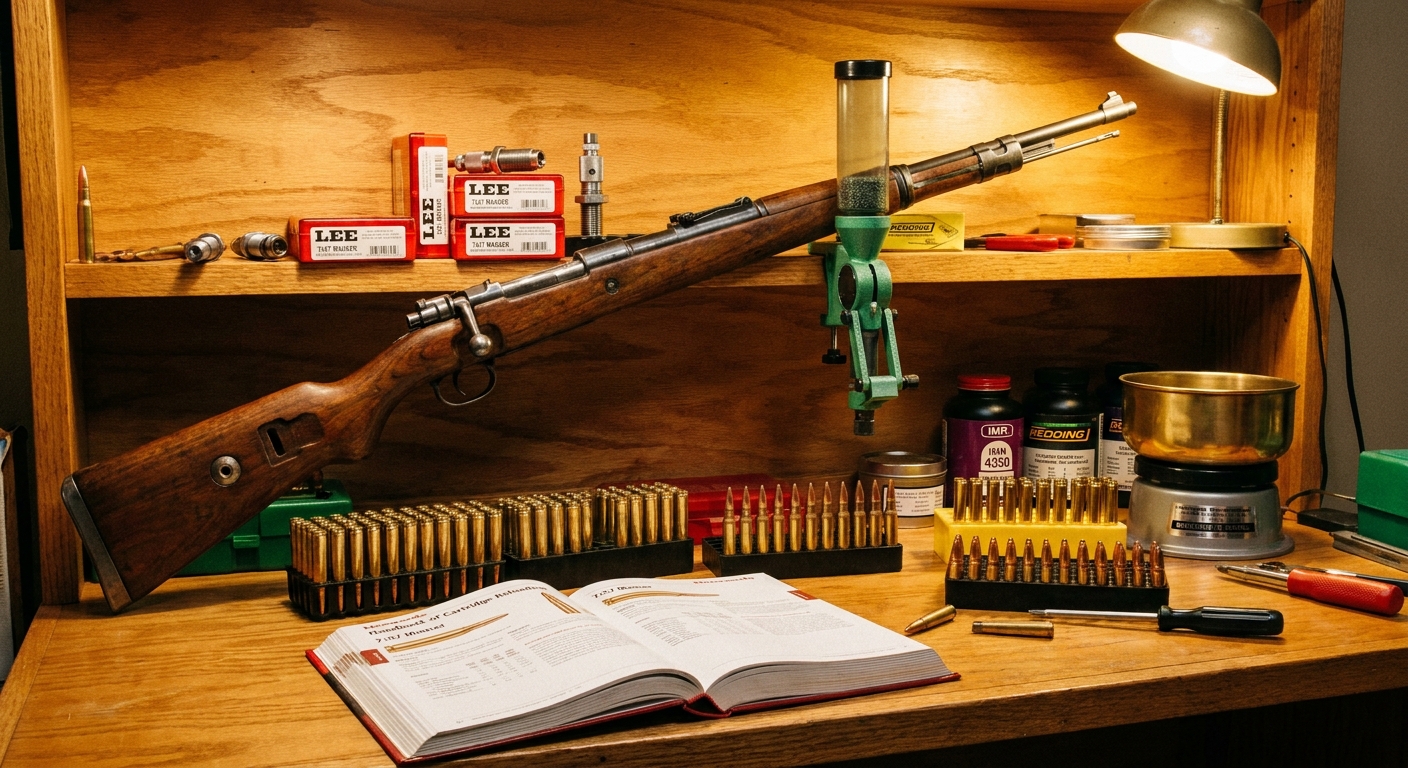
The 7x57 Mauser was introduced in 1892, used by hunters and soldiers on nearly every continent, carried by Frederick Selous in Africa and W.D.M. Bell on elephant, and adopted by one country after another for its balance of velocity, accuracy, and recoil. It is, by any reasonable measure, one of the all-time great cartridge designs. And yet today it's largely ignored by the American hunting mainstream, which means components are consistent, rifles in the chambering are often excellent and underpriced, and the handloaders who work with it regularly treat it as a quiet secret.
This guide covers practical reloading for the 7x57 as an Oregon hunting cartridge — from light deer loads to everything you need for a responsible elk shot in the Cascades or Wallowas.
Understanding the 7x57: Pressure and Parent Cases
The most important thing to know before loading the 7x57 is its pressure situation. SAAMI maximum average pressure for the 7x57 is 51,000 CUP — significantly lower than modern cartridges like the .270 Winchester (65,000 PSI) or 6.5 Creedmoor (62,000 PSI). This low-pressure standard exists because millions of original Mauser 98 actions and earlier rifles are still in active use worldwide, and not all of them are rated for high-pressure loads.
If you're loading for a modern rifle — a Ruger M77, CZ 550, Kimber 84M, or modern Winchester Model 70 in 7x57 — you're working with a strong, modern action and can safely work toward the upper end of published data from reputable manuals. If you're loading for an original military Mauser or a pre-64 commercial rifle, stay at or below the SAAMI standard. Don't hot-rod old rifles.
The 7x57 case is a rimless, bottleneck design with a 57mm case length, 0.473-inch head diameter (standard bolt face), and excellent case capacity for the caliber. Brass is available from Hornady, Norma, Nosler, Lapua (exceptional quality), and Starline. Lapua 7x57 brass is among the best production brass available in any caliber and worth every penny for a rifle you'll load for years.
Bullet Selection
The 7mm bullet diameter gives you access to one of the richest selections of hunting projectiles on the market. For Oregon hunting purposes:
- 120-grain bullets (Nosler Ballistic Tip, Hornady GMX, Sierra Varminter) — deer and pronghorn, high velocity, flat trajectory. These are pleasantly fast in the 7x57 at moderate pressure.
- 139-140 grain bullets — the sweet spot for deer and general big game. Hornady's 139-grain InterLock and 140-grain ELD-X, Sierra's 140-grain GameKing, Nosler's 140-grain Partition. These stabilize well in the standard 1:9 twist of most 7x57 barrels and deliver excellent all-around terminal performance.
- 154-160 grain bullets — elk and larger game territory. Hornady's 154-grain InterLock, Nosler's 160-grain Partition, Swift's A-Frame in 160 grains. The 160-grain Partition from a 7x57 is a legitimate elk load with deep penetration and controlled expansion. Bell used 173-grain solids on elephant with this cartridge — your Oregon elk will not be impressed by the caliber, but it will be dead.
- 175-grain bullets — available but push the limits of most twist rates and case capacity. Stick to 154-160 for heavy game in Oregon.
Powder Selection
The 7x57 has moderate case capacity and shoots best with medium to medium-slow burning powders. Top choices:
- IMR 4350 / H4350 — the classic 7x57 powder. Excellent with 139-160 grain bullets, consistent in temperature variation, widely available.
- Reloder 19 — slightly slower burn rate, excellent for heavier bullets, gives a velocity edge in longer barrels.
- Varget — works well with lighter bullets (120-140 grains), excellent accuracy, temperature stable.
- IMR 4831 / H4831SC — excellent with 154-160 grain bullets, maximizes case capacity, traditional choice for full-power 7x57 loads.
- Reloder 22 / 23 — for top velocity with 140-160 grain bullets in modern strong actions only.
Starting Loads and Practical Data
All data below is starting load data — reduce by 10% and work up in your specific rifle. Never exceed maximum listed in a current, reputable manual (Lyman 50th, Hornady 10th, Nosler 9th).
140-Grain Load (Deer — Primary Oregon Load)
- Bullet: Hornady 140-grain ELD-X or Nosler 140-grain Partition
- Powder: H4350, starting ~44.0 grains, max ~47.5 grains
- Primer: Federal 210 or CCI 200 (standard large rifle)
- COAL: 3.065 inches (check your rifle's throat)
- Expected velocity: 2,620–2,720 fps from a 22-inch barrel
160-Grain Load (Elk)
- Bullet: Nosler 160-grain Partition or Swift 160-grain A-Frame
- Powder: IMR 4831, starting ~43.0 grains, max ~46.5 grains
- Primer: Federal 210M (match primer improves ignition with slow-burning powder)
- COAL: 3.065 inches
- Expected velocity: 2,450–2,550 fps — adequate for elk to 350 yards with proper shot placement
Case Prep and Tips
The 7x57 is not a finicky cartridge, but good case prep pays dividends in accuracy. Trim to 2.233 inches (trim-to length; max is 2.244 inches). The shoulder angle is gentle, which means full-length sizing typically produces consistent headspace — neck-only sizing works well for bolt guns that will be fired from the same chamber repeatedly.
Pocket uniforming and flash hole deburring are worth doing with Lapua or Nosler brass and will be noticed in group size. Anneal every 4 to 5 firings to maintain neck tension consistency, especially with heavier bullets requiring a firm crimp.
Why the 7x57 Still Makes Sense in Oregon
The 7x57 shoots a 140-grain bullet at practical hunting velocities with recoil roughly equivalent to a .243 Winchester. It's accurate, forgiving in barrel length and temperature sensitivity, and in a properly loaded 160-grain Partition configuration will anchor an Oregon bull elk reliably. If you've inherited one, found one in a used gun rack, or always been curious — the handloading path for this cartridge is well-mapped, the components are excellent, and the results in the field have been proven on every continent over more than a century. That's not a bad pedigree for a deer rifle.