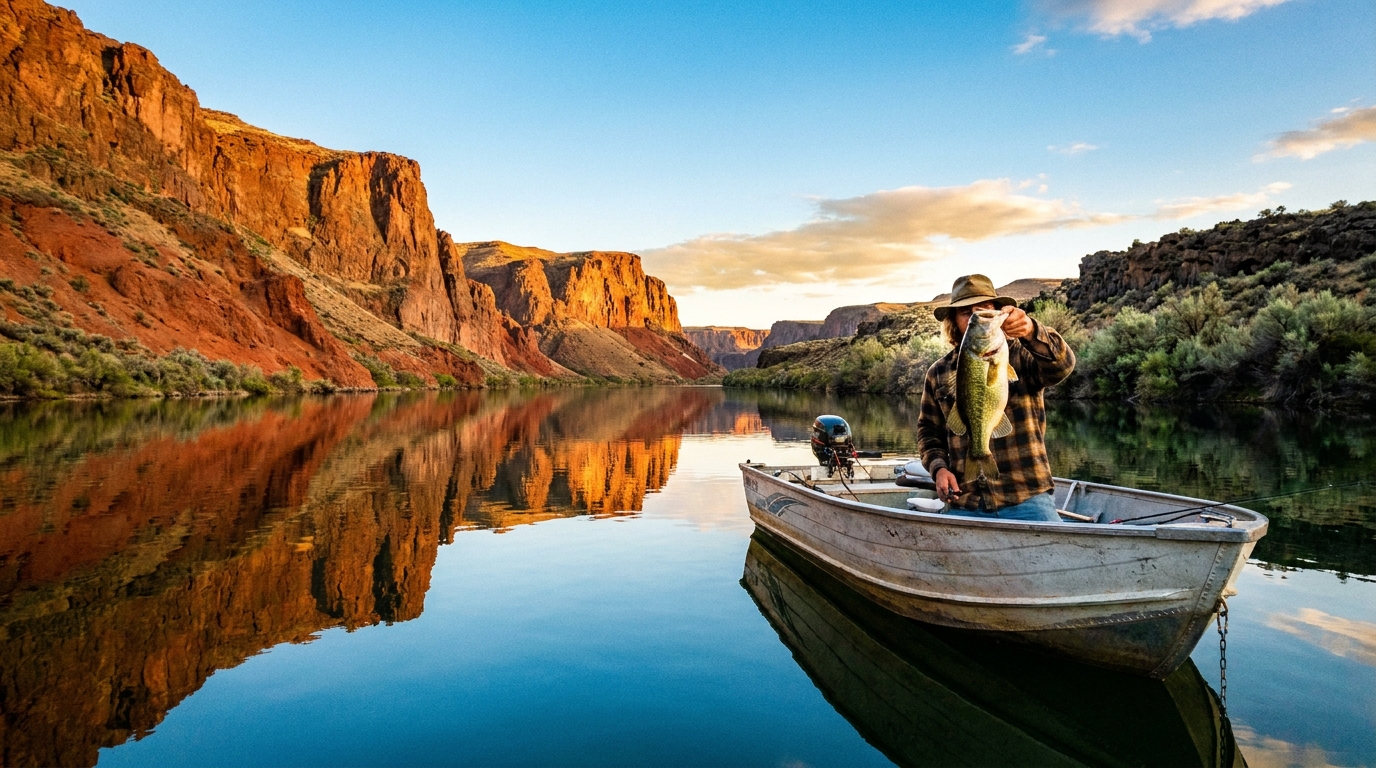
Owyhee Lake doesn't get the press it deserves. Tucked into the far southeast corner of Oregon — past Jordan Valley, past the pavement in some spots — this 53-mile desert reservoir sits inside a volcanic canyon system so remote that most Oregon anglers have never seen it. That's exactly why the fishing is so good.
At full pool, Owyhee holds around 1,075 surface acres and plunges to depths exceeding 300 feet in the main arm. The canyon walls above it — banded layers of rhyolite, basalt, and ancient ash — climb several hundred feet off the water in places, making for scenery that looks more like Utah than the Pacific Northwest. In summer, when water temps warm through the canyon shallows, this place comes alive for warm-water species.
What's in the Water
The reservoir holds a solid mix of species, but three dominate the summer fishery:
- Largemouth bass — The main draw for most summer visitors. Fish run 1–4 pounds routinely, with five-pounders in the mix for anglers who know where to look.
- Black crappie — Found schooled in deeper brush piles and rocky structure. Crappie here grow fat on a desert reservoir forage base and often run 10–12 inches.
- Channel catfish — Underrated but plentiful. Night fishing the flats near the Leslie Gulch area produces catfish in the 3–8 pound class consistently through July and August.
- Yellow perch — Found in the shallower northern arms, particularly near weed growth. Great table fare and useful for early-season action before bass season kicks off.
Summer Bass Tactics
By July, bass in Owyhee have pushed into two primary zones: the shaded canyon walls in the main arm and the weedy flats near the upper reservoir near Owyhee State Park. Both require different approaches.
Canyon Wall Bass
This is the most distinctive fishing on the lake. The vertical rhyolite walls drop straight into 30–60 feet of water in the main arm, and bass suspend along these walls at varying depths depending on time of day. Early morning, fish are shallow — within 10 feet of the surface, tight to the rock. By 10 AM in July, they've pushed deeper.
Work a drop shot or shaky head vertically along the canyon face. A 4-inch green pumpkin finesse worm on a 3/16 oz drop shot head is the standard. Let it fall, keep light contact, and work it slowly. Swim jigs and small crankbaits — a Megabass Vision 110 or similar stick bait — draw aggressive reaction strikes early in the morning before the sun hits the walls.
Shallow Flat Bass
The upper portions of the reservoir near the dam and the Snively Hot Springs area hold grass beds and submerged brush that largemouths move into in low light. Topwater works well from first light until 8 AM — a popper or walking bait like a Heddon Super Spook Jr. draws explosive hits. Once the sun climbs, switch to a Texas-rigged beaver bait or punch rig where vegetation thickens.
Crappie: Find the Structure
Black crappie in Owyhee relate hard to submerged structure — old creek channel edges, submerged brush, and rocky points. In summer, look for them suspended 15–25 feet down over 30–40 feet of water. They're there; you just need sonar to find them.
A 1/16 oz to 1/8 oz marabou jig in white or chartreuse dropped vertically into the school is the most consistent producer. If you can mark fish on your graph and drop a bait into the cloud, expect fast action. Crappie here don't require finesse — they're eating, and they commit.
Evening crappie fishing around the rocky shorelines near the Leslie Gulch boat launch is worthwhile too. Cast small tube jigs or crappie magnets parallel to the rock walls and retrieve slowly. Fish push shallow at dusk and will stack in 5–8 feet of water near anything that offers shade.
Catfish After Dark
This is Owyhee's most overlooked fishery. Channel cats grow large in this desert reservoir, and July and August nights are prime. Set up on the sandy flats near the upper end of the reservoir, or work the transition zones where the canyon walls give way to wider canyon floor near the middle arm.
Cut sucker, chicken liver, or commercial stink bait on a 1–2 oz egg sinker rig with a short 12-inch leader and #2/0 circle hook. Multiple rods out on rod holders, lantern running, and patience — that's catfishing at Owyhee. Runs often come between 10 PM and 2 AM.
Access and Logistics
The main access points are:
- Leslie Gulch Road — Off Hwy 95 south of Jordan Valley. This puts you into the upper canyon arm and provides the most dramatic canyon access. The road is gravel and rough in spots — passable for most vehicles but trailers require care.
- Owyhee State Park (Lake Owyhee State Park) — Northwest of the reservoir via Hwy 201 from Nyssa. This is the easiest access, with a developed boat ramp, camping, and restrooms. Fills up on summer weekends.
- Birch Creek boat launch — Middle of the main arm, good for accessing deeper canyon structure.
A boat is essentially required for the best fishing. Shore access is limited to a few launch areas due to canyon terrain. Day-use and camping fees apply at the state park. No fees at the BLM Leslie Gulch area, but facilities are minimal.
Regulations and Season Notes
Owyhee Lake falls under ODFW Zone 5 warm-water regulations. Largemouth bass: 5 fish per day, 12-inch minimum. Crappie: 25 per day, no minimum size. Channel catfish: 10 per day. Always verify current ODFW regulations before fishing — rules can change year to year.
Water levels fluctuate significantly based on snowpack and irrigation demand. In drought years, low water concentrates fish but also limits boat ramp usability at some access points. Check current lake levels via the Bureau of Reclamation website before making the drive.
The Drive Is Worth It
Getting to Owyhee Lake is a commitment. From Bend, you're looking at 3.5 hours. From Portland, over 5. There's no cell service for most of the route once you leave Jordan Valley or Nyssa, and services are nonexistent lakeside. Bring everything you need — fuel, food, water, and spare boat parts.
That remoteness is exactly the point. While the rest of Oregon crowds the Deschutes, Willamette, and Coast Range rivers, Owyhee Lake sits out here in the high desert, largely unfished, largely undiscovered. The bass don't know any better. Neither do the crappie. Go find out for yourself.