Arrows take a beating. Between range sessions, brush contact, marginal pass-throughs, and the occasional unfortunate encounter with a target stand, even well-cared-for arrows end up with torn, missing, or melted fletching. Most bowhunters' first instinct is to toss the shaft or leave it to a pro shop — but refletting is one of the more accessible DIY skills in archery, and mastering it means you can keep your quiver full, tune your own setup, and make field repairs when it counts.
Understanding Your Fletching Options
Before you buy materials, know what you're working with. Fletching falls into two broad categories:
Vanes
Plastic or rubber vanes are the standard for most hunting setups. They're waterproof, durable, and consistent. Low-profile vanes (2 to 2.5 inch) are popular with mechanical broadheads and faster bows; larger vanes (3 to 4 inch) provide more drag and stabilization for fixed-blade broadheads or heavier arrows. Vanes are glued directly to the shaft.
Feathers
Natural or synthetic feathers offer excellent drag and are forgiving of poor form or arrow paradox at the shot — they compress through a rest or past a shelf rather than deflecting. They're the traditional choice and remain popular among traditional archers, but they absorb water and require more careful maintenance in wet Pacific Northwest conditions.
For most Oregon bowhunters hunting elk or deer in September and October — often in wet or dewy conditions — quality plastic vanes are the practical choice.
Tools and Materials You Need
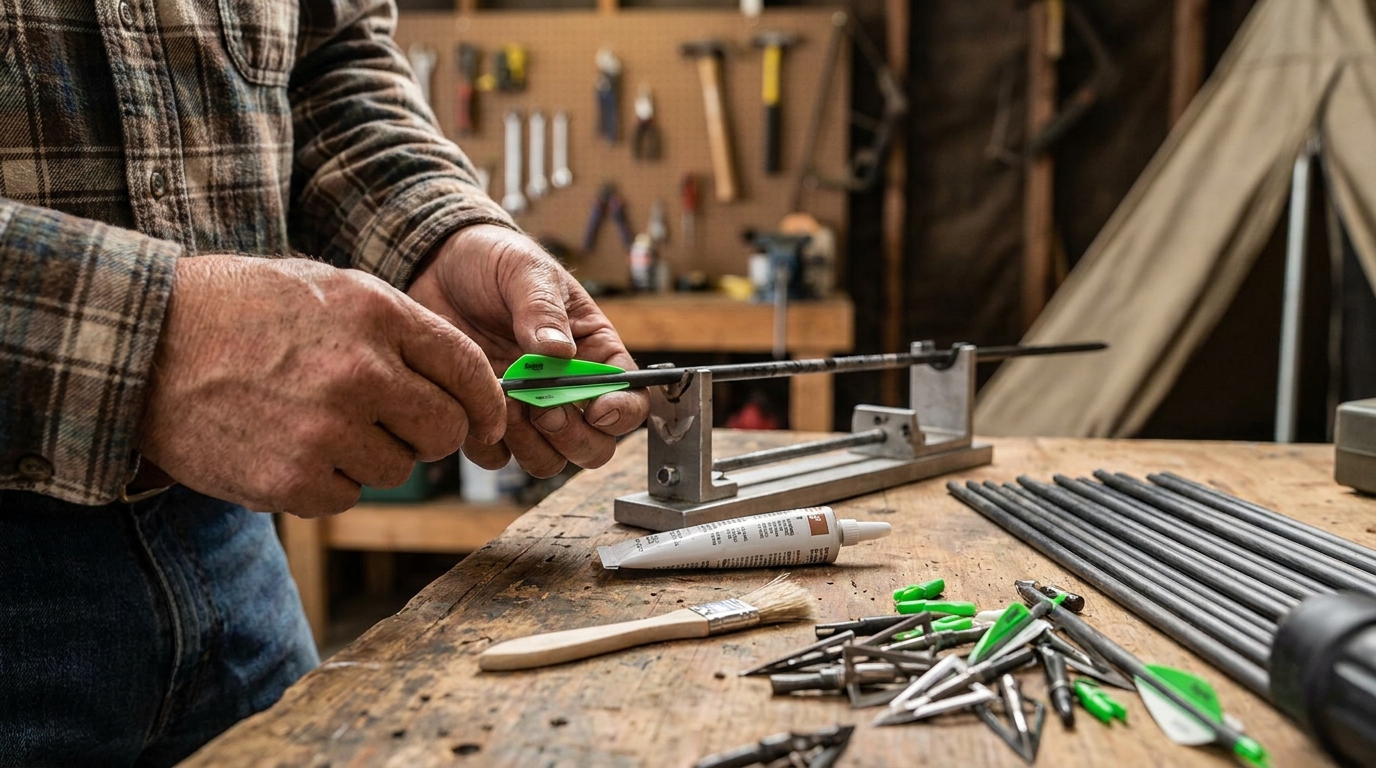
- Fletching jig: A quality jig is the most important investment. The Bohning Tower Jig, Arizona EZ Fletch, and Bitzenburger are proven options. The Arizona EZ Fletch mounts all three vanes simultaneously and is fast for batch work. The Bitzenburger allows precise angle and offset adjustments. Either will serve you well.
- Fletching adhesive: Bohning Fletch-Tite Platinum is a standard choice — bonds quickly, stays flexible, and holds in the field. For feathers, use a softer cement. Avoid super glue (cyanoacrylate) as a primary adhesive — it dries brittle and the bond can fail under flex.
- Acetone or adhesive remover: For stripping old fletching and cleaning the shaft.
- Alcohol wipes or Q-tips: Final prep clean before bonding.
- Razor blade or vane stripper: For removing old fletching cleanly without gouging the shaft.
Step-by-Step: Reflething an Arrow
Step 1 — Strip the Old Fletching
Use a vane stripper tool or carefully slice under the base of each vane with a single-edge razor blade, working from front to back along the length of the vane. Don't dig into carbon or aluminum — you're just breaking the adhesive bond. Once the vanes are off, use a cotton ball or pad soaked in acetone to remove all remaining adhesive residue from the shaft. Let it dry fully — any acetone residue will prevent the new adhesive from bonding correctly.
Step 2 — Prep the Shaft
Wipe the fletching area with an alcohol wipe and let it dry. This final degreasing step matters — skin oils transferred during handling can cause bond failure. Handle the cleaned area as little as possible from this point on.
Step 3 — Set Up Your Jig
Load a vane into the jig clamp with the base centered and facing out. Set your offset or helical angle. Straight fletching is the simplest to apply but produces less spin stabilization — a 1 to 3-degree right or left offset, or a gentle helical, will spin-stabilize your arrow better and improve broadhead accuracy. A right-hand shooter with right-helical vanes creates clockwise rotation; match the rotation direction to your arrow's natural nock twist for best results.
Step 4 — Apply Adhesive and Set
Apply a thin, even bead of fletching cement along the entire base of the vane. Less is more — excess glue squeezes out and creates cleanup work. Clamp the jig against the shaft at your target distance from the nock (typically 1 to 1.5 inches), hold for 60 seconds, then allow a full cure of 5 to 10 minutes before rotating to the next vane position. Rushing cure time is the most common mistake beginners make.
Step 5 — Inspect the Bond
After all three vanes are applied and fully cured (give it a few hours for best results), run your thumbnail firmly along the base of each vane. Any section that lifts or feels loose needs a small repair — work a tiny amount of adhesive under the loose section with a toothpick or the applicator tip and clamp it again.
Field Repair Kits for Hunting Camp
Pack a small kit in your hunting pack or basecamp bag: one Arizona EZ Fletch or a simple straight-clamp jig, a small bottle of Fletch-Tite, acetone wipes, extra vanes in your chosen style, and a razor blade. The entire kit fits in a quart zip-lock bag and weighs almost nothing. A marginal elk hit that leaves your arrow in the ground with damaged fletching shouldn't end your season — with five minutes and this kit, that arrow can be back in your quiver and flying true before the next morning's hunt.
When to Replace the Shaft
Reflething saves money and extends arrow life, but know when to retire a shaft. Any carbon arrow that takes a hard hit — tree, rock, deflection off bone — should be flex-tested and spin-tested before reuse. If it cracks, splinters, or wobbles on a spin test, it's done. A splintering carbon shaft that fails on the shot is a serious injury risk. No arrow is worth that.
Fletching your own arrows is satisfying in the same way that any hands-on preparation for hunting is satisfying. Every arrow in your quiver that you built and tuned yourself is one more connection to the craft. Do it right, do it consistently, and you'll never wonder whether your gear is holding you back when it counts.