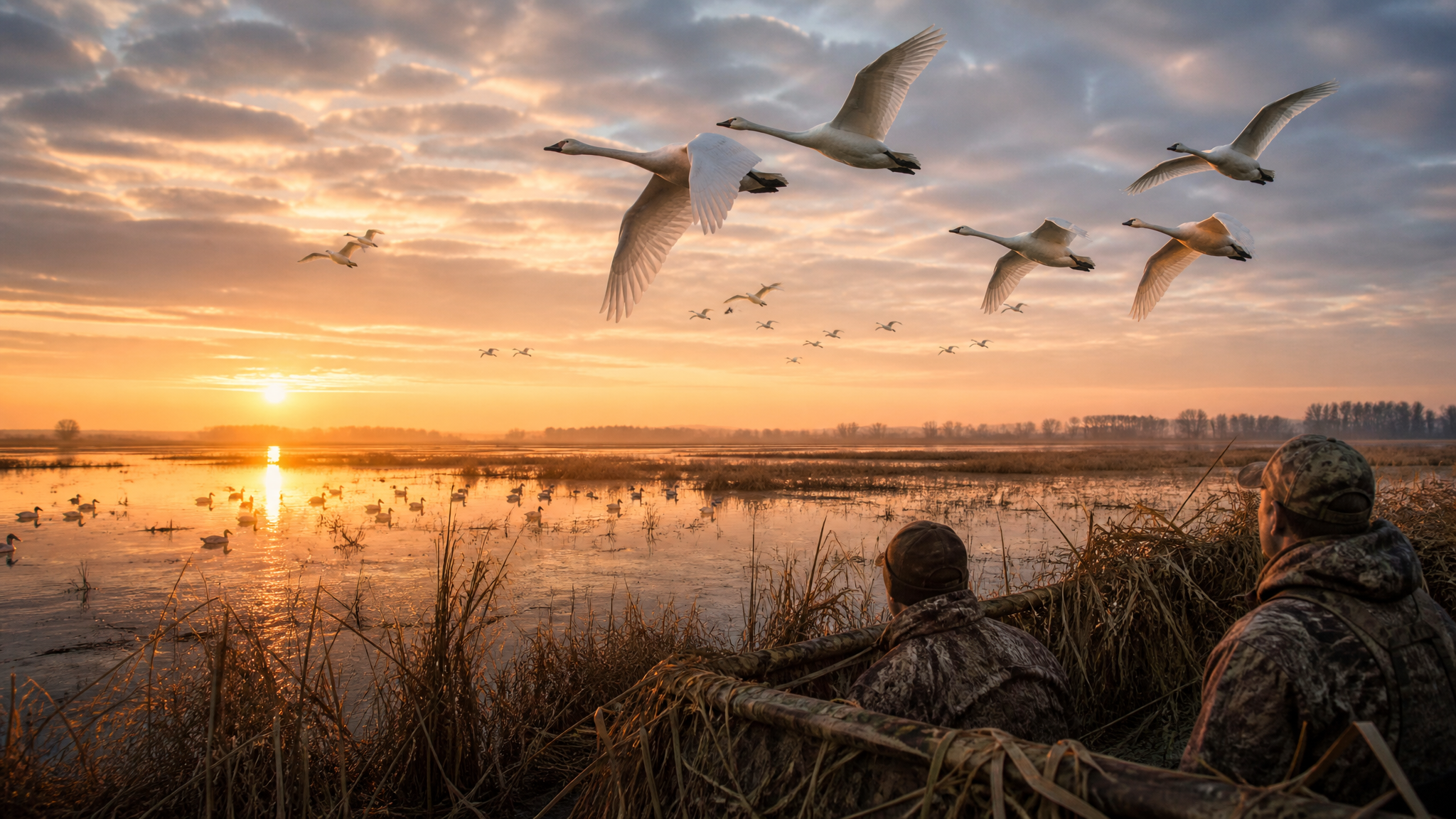
Hunting tundra swans is not something most Oregon hunters even know is legal. It is. And it might be the most memorable hunt you ever do. The birds are enormous — adult tundra swans weigh 14 to 23 pounds with wingspans pushing six feet — and they travel in tight family groups that respond to calling and decoys in ways that will make your jaw drop. The season is limited, the tags are competitive, and the experience is in a class by itself.
The Oregon Swan Season
Oregon’s tundra swan season is managed by ODFW through a limited-entry permit system. Permit numbers vary by zone and year, but the state typically issues permits in the Klamath Basin and eastern Oregon zones through a random drawing. Applications are submitted in October for the fall season, which generally runs from mid-November through late December. Check ODFW’s current regulations for zone-specific dates and permit quotas — these shift from year to year based on population surveys.
The bag limit is one swan per permit holder. Tundra swans (Cygnus columbianus) are the legal target species; trumpeter swans (Cygnus buccinator) are protected and must never be taken. The two species look similar in flight, which is why ODFW requires hunters to pass an identification test before receiving a permit. Study the differences: tundra swans have a yellow spot at the base of the bill; trumpeters do not. Tundra swans are also smaller, with a proportionally more rounded head.
Where Oregon Swans Concentrate
The Pacific Flyway carries the bulk of tundra swans that breed in Alaska and western Arctic Canada to their wintering grounds in California’s Central Valley. Oregon sits in the middle of that funnel, and several areas concentrate birds hard through November and December.
- Klamath Basin: The Klamath is the most productive swan hunting area in Oregon. Birds stage heavily in the marshes around Lower Klamath and Tule Lake National Wildlife Refuges (hunt the adjacent private and state lands, not the refuges themselves), as well as on private grain fields and wetlands throughout Klamath County. Flooded grain fields holding waste barley or wheat are gold.
- Warner Valley (Lake County): The marshes around Warner Lakes and Hart Mountain can hold exceptional numbers of swans during migration. Access is largely on BLM and state land. This is a more physically demanding hunt — expect mud and cold.
- Malheur National Wildlife Refuge Area: The areas surrounding the refuge (again, hunt outside the refuge boundaries) and the private wetlands north toward Burns hold birds mid-season. Permission from landowners around the Harney Basin can be golden — ask early and ask politely.
Decoys and Calling
Swan hunting is a decoy-intensive game. You need big spreads to be convincing — a minimum of 12–18 full-body or magnum shell decoys spaced realistically on the water or in a field. Flocked white decoys in realistic resting and feeding poses will outperform glossy white shells. Space birds 4–5 feet apart; swans are not tight-packers.
Calling is effective and surprisingly simple. Tundra swans produce a high, bugling wh-OOO sound, often in a series of 3–5 notes. Electronic callers are legal for swans in Oregon, but learning to mouth-call with a goose call pitched high adds an authentic randomness that complements electronic sound. Call aggressively when birds are a half mile out, then back off as they commit and drop their feet.
Layout blinds buried in snow or white stubble work well. For open-water hunting, a layout boat or mud boat with white burlap or sheet fabric draped over the sides will disappear into the decoy spread. These birds are not paranoid — a well-placed hunter in a good blind is almost invisible to committed birds.
Shotguns and Loads for Swans
Do not undergun this hunt. A tundra swan is one of the toughest birds in North America to bring down cleanly. A 12-gauge is the minimum, and a 3.5-inch chamber is strongly preferred. Use heavyweight non-toxic shot: Bismuth, TSS, or premium steel loads. For steel, BB or BBB shot in a 3.5” hull pushing 1,550+ fps is the floor. For TSS #4 or #5 shot, you gain a devastating energy advantage at distance.
Pattern your gun at 40 yards with your chosen load before the season. Modified or Improved Modified chokes are appropriate for most steel loads; consult your choke manufacturer for bismuth or TSS recommendations. Shots beyond 50 yards should be passed.
After the Shot
A tundra swan provides an enormous amount of meat — treat it like a goose on steroids. Breast the bird out, age the meat for 2–3 days in a refrigerator, and prepare it like a large Canada goose. Slow-roasted or braised breast in a Dutch oven is exceptional. The back straps can be sliced thin and grilled hot and fast like venison.
The experience of hunting tundra swans in Oregon’s high desert marshes in November — birds dropping out of a gray sky against a backdrop of rimrock and frozen cattails — is something you’ll remember longer than most elk hunts. Apply for the tag. It’s worth the effort.