Every fall, hunters all over Oregon show up to opening day with a shotgun they haven't fired since March, a box of shells grabbed off the shelf the night before, and no idea what their choke is actually doing with that load. Then they miss. Then they blame the decoys, the dog, the wind, or the shooting. The real issue was the 30 minutes of patterning work they skipped in August.
Shotgun patterning isn't complicated. But it requires an afternoon at the range and some honest evaluation of what your gun, choke, and load combination is actually producing. Do this work now, in August, before the season pressure builds and before every hunter in the valley is monopolizing the shooting bench on the last weekend of September.
What Patterning Actually Tells You
A shotgun pattern test measures two things: the density and distribution of your pellet charge within a 30-inch circle at a given distance. The standard test distance for waterfowl patterning is 40 yards — the outer edge of ethical shooting range for most waterfowl. You're looking for even coverage within the circle with no large gaps (called blown patterns) and an adequate number of pellets per square foot to achieve lethal placement on a duck or goose.
The rule of thumb for lethal waterfowl pattern density: a minimum of 3 to 4 pellets in a vital zone at your maximum shooting distance. If you can't achieve that consistently, you're either shooting too far, using the wrong choke, or using the wrong load.
What You Need for a Pattern Session
- Large paper targets, at least 24 by 24 inches (butcher paper or newsprint works fine)
- A marker to draw a 30-inch circle (use a 15-inch string tied to a pen)
- A consistent shooting rest or bench to eliminate human variation
- A tape measure set to exactly 40 yards
- At least 5 shells of each load and choke combination you want to test
- Your hunting shotgun with a clean bore
- A permanent marker to number each pattern
Choke Selection for Oregon Waterfowl
Steel shot — mandatory for all waterfowl hunting in Oregon — patterns differently than lead. Steel is harder and doesn't deform as it travels down the barrel, which means it patterns tighter than equivalent lead loads through the same choke. The general rule: open up one choke size for steel compared to lead.
Duck Shooting (30 to 40 yards)
- Modified (M): The most common and versatile choke for steel duck loads. Good for most pass shooting and decoy work at 25 to 45 yards.
- Improved Modified (IM): Use with smaller shot sizes (BB, No. 2, No. 3) or lighter loads at the outer range of your comfort zone. Never use IM with steel loads larger than BB — pressure concerns apply.
- Improved Cylinder (IC): For close decoyers and tight-cover situations — flooded timber, marsh hunting under 25 yards. Excellent with larger steel shot at close range.
Canada Goose and Specklebelly (40 to 50 yards)
- Modified or Light Modified: For full-plumage steel goose loads (BBB, T, F shot). Tight chokes with large steel at magnum velocities create dangerous pressure spikes.
- Bismuth and Heavyweight Non-Toxic: If you're shooting Federal HEAVYWEIGHT TSS, Boss, or Bismuth loads (which pattern more like lead), an IM or Light Full choke is appropriate. These alternatives allow tighter constriction safely.
Critical safety note: Never use Full choke with steel shot of any size. It is not a performance issue — it is a safety issue. Choke constriction with hard steel at high pressure can crack or blow choke tubes. Mark your chokes and know exactly what's in your gun before each session.
Running Your Pattern Test
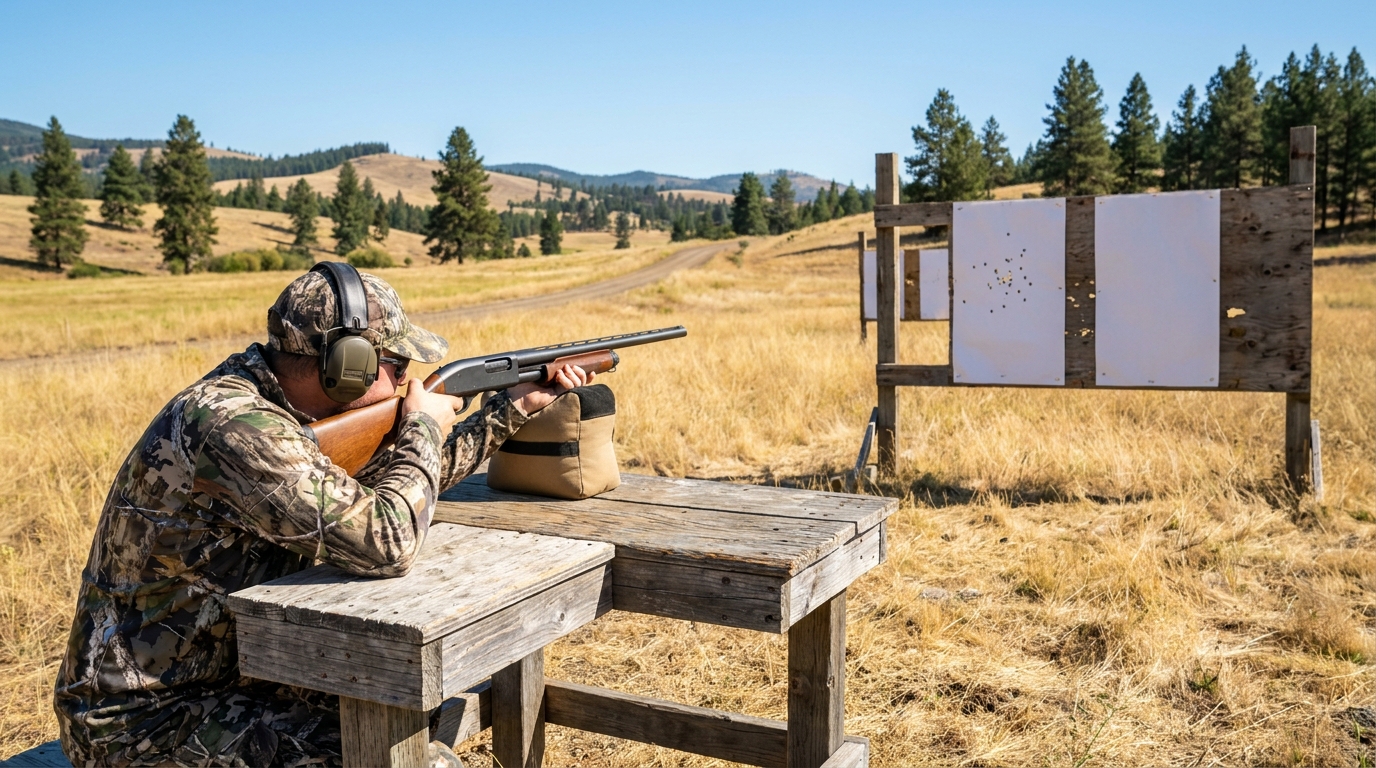
Set up your pattern board at exactly 40 yards. Shoot from a stable rest to eliminate human hold variation — you're testing the gun and load, not your swing. Fire one round at each new blank target. After firing, draw your 30-inch circle centered on the densest portion of the pattern, not the bullseye. Count all pellets within the 30-inch circle.
Shoot at least 5 patterns with each combination. Average the pellet count across all five shots. One flier doesn't tell you anything — five shots start to show you what the load is really doing. Evaluate your patterns for overall density (what percentage of pellets are inside the 30-inch circle — 60 to 70 percent is the baseline for effective waterfowl patterns at 40 yards), evenness (no large gaps where a bird could fly through unhit), and point of impact versus point of aim.
Load Selection: Steel Shot Size for Oregon Birds
- Teal (early season, September): No. 4 or No. 3 steel, 1-1/8 oz, 1,400 to 1,500 fps
- Mallard, widgeon, pintail: No. 2 or No. 3 steel, 1-1/8 to 1-1/4 oz, 1,400 to 1,550 fps
- Diver ducks (scaup, redhead): No. 2 or BB steel, 1-1/4 oz, 1,450-plus fps
- Canada geese: BBB, T, or F steel, 1-1/4 to 1-3/8 oz, 3-inch or 3.5-inch magnum loads
- Specklebellies: No. 2 or BB steel in 1-1/4 oz 3-inch loads; BBB for larger birds
Oregon-Specific Notes
Oregon's season structure creates a unique situation for waterfowl shooters: September teal season often overlaps with early dove season, and the main duck season doesn't open until late October. This August patterning session is your chance to confirm your teal load — which is usually a lighter, faster-opening pattern than your standard duck load — before the September opener. Run your teal load separately from your main duck loads; close-range teals in flooded grass call for very different pattern performance than 40-yard pass shots over the Klamath Basin marshes.
The Klamath Basin, Sauvie Island, Malheur Refuge, and the Willamette Valley flyways all produce excellent duck and goose hunting when conditions align. None of that matters if your gun is throwing blown patterns. Do the work now.
Document Everything
Keep a log. Write down the date, weather conditions, gun, barrel length, choke, load details, and average pellet count per test. Take a photo of each pattern target. This becomes invaluable when you're standing in a sporting goods store in October trying to remember whether the 1,500 fps BBB load performed better than the 1,300 fps version through your Modified choke.
Your pattern journal is one of the most useful tools a waterfowl hunter can keep. Build it this August, update it each year, and you'll never again wonder why you missed the greenhead that crossed at 35 yards.