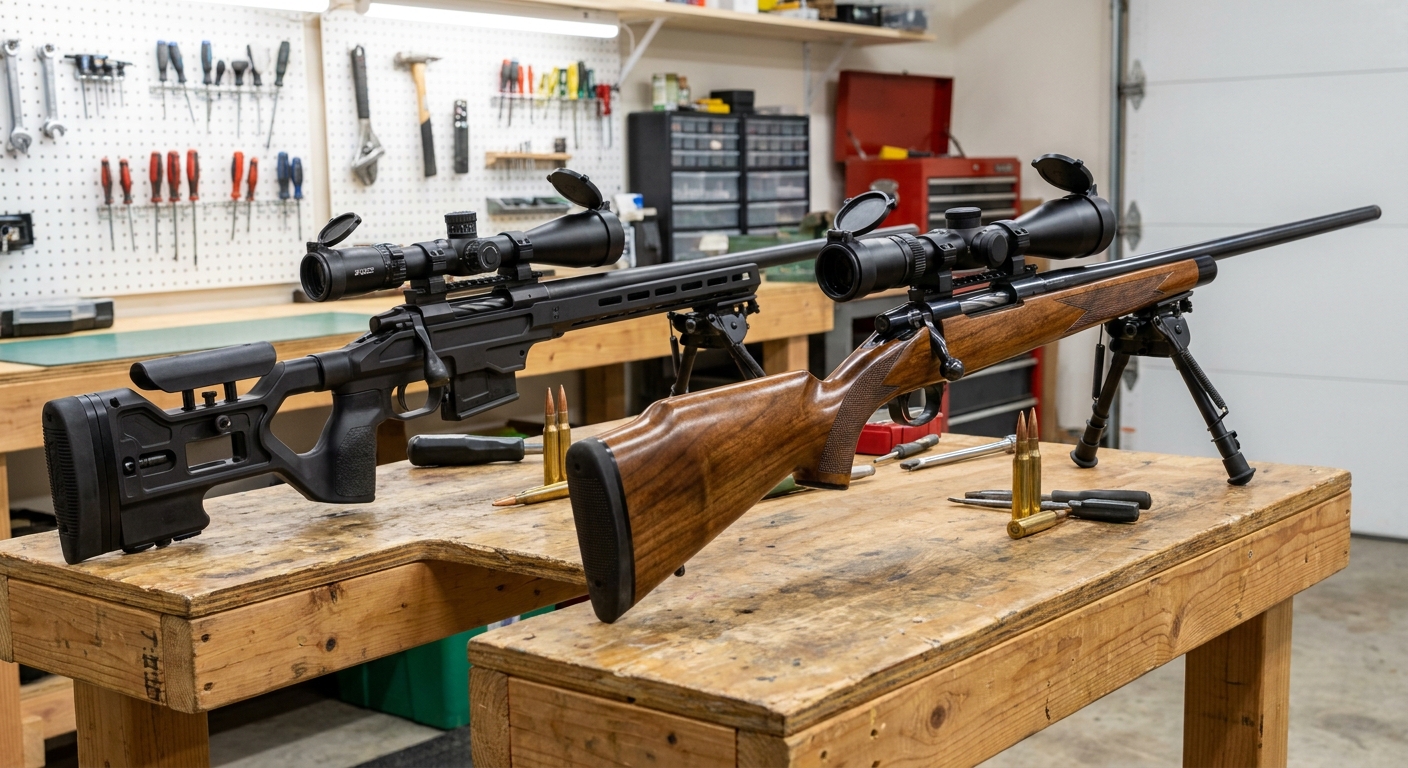
Walk through any rifle section at a trade show today and you will see two distinctly different philosophies staring back at you: the clean, adjustable geometry of an aluminum chassis system and the timeless lines of a pillar-bedded synthetic or wooden stock. Both approaches build accurate, capable hunting rifles. Choosing between them is a matter of understanding what each does well and what it costs you.
What Is a Chassis System?
A chassis stock replaces the traditional rifle stock with a machined aluminum or polymer skeleton. The barreled action sits in a rigid aluminum chassis that provides a flat, consistent bedding surface, a standard AR-style grip and trigger guard, and usually M-LOK or Picatinny rail slots for accessories. Most chassis systems feature fully adjustable length of pull and comb height, allowing the shooter to dial in fit precisely for prone shooting, sitting, or use with a suppressor.
Popular chassis systems for hunting-oriented rifles include the Magpul Hunter series, the MDT ESS and LSS platforms, the KRG Bravo and Whiskey-3, and the Kinetic Research Group offerings. These range from roughly 350 dollars for entry-level polymer chassis to over 1,000 dollars for fully machined aluminum competition-grade systems.
What Is a Bedded Traditional Stock?
A traditional bedded stock, whether fiberglass, carbon fiber, or wood, uses either pillar bedding or full epoxy bedding to create a rigid, repeatable contact surface between the action and stock. The rifle is shaped ergonomically from the factory and typically lacks the adjustment range of a chassis but provides a more conventional feel and a slimmer profile.
Quality hunting-oriented bedded stocks from makers like Manners, McMillan, Stocky's, and Bell and Carlson have been the standard for precision hunting rifles for decades. A properly pillar-bedded fiberglass stock on a well-fitted barreled action will deliver chassis-level accuracy for a fraction of the cost.
Weight and Packability
This is where traditional stocks win decisively for most western hunters. A quality fiberglass or carbon fiber hunting stock weighs 20 to 28 ounces depending on design. A quality aluminum chassis stock typically runs 36 to 52 ounces. That is up to two pounds of additional weight before you start adding the AR-style accessories that chassis rails invite.
When you are backpacking into a wilderness unit for mule deer or elk, those two pounds matter. The cumulative weight of camp, water, meat, and rifle already pushes most pack-out loads into uncomfortable territory. A light, traditionally stocked mountain rifle in the sub-7-pound complete weight range is a very different animal from an 11-pound chassis rifle on the range.
That said, some chassis makers have addressed this directly. The KRG Bravo and certain MDT polymer chassis options bring total weight much closer to traditional stocks, making them viable for hunting applications where you prioritize the adjustability benefits.
Adjustability and Fit
This is where chassis systems have a clear edge. The ability to set length of pull and comb height precisely means the rifle can fit multiple shooters, accommodate a suppressor without losing cheek weld, and transition between bipod-prone and field positions without compromising eye alignment. For hunters who shoot across multiple positions in varied terrain, a well-fitted chassis can provide a real practical advantage.
Traditional stocks address fit through the gunsmithing arts: pad spacers, cheek riser pads, and custom work. The adjustability is there but it is hardware-based rather than tool-free. Once set up correctly for a specific shooter, a traditional stock is arguably more repeatable than a chassis with multiple adjustment points that can shift if not properly torqued.
Accuracy and Bedding Consistency
Modern chassis systems and properly bedded traditional stocks both deliver sub-MOA accuracy when paired with a quality barreled action. The chassis advantage is consistency and ease of fitting: the aluminum bedding surface does not change with temperature or humidity the way even the best synthetic stocks can. For extreme-range precision shooting in variable conditions, a chassis offers a more controlled platform.
For typical hunting distances inside 600 yards, the accuracy difference between a properly bedded traditional stock and a quality chassis is negligible. Both will group into half-MOA with a quality barrel and handloads. The chassis is not buying you practical field accuracy at hunting ranges.
Durability and Maintenance
Aluminum chassis are essentially indestructible from a structural standpoint. They will not warp, crack, or oil-soak. Traditional synthetic stocks are nearly as durable, but the bedding compound can loosen over time, especially if the rifle sees high round counts or significant temperature swings. Wood stocks require more care and are poorly suited to wet Coast Range conditions without proper sealing.
The Verdict for Oregon Hunters
For the majority of Oregon big game hunters, a lightweight, properly bedded synthetic stock in a fiberglass or carbon fiber design is the better choice. It saves weight where weight matters most, handles weather without complaint, and delivers all the accuracy the field requires. Look at proven options like the Manners EH1, Bell and Carlson Medalist, or a factory-bedded Bergara stock as starting points.
Choose a chassis if you are shooting PRS or precision competitions, if you share a rifle with multiple shooters of different builds, if you are running a heavy suppressor and need adjustable comb height, or if you shoot primarily from a bench or prone position where weight is irrelevant. The adjustability and consistency are genuine benefits in those applications.
Either way, the stock is only as good as the bedding. However you configure your rifle, make sure the action is properly mated to its platform. A poorly bedded chassis is no better than a warped synthetic stock. Get the fundamentals right and both systems will serve you well.