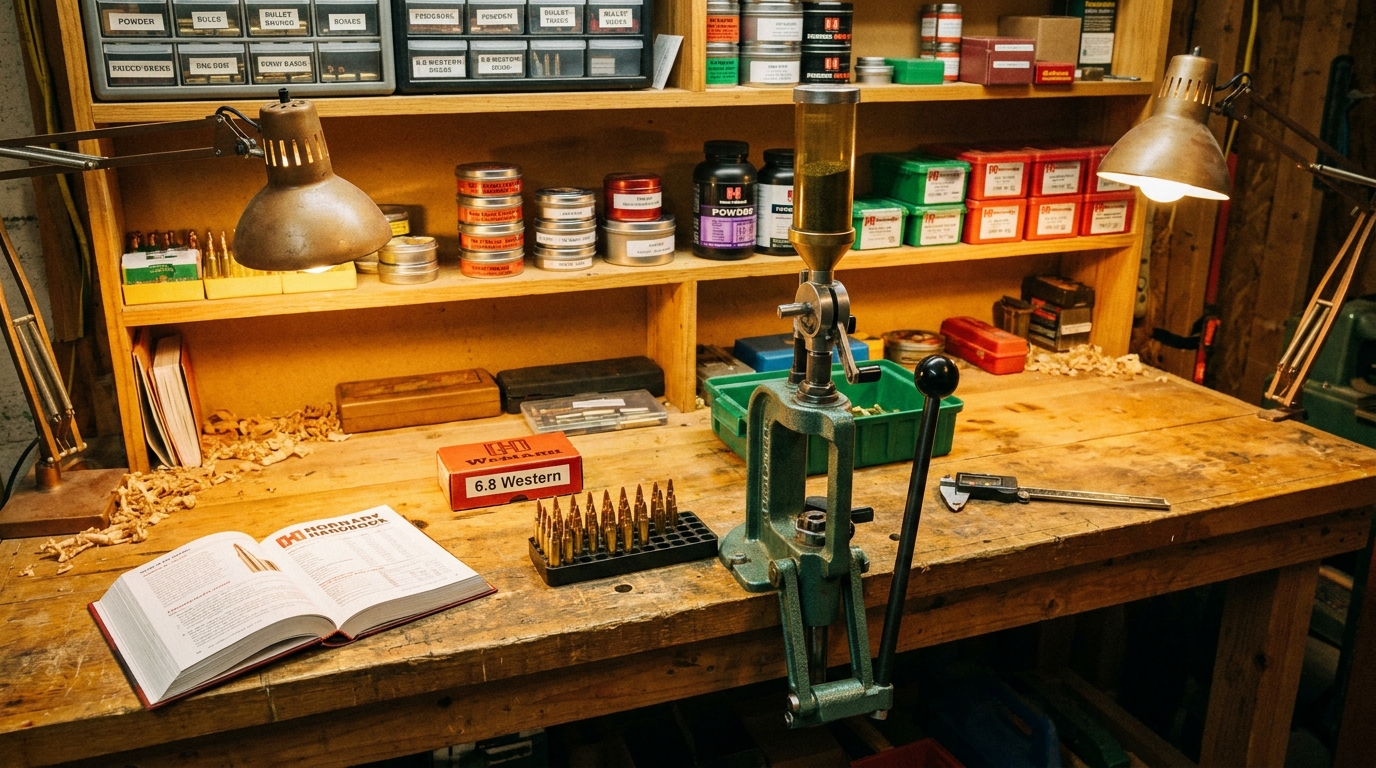
The 6.8 Western arrived in 2021 as a collaboration between Winchester and Browning, and it has earned its place quickly. Designed from the ground up for heavy, high-BC bullets at moderate velocities, it delivers exceptional long-range terminal performance in a package that fits standard long-action rifles. For Oregon elk hunters or Eastern Oregon mule deer hunters who want a cartridge that genuinely reaches out, the 6.8 Western deserves serious attention. And for handloaders, it rewards work at the bench with accuracy that rivals purpose-built precision calibers.
What Makes the 6.8 Western Different
The 6.8 Western is built around a short, fat case with a 1:8 twist rate that accommodates heavy, high-BC .277-caliber bullets — specifically bullets in the 165–175 grain range that simply will not stabilize in the older 1:10 twist .270 Winchester. Think of it as a .270 Winchester that was re-engineered to launch the heavy bullets that BC calculations favor at distance.
The result is a cartridge that pushes 165-grain bullets around 2,970 fps and 175-grain bullets near 2,835 fps — with G1 BCs in the .600–.620 range. That kind of sectional density and retained velocity at 500 yards is what makes the 6.8 Western compelling for long-range hunting applications across open Oregon country.
Case Preparation
Winchester brass is the primary sourcing option for 6.8 Western, and it is well-made. Primer pockets are uniform, case walls are consistent, and neck thickness runs tight. A few prep steps pay dividends in accuracy:
- Trim to length: SAAMI maximum is 2.020 inches. Trim to 2.015 inches after the first firing. Cases grow slowly but consistently.
- Deburr and chamfer: Standard procedure. A 21-degree VLD chamfer eases bullet seating, especially with long, heavy projectiles.
- Flash hole deburring: Particularly worth doing on 6.8 Western brass. Flash hole consistency translates directly to SD and ES at the chronograph.
- Annealing: Given the heavy bullets and higher seating pressures, annealing every 3–4 firings extends brass life and maintains neck tension.
Primer Selection
The 6.8 Western uses a standard large rifle primer. CCI 200 and Federal 210M (Gold Medal Match) are both excellent choices. The Federal 210M provides a slightly hotter ignition that is beneficial with the slower powders this case performs best with. Magnum primers (Federal 215M, CCI 250) are not necessary but are occasionally used with the slowest propellants at cold-weather loads — useful for elk camp in the Blues or Wallowas.
Powder Selection
Burn rate is critical in the 6.8 Western. The case is optimized for slow-to-medium-slow powders. Too fast and you are leaving velocity on the table; too slow and you hit pressure limits before reaching optimal performance.
- Hodgdon H4350: The go-to powder for 6.8 Western with 162–165 grain bullets. Exceptionally consistent, temperature-stable (Extreme series), and gives up very little to anything else in this case. Load range typically 52–55 grains depending on bullet.
- Hodgdon H4831SC: Excellent with the heavy 175-grain projectiles. Slightly slower burn rate suits the heavier bullets. 53–56 grain charge weights are typical.
- IMR 4451: A temperature-stable, single-base option that competes closely with H4350. Worth testing if H4350 is unavailable.
- Reloder 19: Performs well, particularly with 165-grain bullets, but is temperature-sensitive — a consideration for hunters who load for both Oregon summer scouting and November cold.
- Hodgdon Retumbo: With 175-grain bullets at max charges, Retumbo can push right at the performance ceiling. Compress charges are not uncommon — seat bullets accordingly.
Bullet Selection
The 6.8 Western's 1:8 twist was purpose-built for bullets the .270 Win could never stabilize. Take advantage of it:
- Berger 170gr Hunting VLD (.277): G1 BC of .617. Exceptional at distance. Seats to 3.34 inches OAL for most actions with acceptable magazine clearance.
- Hornady 162gr ELD-X: Purpose-built for long-range hunting. G1 BC of .620. Heat Shield tip maintains BC at velocity. Excellent terminal expansion down to moderate impact velocities.
- Sierra 165gr GameKing HPBT: A proven hunting bullet with strong BC for its weight. More economical than premium options; good choice for load development practice.
- Federal 175gr Terminal Ascent: If you are shooting factory ammo and want to replicate the load in handloads, the 175gr Terminal Ascent bullet (.530 G1 BC) is available as a component from several sources.
Starting Load Data
Always begin load development 10% below maximum and work up in 0.5-grain increments while monitoring for pressure signs. The following are reference ranges — consult your powder manufacturer's current data as the definitive source:
- 162gr Hornady ELD-X / H4350: Start 52.0 gr, max ~55.0 gr — expect 2,920–2,970 fps from a 22-inch barrel
- 165gr Sierra GameKing / H4831SC: Start 52.5 gr, max ~55.5 gr — expect 2,880–2,940 fps
- 175gr Berger Hunting VLD / Retumbo: Start 53.0 gr, max ~56.0 gr — expect 2,790–2,840 fps
Seating Depth and OAL
The 6.8 Western's magazine length in most rifles (Browning X-Bolt, Winchester Model 70) runs to 3.34–3.36 inches COAL. With 175-grain VLD-style bullets, you will often be close to magazine limits. Measure your specific rifle's throat with a Hornady OAL gauge and begin testing at 0.020 inches off the lands. VLD bullets often prefer a jump of 0.030–0.050 inches — allow for this in your development process.
Field Performance
On elk, the 6.8 Western with a 162 ELD-X or 175-grain premium bullet is simply excellent. At realistic Oregon mountain elk ranges — 200 to 450 yards — it delivers 2,200–2,700 ft-lbs of energy with controlled expansion. The heavy, high-BC bullets resist wind drift in ways that a 130-grain .270 does not, and they retain sufficient velocity for reliable terminal performance at extended range.
Recoil is manageable — noticeably less than a .300 Win Mag, slightly more than a .30-06. Muzzle brakes and suppressors work well with this cartridge. If you are building a dedicated long-range hunting rig and the 6.5 Creedmoor feels a touch light for elk, the 6.8 Western fills that gap convincingly.
The brass is not yet as abundant as .308 or 6.5 Creedmoor, and price reflects that. Treat your cases well, anneal regularly, and each case will give you 8–12 firings at hunting-level pressures without issue.