The .45 Colt — also called the .45 Long Colt, though that designation is technically unofficial — has been in continuous production since 1873. That’s over 150 years of American service, from the original Colt Single Action Army to modern Ruger Blackhawks, lever-action rifles, and everything in between. For reloaders, it’s one of the most interesting pistol cartridges in existence: the same case can be loaded to gentle Cowboy Action loads that barely disturb the gravel, or pushed to honest hunting velocities that handle black bear and feral hogs at reasonable distances.
The catch is that there’s a significant pressure difference between what’s safe in an original single-action revolver and what a modern Ruger single-action or a modern lever gun can handle. Get this wrong and you’ll have a bad day. Get it right, and you’ll have one of the most satisfying cartridges in your reloading rotation.
Understanding the Pressure Divide
The .45 Colt operates at a SAAMI maximum average pressure of 14,000 psi — one of the lowest of any modern centerfire cartridge. This limit exists to protect original Colt SAA revolvers and their clones, many of which have thin cylinder walls by contemporary standards.
However, modern Ruger Blackhawks and Ruger Vaqueros built on the Bisley or New Model frames are substantially stronger. Many reloaders and load manuals publish “Ruger-only” or “Strong Gun” loads for the .45 Colt that push pressures to 25,000-30,000 psi. These loads are explicitly not for Colt SAA revolvers, Italian clones, or any gun of unknown provenance. If you load Ruger-only data, mark your ammunition clearly and never run it through an unsuitable gun.
For the purpose of this guide, we’ll cover standard-pressure loads suitable for all .45 Colt firearms, and note where Ruger-only loads begin.
Components
Brass
Starline is the gold standard for .45 Colt brass and is widely available. Their cases are consistent, have good neck tension out of the box, and last for many reloading cycles. Remington, Winchester, and Federal brass all work, though Federal tends to run slightly thicker. Trim length is 1.285 inches; cases should be checked periodically but don’t need frequent trimming given the cartridge’s modest pressure.
Primers
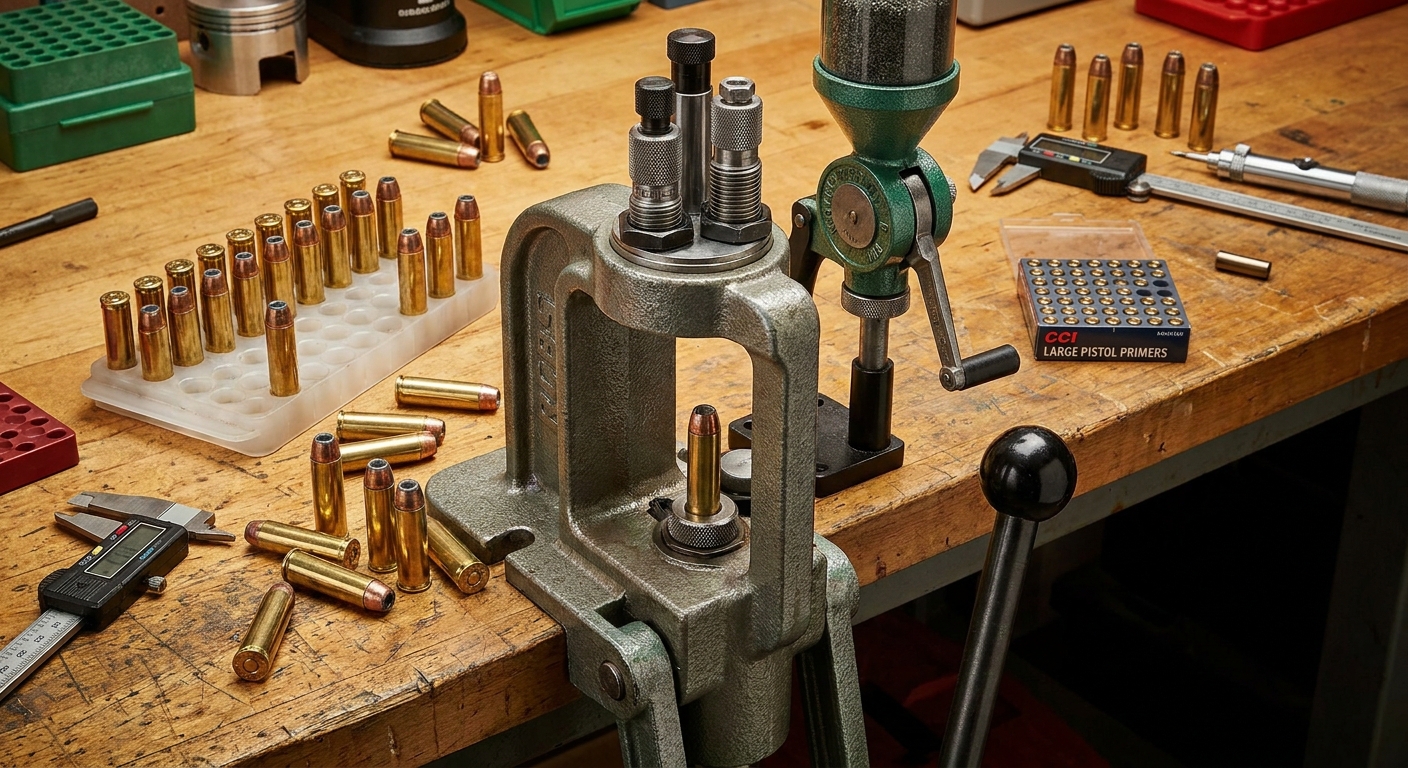
Standard large pistol primers work for most loads. CCI 300, Federal 150, and Winchester WLP are all appropriate. For heavy Ruger-only loads with slow-burning powders, large pistol magnum primers (CCI 350, Federal 155) can improve ignition consistency, especially in cold weather.
Bullets
The .45 Colt uses .452-inch diameter bullets. For Cowboy Action, cast lead bullets are traditional and economical — a 200-grain RNFP (round-nose flat-point) or 250-grain LRN (lead round nose) at modest velocity minimizes leading and keeps costs low. For hunting, cast or jacketed bullets in the 250-300 grain range are appropriate. Hornady’s 250gr XTP, Sierra’s 240gr JHC, and Cast Performance’s hard-cast WFN bullets in 260-300 grains are all proven performers on game.
Cowboy Action Loads
The Cowboy Action Shooting community drives demand for mild .45 Colt loads that make minor power factor (125,000 minimum) while generating minimal recoil and smoke. Key parameters: velocity around 750-800 fps, soft-shooting powder, cast lead bullets.
- 200gr RNFP cast, 5.5gr Hodgdon Clays: ~780 fps from a 4.75″ barrel. Extremely clean, minimal recoil. A favorite for Cowboy Action competitors.
- 250gr LRN cast, 6.0gr Hodgdon Trail Boss: ~750 fps. Trail Boss was designed for vintage cartridges and Cowboy Action — it’s bulky, fills the case well, and essentially self-limits against dangerous overcharges. Highly recommended for new .45 Colt reloaders.
- 200gr RNFP, 5.0gr Alliant Red Dot: ~760 fps. Slightly more flash than Clays but very consistent. Works well in both revolvers and lever-action rifles.
Standard Hunting and Defense Loads
For hunters using standard-pressure guns (Colt SAA clones, Uberti, EMF, older Rugers), these loads push into genuine stopping-power territory:
- 255gr cast SWC, 8.5gr Unique: ~900 fps, ~459 ft-lbs. The classic Keith load. This is where the .45 Colt earned its stopping-power reputation. Flat-shooting to 50 yards, adequate for deer at close range.
- 250gr Hornady XTP, 9.0gr Power Pistol: ~950 fps, ~502 ft-lbs. Controlled expansion, good penetration. The XTP’s construction handles the .45 Colt’s moderate velocity better than many premium bullets designed for higher-velocity cartridges.
- 250gr Hornady XTP, 8.5gr Hodgdon HS-6: ~920 fps. Cleaner-burning than Power Pistol, slightly lower velocity, equally effective on whitetail and hogs inside 75 yards.
Ruger-Only Heavy Loads
For modern Ruger Blackhawk, Bisley, and similar strong single-action revolvers ONLY. Do not use in Colt SAA, clones, or lever-action rifles unless the manufacturer explicitly supports these pressures.
- 300gr cast WFN, 20.0gr Lil’ Gun: ~1,150 fps, ~882 ft-lbs. This is legitimate hunting performance — adequate for black bear, feral hogs, and deer at reasonable revolver distances. Recoil is substantial.
- 260gr Cast Performance WFN, 22.0gr H110: ~1,200 fps. Maximum-range hunting load. Penetrates deeply through heavy bone and muscle. A modern equivalent of the original Keith hunting load concept, executed with modern powders and hard-cast projectiles.
Lever-Gun Considerations
The .45 Colt is a natural in lever-action rifles — the Winchester 1873, Henry Big Boy, and Ruger Vaquero-compatible models pair the revolver and rifle for convenience and power. In a 16-20 inch rifle barrel, standard-pressure loads gain 100-150 fps over revolver velocity, pushing the 255gr Keith load above 1,000 fps and opening the cartridge’s range envelope meaningfully. Lever-gun-specific loads should stay within standard SAAMI pressure limits unless the manufacturer explicitly supports higher pressures in writing.
OAL and Crimp
Seat bullets to 1.590–1.600 inches OAL for most loads. The .45 Colt headspaces on the case mouth, so a firm roll crimp (not a taper crimp) is essential — it prevents bullet setback under recoil and ensures consistent ignition. A Lee Factory Crimp Die or Redding Profile Crimp Die produces excellent results. Over-crimping into the bullet’s bearing surface is a common mistake; the groove should disappear into the crimp, not get crushed.
Final Thoughts
The .45 Colt rewards patience and understanding. It’s a cartridge where knowing your gun’s ancestry matters, where the difference between standard and Ruger-only data is not a minor footnote but a critical safety consideration. Get those fundamentals right, and you have a cartridge that spans the entire spectrum from gentle Cowboy target loads to serious hunting medicine — all from the same century-old case design.