The .30-30 Winchester was introduced in 1895 — the first small-bore, smokeless powder sporting cartridge developed in the United States. By any reasonable accounting, it has killed more whitetail deer than any other cartridge in American history. It's not glamorous. It won't win PRS matches. Nobody's running a .30-30 bolt gun with a 6x24 scope at a mile. But in the timber, on deer-sized game inside 200 yards, it does its job with quiet efficiency, and handloading it unlocks performance that factory ammo can't match.
Understanding the .30-30's Design Constraints
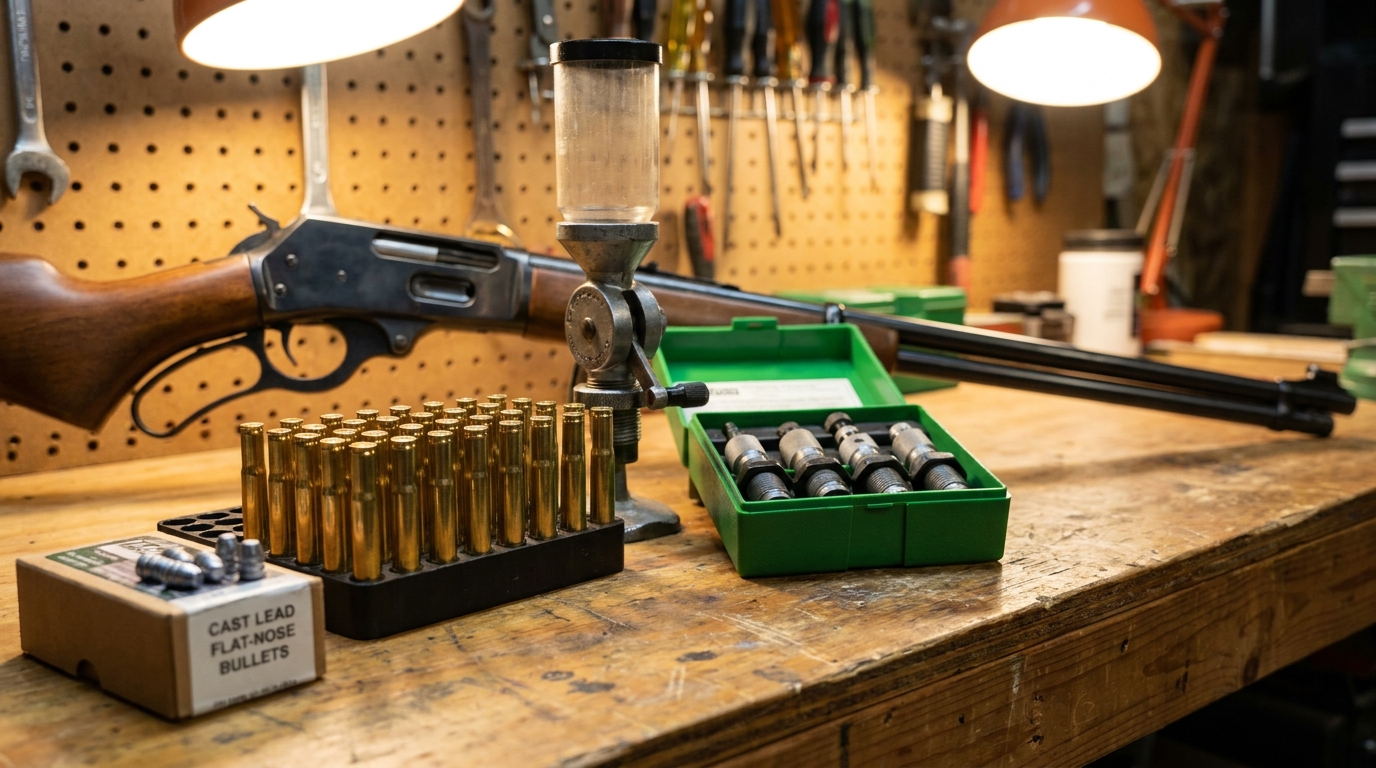
Before diving into load data, it's critical to understand the tubular magazine limitation. In a lever-action rifle — the Marlin 336, Winchester Model 94, Henry All-Weather — cartridges stack nose-to-primer in a tubular magazine. A pointed spitzer bullet in that stack can detonate the primer of the round in front of it under recoil. This is why the .30-30 has used flat-nose and round-nose bullets for most of its history.
The notable exception: Hornady LEVERevolution bullets use a flexible elastomer tip that compresses safely under recoil while still providing the ballistic advantage of a spitzer profile. If you're loading for a single-shot rifle (H&R Handi-Rifle, T/C Contender) or a Savage 340, you can use any bullet profile you like. For lever guns, stick to flat-nose, round-nose, or Hornady FTX bullets.
Brass Selection and Prep
The .30-30 is not a high-pressure cartridge (SAAMI max: 42,000 CUP), which means brass lasts a long time with proper care. Winchester and Remington headstamped brass are both excellent. Starline brass is the handloader's premium choice — consistent wall thickness and excellent annealing.
- Full-length resize each time — the .30-30 is a rimmed cartridge headspacing on the rim, but FL sizing ensures reliable feeding in lever guns with their aggressive extraction
- Trim to length: 2.029" (SAAMI max 2.039") — trim every 3-4 firings
- Primer pocket: Clean and uniform; the .30-30 uses a Large Rifle primer
- Debur and chamfer case mouths after trimming
Primers
The .30-30 is not a difficult primer. Standard Large Rifle primers work perfectly. Federal 210, CCI 200, Winchester WLR, and Remington 9½ all perform well. Magnum primers are unnecessary and can push pressures up in a cartridge that doesn't need it.
Bullet Selection
For Deer Hunting (Flat-Nose, Lever Guns)
- Hornady 150-grain FP (Flat Point): The classic choice — broad meplat for good energy transfer, proven terminal performance. Part #3035.
- Sierra 150-grain FN Pro-Hunter: Excellent accuracy and consistent expansion, a long-time favorite for handloaders
- Speer 170-grain FP: The heavier option for close-range timber hunting; hits harder at short range, drops more at distance
- Hornady 160-grain FTX (FleX Tip): The modern option for lever guns — use this if you want the ballistic advantage of a tipped bullet safely in a tubular magazine. BC of .330 vs. ~.210 for a flat-nose 150-grain.
For Single-Shot Rifles
- Hornady 150-grain SST or Sierra 150-grain GameKing SPBT: Spitzer bullets with real BCs; flatten the .30-30's trajectory significantly
Powder Selection
The .30-30 has a relatively small case capacity and works best with medium-burn-rate powders. The classic choices remain the best:
- IMR 3031: The all-time classic for .30-30 — measures well, meters through a powder measure cleanly, and gives excellent velocities. Start here.
- Hodgdon H335: Ball powder, meters very consistently. Slightly higher velocities than IMR 3031 in some load combinations.
- IMR 4895: Slightly slower than 3031, works well with 170-grain bullets
- Varget: Temperature-insensitive extruded powder; not the classic choice but gives excellent results, particularly with the 150-grain FTX
- Hodgdon H4895: Versatile and forgiving; good for all bullet weights
Proven Load Data
Always work up from starting loads. The data below is from published sources; verify against a current manual before loading.
150-Grain Flat Nose (Lever Gun)
- IMR 3031: Start 28.0 gr (1,975 fps) — Max 31.0 gr (2,200 fps)
- H335: Start 28.5 gr (2,000 fps) — Max 31.5 gr (2,220 fps)
- Varget: Start 29.0 gr (1,980 fps) — Max 32.0 gr (2,190 fps)
160-Grain FTX (Lever Gun — recommended)
- H4895: Start 29.0 gr (2,000 fps) — Max 32.0 gr (2,210 fps)
- IMR 3031: Start 27.5 gr (1,940 fps) — Max 30.5 gr (2,150 fps)
170-Grain Flat Nose (Heavy Timber Load)
- IMR 4895: Start 26.0 gr (1,800 fps) — Max 29.0 gr (2,000 fps)
- H335: Start 27.0 gr (1,850 fps) — Max 30.0 gr (2,050 fps)
Seating Depth and COL
The .30-30's cartridge overall length (COL) is constrained by the magazine length on lever guns. Standard COL for 150-grain flat-nose loads is 2.550". The 160-grain FTX has a published COL of 2.550" as well. Don't exceed the cartridge overall length that fits your magazine — measure with dummy rounds before committing to a seating die setting.
Cannelure is your friend here: most .30-30 bullets have a cannelure groove, and you should seat to that cannelure and apply a firm roll crimp. Lever-action feeding and recoil make a solid crimp non-negotiable.
Crimping: Don't Skip This Step
This is probably the single biggest mistake .30-30 handloaders make — failing to apply a proper roll crimp. The cartridge headspaces on the rim, so crimping doesn't affect headspace. Use a Lee Factory Crimp Die or the crimp function built into your seating die. A firm, consistent crimp prevents bullet setback under recoil in the magazine and maintains consistent powder ignition under the firing impulse of a lever-action.
Accuracy Expectations
A Marlin 336 or Winchester 94 with a quality load will typically group 1.5 to 2.5 inches at 100 yards from a rest — sometimes better with a rifle that likes a particular load. That's entirely adequate for any deer hunting inside 150 yards. The .30-30's practical effective range is 200 yards in capable hands; at that distance a 150-grain flat-nose at 2,200 fps has retained about 1,000 ft-lbs of energy and adequate expansion velocity.
If you're loading for a Savage 340 bolt gun or single-shot with spitzer bullets and a scope, sub-MOA groups are achievable with a good barrel and careful load development.
The Bottom Line
The .30-30 Winchester doesn't need to be anything other than what it is: a moderate-recoiling, timber-capable deer cartridge that's simple to handload, gentle on brass, and deeply satisfying to shoot from a wood-stocked lever gun. Load it right — flat-nose or FTX bullet, IMR 3031 or Varget, firm roll crimp — and it'll still be killing deer long after the latest cartridge fad has faded from the catalogs.