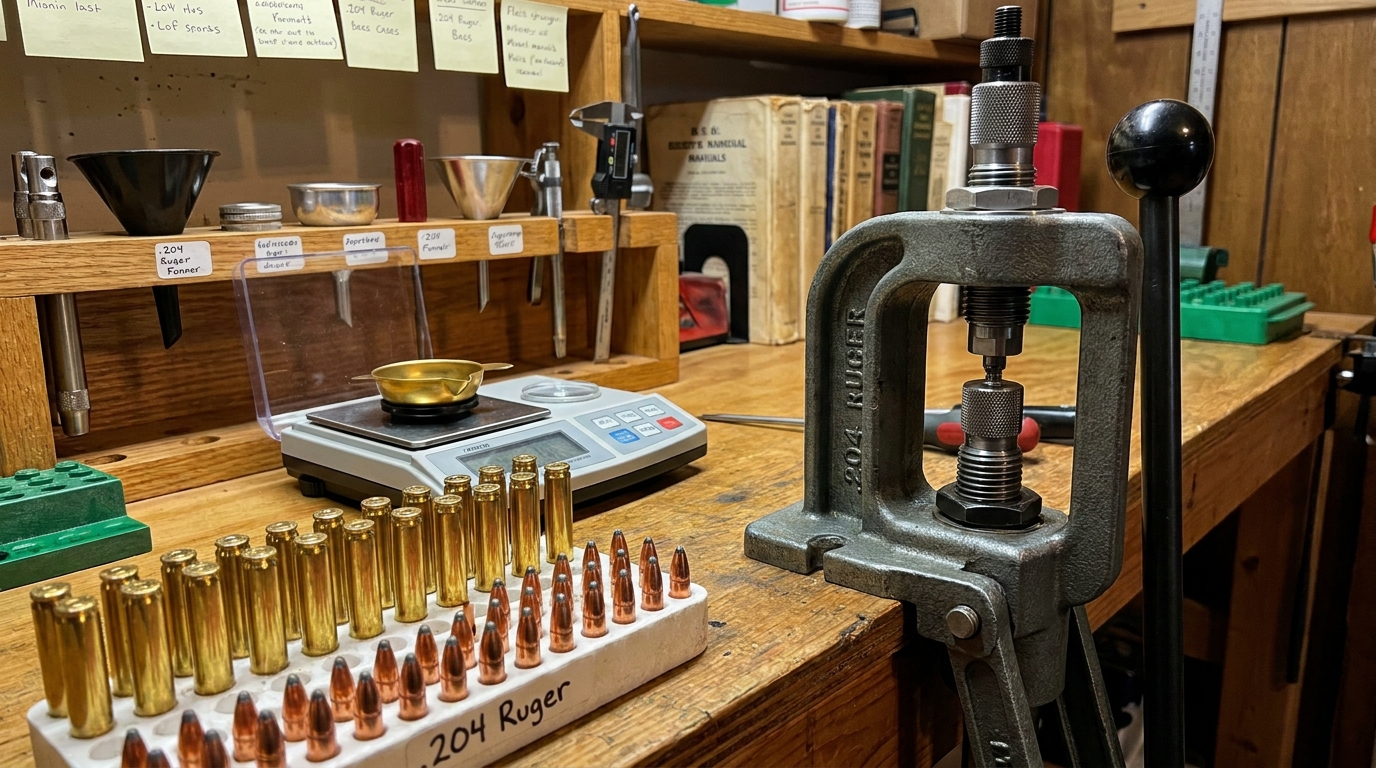
When the .204 Ruger arrived in 2004, it was the fastest commercially produced rifle cartridge ever introduced, pushing a 32-grain bullet past 4,225 fps from a factory rifle. Two decades later, it remains one of the most capable and underappreciated varmint rounds on the market. For Oregon high desert ground squirrel hunters who are also handloaders, the .204 Ruger is an absolute dream: fast, flat, accurate, and easy on brass.
Why Reload the .204 Ruger?
Factory .204 Ruger ammunition has improved significantly since the cartridge’s debut, but it still tends toward heavier bullets (32–40 grains) in standard loads. Handloading opens up the full bullet selection from 24 to 45 grains, lets you tune velocity to your specific barrel, and dramatically reduces cost when you’re burning 200+ rounds in a day of squirrel shooting across eastern Oregon’s rimrock country.
The case itself is derived from the .222 Remington Magnum and holds approximately 28.5 grains of water. It’s small, efficient, and extremely gentle on brass — you can expect 10+ firings from a well-cared-for case before seeing any primer pocket loosening.
Brass Selection and Prep
Hornady and Nosler both produce quality .204 Ruger brass. Hornady brass is more widely available and very uniform; Nosler brass is slightly heavier and more consistent at the primer pocket but commands a premium. For high-volume varmint shooting, Hornady is the practical choice.
Standard prep applies: full-length resize, trim to 1.845” (max is 1.850”), deburr case mouth, uniform primer pockets. The .204 runs at relatively high pressure (up to 62,000 PSI), so primer pockets tighten uniformly after a few firings — check them every 3–4 reloads for loose pockets that indicate the brass is getting tired.
Primer Selection
Small rifle primers only. The .204 Ruger is ignited reliably with standard small rifle primers from CCI, Remington, Federal, or Winchester. Use magnum small rifle primers only if you’re loading very cold temperatures or with slow-burning ball powders that require the extra ignition energy. For most .204 loads, standard primers (CCI 400, Federal 205, Remington 7.5) work perfectly and give more consistent results than magnums with the faster powders in this cartridge.
Powder Selection
The .204 Ruger operates in a sweet spot for several powders. The case volume, operating pressure, and optimal bullet weights point toward medium-fast powders in the burn rate range of H322 to Varget:
- Hodgdon H322: The gold standard for the .204 Ruger. Outstanding accuracy across bullet weights from 32–40 grains. Meters well through a powder measure. Start at 26.0 gr, max around 27.5 gr (32-gr bullet). Expect 3,900–4,000 fps with 32-gr bullets.
- Benchmark: Another top performer, particularly with 32–35 grain bullets. Slightly faster than H322, excellent lot-to-lot consistency. Many benchrest and varmint shooters prefer it for the tightest groups.
- Hodgdon CFE 223: Ball powder that meters exceptionally well and delivers high velocities. Slightly more temperature-sensitive than stick powders, but excellent for high-volume shooting where consistent powder throws matter more than tiny ES improvements.
- IMR 8208 XBR: Excellent choice for 40-grain bullets where you want slightly slower velocity with better BC projectiles. Temperature-stable and consistent.
- Varget: Works well in the .204 with heavier 40-grain loads. Not the top performer with lighter 32-grain bullets but a solid all-around choice if you already have a large supply.
Bullet Selection for Ground Squirrels
For eastern Oregon ground squirrel and prairie dog shooting, explosive-expanding bullets in the 32–35-grain range are the first choice:
- Hornady 32 gr V-MAX: The benchmark varmint bullet for this caliber. At 4,000+ fps, the polymer tip initiates explosive expansion on impact. Exceptional accuracy and virtually eliminates runners at distances to 400 yards.
- Berger 35 gr FB Varmint: Slightly heavier with a better BC (0.224 vs. 0.210 for the V-MAX). Fractionally less velocity but noticeably better performance at 350–500 yards in the wind.
- Nosler 35 gr Ballistic Tip: Accurate and consistent. A good choice if you find Hornady V-MAX bullets in short supply.
- Sierra 39 gr BlitzKing: For longer-range work, this heavier option with its excellent BC of 0.265 holds velocity and energy further downrange. Reduces the velocity advantage over lighter loads but delivers better wind drift numbers past 400 yards.
Load Development: A Proven Starting Point
The following is a proven starting point for the .204 Ruger with H322 and the Hornady 32-gr V-MAX. Always start 10% below published maximum and work up in 0.3-grain increments while watching for pressure signs:
- Brass: Hornady, once-fired, trimmed to 1.845”
- Primer: CCI 400
- Powder: H322, 26.5 gr (start) — 27.5 gr (max)
- Bullet: Hornady 32 gr V-MAX, seated to 2.235” COAL (0.020” off the lands as a starting point)
- Expected velocity: 4,000–4,100 fps (24” barrel)
Pressure signs to watch: flattened primers, ejector swipes on the case head, difficult bolt lift, or excessive case head expansion (.004”+ over new brass). The .204 Ruger is a high-pressure cartridge; respect the maximum loads in published data.
Putting It to Work in Oregon
Ground squirrel season in Oregon is essentially year-round on private land and open BLM with no closed season, though late May through July is peak action when juveniles emerge and squirrel populations are at their highest density. Eastern Oregon counties — Lake, Harney, Malheur, Crook, and Jefferson — offer the most concentrated shooting opportunities.
The .204 Ruger’s flat trajectory (−10” at 400 yards from a 200-yard zero with a 32-gr V-MAX) means minimal holdover at typical squirrel shooting distances of 50–350 yards. Combine that with a well-built handload running sub-MOA groups and you have a rifle that is genuinely capable at any range you’d reasonably attempt on a 14-inch-tall target. That’s what keeps the .204 Ruger quietly popular among serious Oregon varmint hunters who discovered it years ago and never looked back.