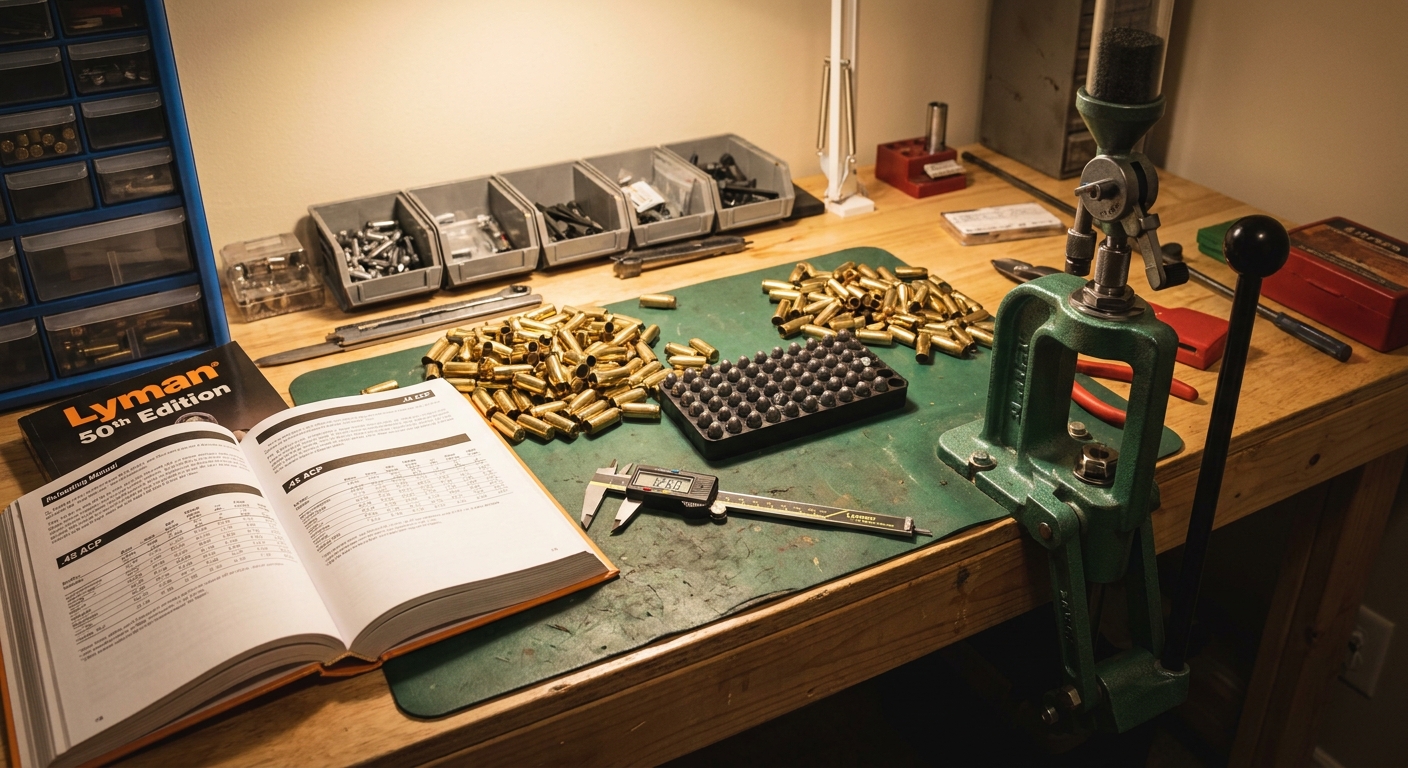
John Browning's century-old cartridge remains one of the most pleasant to reload in the entire handgun canon. The .45 ACP is large, low-pressure by handgun standards, and almost impossible to overwork your brass on. It's also a cartridge that rewards careful handloading — factory ammunition rarely unlocks everything a 1911 or a modern double-stack .45 is capable of. Whether you're shooting USPSA Major, running a carry pistol, or just trying to keep your range sessions affordable, handloading the .45 ACP is worth every minute.
Brass Selection and Prep
The .45 ACP produces very little brass stress. Cases last a long time — many reloaders get 10 or more loadings from quality brass before retirement. Stick with once-fired brass from a single headstamp when accuracy matters. Winchester, Federal, and Starline are the gold standards. Mixed headstamp brass is fine for practice loads.
Sizing and depriming is straightforward with any carbide die set — no case lube needed with carbide. Trim length is rarely a concern with pistol brass, but check for case bulge from unsupported chamber pistols like Glocks. A Lee FCD (Factory Crimp Die) or a Redding Profile Crimp Die corrects this reliably. Inspect primer pockets for uniformity and toss any cases with loose pockets.
Powders: What Works and Why
The .45 ACP operates at modest pressure (21,000 psi max) and does best with medium-burning pistol powders in the Hodgdon Clays / WST / Titegroup / Power Pistol range. Here are the proven performers:
- Hodgdon Clays: The competition reloader's first choice for light to standard loads. Extremely clean, very consistent, and meters beautifully. 4.6–5.2 gr under a 230 gr FMJ produces a soft, flat-shooting load ideal for USPSA and IDPA.
- Winchester WST (White Shooting Team): Low flash, very clean, excellent accuracy. A close competitor to Clays in performance and a bit easier to find. 4.8–5.5 gr range with 230 gr bullets.
- Hodgdon CFE Pistol: The copper-fouling eraser. Excellent performance across bullet weights, meters well, and keeps barrels cleaner longer. Great all-around choice.
- Alliant Power Pistol: When you need Major Power Factor (165,000+) for USPSA with heavier bullets, Power Pistol delivers reliable velocity. 7.0–8.2 gr under a 200 gr LSWC will make Major comfortably in most 5-inch guns.
- Hodgdon Universal: A versatile, widely available powder that works across a broad range of .45 ACP loads from 185 gr to 230 gr. Not the most accuracy-focused choice but solid for volume practice loads.
Bullet Selection by Application
Range and Competition
Cast lead roundnose or semi-wadcutter bullets from Missouri Bullet Company, Precision Bullets, or your own casting setup are the most economical choice. A 200 gr LSWC at 830–870 fps is the classic .45 ACP competition load — accurate, low-recoil, and easy on barrels. Plated bullets from Berry's or Rainier are a step up from bare lead for barrels that don't like exposed lead.
USPSA Major Power Factor
To make Major in USPSA (165 PF), you need bullet weight × velocity / 1000 ≥ 165. A 230 gr FMJ at 730 fps makes 167.9 — just over the line. A 200 gr at 835 fps makes 167.0. Most standard 230 gr loads come in at Minor, so load development for Major should include chrono verification. Work up carefully — many 1911s prefer 5.8–6.5 gr of Power Pistol under a 200 gr bullet for comfortable Major loads.
Self-Defense Loads
For defensive ammunition, most shooters are better served by quality factory hollow points (Federal HST, Speer Gold Dot, Hornady Critical Duty). If you do reload defensive loads, use jacketed hollow point bullets from Hornady, Sierra, or Speer, and verify reliable expansion at your chosen velocity. A 230 gr JHP at 830–860 fps from a 5-inch barrel is the standard defensive .45 ACP benchmark. Test for reliable feeding in your specific pistol — JHP geometry varies.
OAL, Crimping, and Feeding
The .45 ACP is a headspace-on-case-mouth cartridge, which means crimp is critical. You want a firm taper crimp that removes all flare from the case mouth — typically 0.469 to 0.471 inches at the crimp point. Too little crimp causes feeding problems; too much collapses the case mouth and can cause pressure spikes. A taper crimp, not a roll crimp, is correct for this headspace design.
Cartridge OAL depends on bullet profile. Start at 1.260 inches for most 230 gr FMJ roundnose bullets and adjust for your specific feed ramp. Check OAL by plunk-testing loaded rounds in your barrel — they should drop freely and spin without resistance. Short OAL on a flat-nose bullet can spike pressure unexpectedly.
Starter Load Data
- 230 gr FMJ / Hodgdon Clays / 5.0 gr / OAL 1.260" / ~820 fps / ~188 PF — Wait, that's wrong. 230 × 820 / 1000 = 188 PF — actually that makes Major easily. Let's correct: Clays under a 230 gr at 5.0 gr is ~780–800 fps, ~180 PF. Minor (125 PF) is easily made with any standard load.
- 230 gr FMJ / WST / 5.2 gr / OAL 1.260" / ~800 fps — Clean, soft, excellent for high-volume shooting
- 200 gr LSWC / Power Pistol / 7.8 gr / OAL 1.260" / ~875 fps — Reliable Major PF competition load
- 185 gr JHP / CFE Pistol / 7.5 gr / OAL 1.200" / ~1,000 fps — Higher velocity defensive-style load
Always start 10% below published max and work up. Verify with a calibrated chronograph. Load data is for reference only — consult current manufacturer reloading manuals.
Equipment Recommendations
The .45 ACP is a volume round — most reloaders loading it seriously run a progressive press. A Dillon 550, 650, or 750 is the gold standard. For smaller batches, a Lee Classic Turret or RCBS Pro Chucker works well. Use a carbide 4-die set (size/deprime, expand/bell, seat, crimp). A digital powder dispenser like the RCBS ChargeMaster or Lyman Gen6 improves consistency on critical loads. Always run a final plunk test on a representative sample from every loading session.
The Bottom Line
The .45 ACP is one of the most rewarding cartridges to handload. It's forgiving on components, gentle on brass, and capable of exceptional accuracy with minimal effort. Whether you're chasing Major PF trophies at a USPSA match or just trying to keep your 1911 fed through a long summer of range sessions, a well-developed .45 ACP handload delivers quality that factory ammunition rarely matches — at a fraction of the cost.