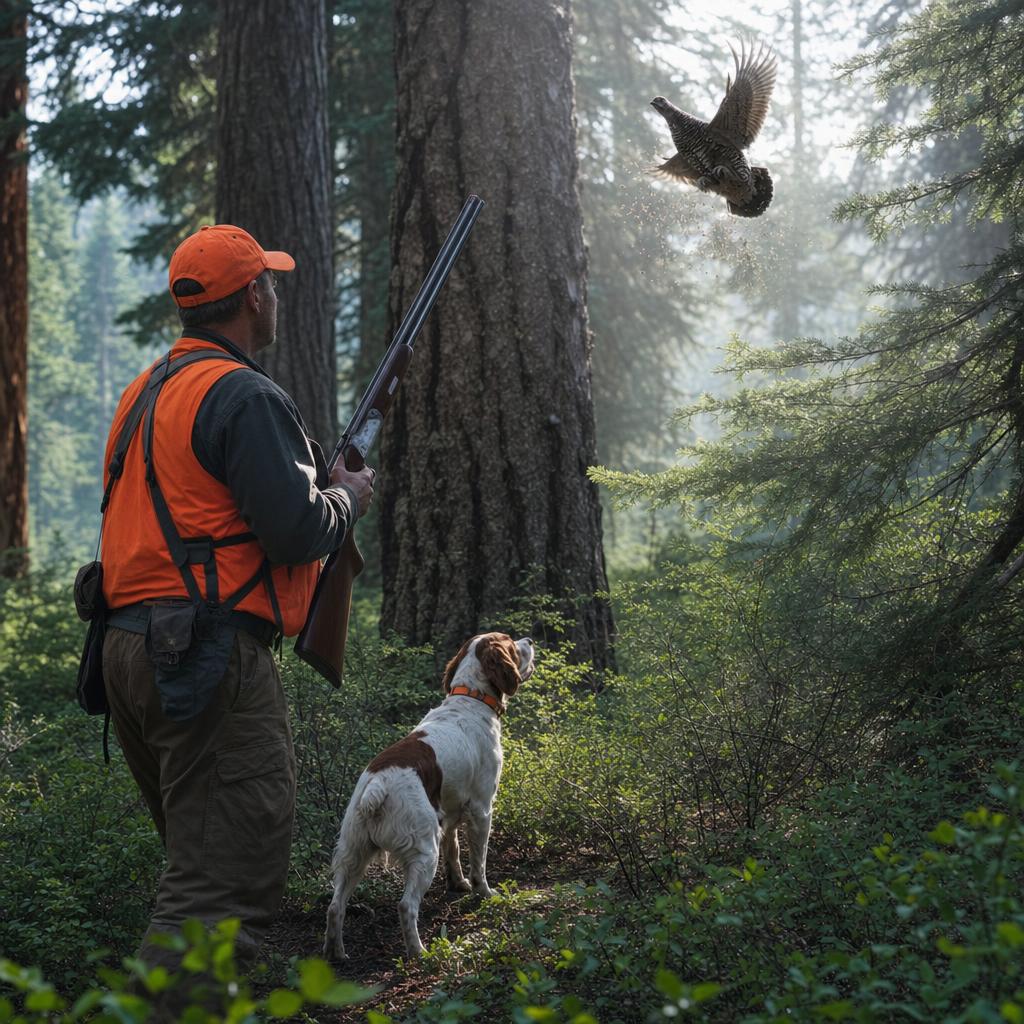
Ask most Oregon hunters about upland birds and they'll mention pheasants in the Willamette Valley or chukars in the canyon country east of the Cascades. Few mention sooty grouse — and that's exactly why you should be hunting them. Oregon's largest native grouse species lives in the Cascade and Coast Range mountains where most hunters never think to go in September, offering wide-open country, minimal competition, and birds that hold well for close flushes. If you've got a dog and a pair of boots that can handle steep timber country, sooty grouse are one of the best-kept secrets in Oregon upland hunting.
Know Your Bird: Sooty Grouse in Oregon
Sooty grouse (formerly called blue grouse, before the species was split) are large, dark forest grouse of the Pacific Coast mountains. Oregon males are slate-gray with a yellow-to-orange eye comb, a dark tail with a pale gray terminal band, and inflatable neck sacs used during spring courtship. Females are mottled brown for camouflage. Adult males can weigh over 3 pounds — considerably bigger than ruffed grouse — and their size makes them a worthwhile table bird.
Sooty grouse are notoriously calm birds that often refuse to flush from tree branches, earning the nickname "fool hens" from early Pacific Northwest settlers. That reputation is partly deserved — birds roosting in conifers can be almost impossibly unflappable — but birds on the ground in huckleberry and understory cover behave much more like typical upland grouse, flushing wild when pressured and flying hard through timber.
Where to Find Sooty Grouse in Oregon
The Cascades: Prime September Habitat
Sooty grouse summer at high elevations — often above 5,000 feet — near subalpine meadows, huckleberry fields, and open conifer stands dominated by mountain hemlock, silver fir, and lodgepole pine. In September, birds begin moving downslope as temperatures drop, transitioning from high meadow edges to mid-elevation mixed forest with heavy understory cover.
Focus your September effort on the transition zones between open meadows and dense timber, huckleberry patches on south-facing slopes where berries are ripening, and edges along old logging roads through mature stands. The Mount Hood National Forest, Willamette National Forest, and the Cascades unit of the Deschutes National Forest all hold excellent sooty grouse populations. Specific areas worth scouting include the Salmon-Huckleberry Wilderness southwest of Government Camp, the Ollalie Lake Scenic Area, and forest roads branching off Highway 58 east of Oakridge.
Coast Range Populations
The Oregon Coast Range hosts a separate population of sooty grouse that receives even less hunting pressure than the Cascade birds. These birds occupy mature Douglas fir and Sitka spruce forests from the Columbia River south to the California border. Look for them on steep ridgelines with brushy clearcut edges, south-facing slopes with scattered firs and heavy salal undergrowth, and old-growth pockets within the Siuslaw National Forest. Access can be challenging — many productive areas require hiking old skid roads — but the reward is birds that have rarely seen a hunter.
Hunting Tactics
Walk-Up Hunting with Dogs
Flushing dogs — Labs, spaniels, and Brittany spaniels — are excellent for sooty grouse in timber country. Dogs work close enough in dense cover to push birds into the air rather than letting them run ahead, and their enthusiasm for scenting and flushing birds keeps hunters from walking past birds holding tight in huckleberry clumps. Keep your dog hunting within 25 yards in heavy timber — a dog ranging 50 yards ahead in firs can flush birds outside shotgun range.
Pointing breeds also work well, particularly in more open subalpine habitat where you can see your dog lock up and have time to move in for a controlled flush. English setters and vizslas with solid timber experience can be devastating on grouse that hold tight in the first weeks of the season.
Still Hunting Without a Dog
Don't let a lack of a dog stop you. Sooty grouse are audible birds — listen for their low, resonant hooting (males) in morning hours, or the rustle and cluck of feeding birds in brush. Move slowly along ridgelines, pausing frequently to scan branches above and undergrowth ahead. When you spot a bird on a branch looking at you with calm curiosity, move laterally to force a flush rather than walking directly underneath, which typically results in the bird simply hopping higher in the tree.
Working Huckleberry Fields
September huckleberry patches are grouse magnets. Birds concentrate in ripe berry patches just like elk concentrate in forage areas — work the edges and interiors of huckleberry fields methodically, particularly in the morning when birds are actively feeding. Step slowly and pause often. Sooty grouse feeding in berry patches will sometimes flush at 20 feet and sometimes let you walk to within 10 feet before exploding into the trees.
Shot Selection and Shotgun Setup
Sooty grouse in timber call for close-range shot selection and open chokes. Most shots in dense fir forest come at 15 to 30 yards — often at birds launching upward through branches. An improved cylinder or skeet choke in 12 or 20 gauge throws the wide pattern needed to connect on birds twisting through timber.
- Gauge: 12 or 20 gauge are ideal; 16 gauge works beautifully if you shoot one
- Choke: Improved Cylinder or Skeet — tight chokes are counterproductive in heavy timber
- Load: 7½ or 8 shot in 1 or 1⅛ oz loads for birds under 30 yards
- Shot size up: 6 shot if hunting open subalpine edges with longer shots possible
- Gun weight: A lighter gun (6–6.5 lbs) is welcome on steep Cascade terrain
Oregon Season Dates and Regulations
Oregon's 2026 sooty grouse season runs from September 1 through December 31, offering one of the longest upland seasons in the state. The daily bag limit is 5 birds, with a possession limit of 10. There is no closed zone for sooty grouse on most national forest land in Oregon — check ODFW's annual upland bird regulations for any unit-specific rules or closures in the area you plan to hunt.
A current Oregon hunting license is required. If you're hunting on Cascade national forest land, no additional tags or permits are needed beyond your license. Some wilderness areas within the Cascades prohibit motorized vehicles but are open to hunting — plan your access accordingly.
Field to Table: Sooty Grouse on the Plate
Sooty grouse eat primarily conifer needles in winter, which gives the meat a mild piney flavor that some hunters love and some find off-putting. September birds feeding on huckleberries, insects, and seeds are excellent table fare — dark, rich breast meat that holds up beautifully to cast-iron cooking. Keep birds cool after the harvest; gut them in the field and pack them out in a game bag hung in shade or placed in a cooler as soon as you reach the trailhead.
Simply seared sooty grouse breast in butter with garlic and thyme is a backcountry classic. The legs and thighs braise well with rosemary, root vegetables, and a splash of Oregon Pinot Noir. These birds deserve a better reputation at the table than their "fool hen" nickname implies.
Get Up into the Timber
Oregon's sooty grouse population is healthy, underutilized, and waiting in some of the most beautiful mountain country in the Pacific Northwest. The pressure is virtually nothing compared to pheasant fields or coastal waterfowl blinds, and the setting — old-growth timber, huckleberry ridges, mountain air — makes for a memorable hunt regardless of bag count. Load a 20 gauge, lace up your boots, and go find the birds that everyone else is ignoring.


