Southeast Oregon's Steens Mountain doesn't look like mule deer country at first glance—or rather, it looks like too much of it. The mountain rises over a mile above the Alvord Desert floor, a fault-block colossus of sagebrush, rimrock, aspen groves, and alpine meadow that stretches 30 miles north to south. Figuring out where to start is the challenge. Finding a shooter buck in velvet before the August archery opener—that's the reward.
The Unit at a Glance
ODFW's Steens Mountain unit covers the mountain itself and the surrounding BLM high desert. Over-the-counter archery tags are available for this unit, meaning you don't need to draw a limited-entry tag to hunt here—a significant advantage in a state where most quality mule deer hunting now requires years of preference points. What you give up in exclusivity you more than make up for in public land access: the Steens Mountain Cooperative Management Area and surrounding BLM lands offer hundreds of square miles of huntable terrain with minimal pressure during the August-through-September archery window.
Where the Bucks Are in Summer
By late July, the big bucks on Steens have pushed to high elevation. Look for them in three primary areas:
- The Kiger Gorge Rim: One of the mountain's four major gorges, the Kiger Gorge rim between 7,500 and 9,000 feet holds bachelor groups of bucks during summer. Glass the aspen stringers and rocky outcrops on north-facing slopes during the morning hours.
- Wildhorse Lake Basin: The high alpine basin at the head of Wildhorse Gorge concentrates deer near water in late July. Bucks feeding in meadows around the lake during low light are visible from the rim above.
- The East Rim: The sheer east face of the Steens drops dramatically toward the Alvord Desert. Bucks use this terrain for thermals and escape routes. Glass from the road system early morning before heat builds over the desert floor.
Glassing Strategy for the High Desert
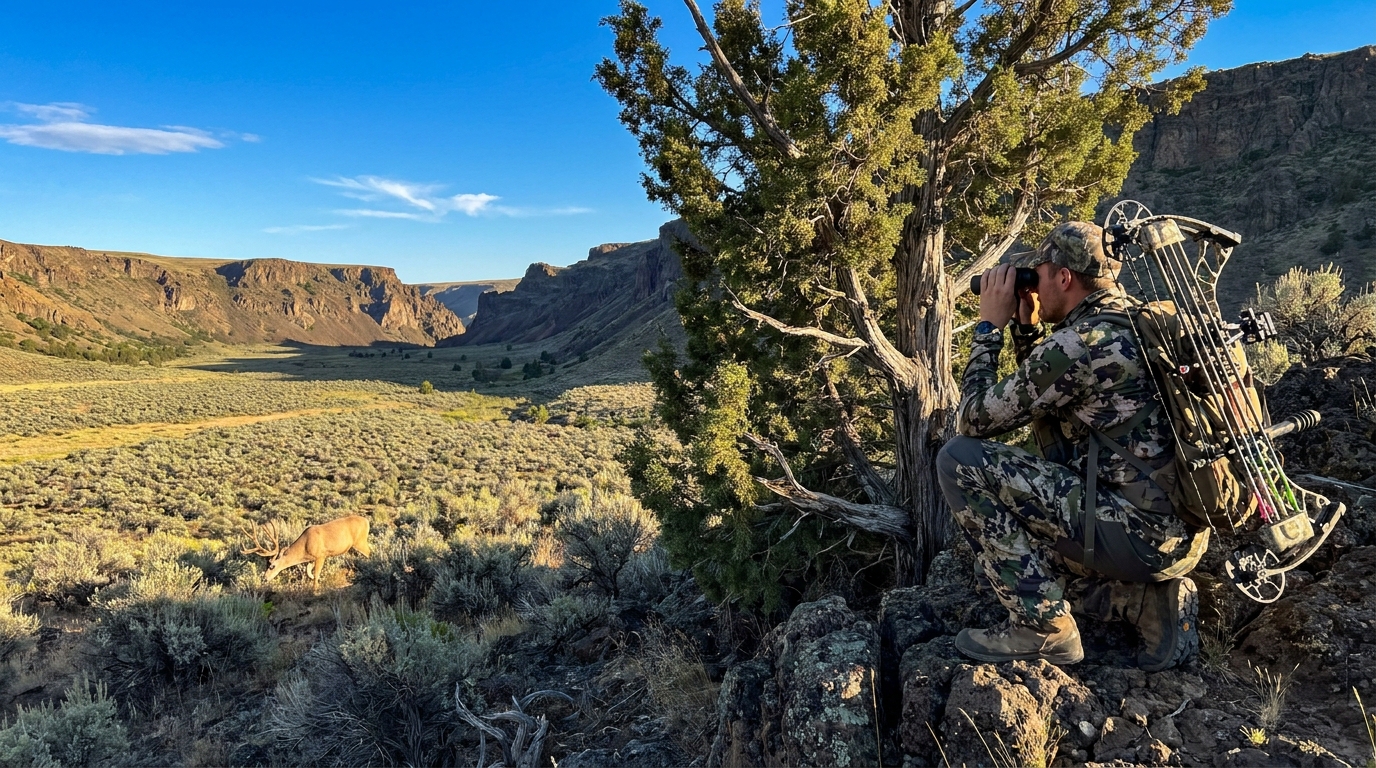
Effective scouting on the Steens is almost entirely optical. You're hunting an open landscape where covering ground on foot burns time and bumps deer. The approach that works:
- Set up before first light at a high vantage point with a quality 10x42 or 12x50 binocular and a spotting scope on a stable tripod
- Grid the terrain methodically—work your glass slowly from near to far, focusing on shade lines, water sources, and terrain transitions
- Mark every buck, then prioritize based on size and accessibility before committing to a stalk
- Let thermals dictate your stalk timing: morning thermals pull uphill on the west face; plan approach routes accordingly
OnX Hunt's Oregon layer shows the BLM/private boundary clearly—the Steens Loop Road corridor has private inholdings you'll need to navigate around. Download offline maps before you leave cell range, which happens fast once you're east of Fields.
Archery Gear Considerations
Shot distances on spot-and-stalk mule deer can vary wildly. Expect anything from 20 yards in a brushy creek bottom to a 60-yard shot across a sage flat you misread on the approach. Set your bow up for confident shooting to 60 yards, period. If you can't make that shot in practice with a broadhead-tipped hunting arrow, don't take it in the field.
- Use a quality rangefinder on every animal before committing to a final approach
- High-desert thermals shift unpredictably—carry a wind indicator and check it constantly during your stalk
- September mornings at 8,500 feet are cold. Pack layers regardless of the forecast
- Mechanical broadheads work well in this environment where shots are often in the open; fixed blades give added confidence on marginal shots through heavy sage
Logistics and Access
The Steens Loop Road (Oregon Route 205 to the Frenchglen turnoff) provides the primary access. Frenchglen is the nearest services—fuel, a historic hotel, and not much else. Stock up in Burns before heading south. Cell service disappears south of Burns on 205 and doesn't return until you're back in that corridor.
Camping is available at Page Springs, Fish Lake, Jackman Park, and South Steens campgrounds (all BLM, fee or free depending on site). Page Springs, just outside Frenchglen near the Donner und Blitzen River, is the most popular and fills on weekends. For hunting camp, the high-elevation sites at Fish Lake and Jackman Park put you closer to the deer and away from the tourist traffic.
Meat Care in High Desert Heat
This is non-negotiable: a deer on the ground at midday in southeast Oregon in August is a meat-care emergency. Bring a quality kill kit—sharp knives, game bags rated for real airflow (not cheap mesh), and a cooler with pre-frozen block ice waiting in your vehicle. Quarter the animal, get it into bags, and get it into the shade immediately. If temps are above 75°F, plan your hunts for the early morning window only and be back at the trailhead before heat builds.
The Steens tests you. The elevation will get your lungs. The terrain will get your knees. The heat will get your food if you're not prepared. Come ready and this mountain gives up some of the most memorable archery mule deer hunting in Oregon.