Oregon's Grizzly Unit doesn't attract the name recognition of units like Silvies, Ochoco, or Chesnimnus — and that relative anonymity is exactly what makes it worth hunting. Sitting in the northern reaches of Grant County, the Grizzly Unit covers a rugged mix of Malheur and Umatilla National Forest timberlands, high-elevation ridges, and the broken canyon country draining toward the North Fork John Day River. For a bowhunter willing to put in the scouting miles, it offers legitimate opportunity at mature mule deer bucks on mostly public ground.
Know the Unit
The Grizzly Unit runs roughly from the community of Granite north to the Umatilla National Forest boundary, bounded to the east by the Greenhorn Mountains and to the west by the John Day drainage. Elevations range from around 3,500 feet in the canyon bottoms to over 7,000 feet on the high ridgelines. This topographic diversity is a major asset — it means deer use the full vertical range throughout summer and fall, giving hunters who understand elevation patterns a real edge.
Archery deer season in the Grizzly Unit typically opens in mid-August, the same date as most Oregon archery deer units. Tags are general issue — no draw required — meaning you can hunt with a valid archery deer license and Oregon hunting license. Check current ODFW regulations for season-specific dates and any antler restrictions that may apply to the unit in a given year.
Where the Deer Are in Late July and August
Right now — late July through early August — bucks in the Grizzly Unit are in late velvet. They're concentrated at higher elevations, feeding heavily to fuel antler growth, and they're relatively predictable. This is the best time to scout and the best time to hunt if your tag is already in hand.
Focus your glassing on these terrain features:
- High-elevation clearcuts and burns: Two- to fifteen-year-old burns in the Malheur National Forest hold exceptional deer populations in summer. The combination of forb-rich regeneration and proximity to timber bedding cover is irresistible to mature bucks. Look for south-facing burns that warm up early and hold moisture longer.
- Ridgeline saddles and benches: Big mule deer bucks prefer terrain that gives them sight lines in multiple directions. Flat benches just below ridgelines — especially those with a mix of brush and scattered timber — are classic summer buck habitat.
- Seeps and springs: The Grizzly Unit's higher country has numerous small springs and seasonal seeps that concentrate deer during dry late-summer conditions. Locate these on USFS topo maps, then glass the surrounding terrain at first and last light.
- North-facing timber: During the heat of the day, mature bucks push deep into north-facing larch and fir timber. Focus your midday hours on identifying bedding draws and setting up for evening ambushes on feeding areas below.
Access and Road Network
Forest Road 10 (the Granite-Bates Road) serves as the primary spine through the southern portion of the unit. Numerous spur roads branch off into the Malheur National Forest, providing access to the high country with a high-clearance vehicle. MVUM (Motor Vehicle Use Map) compliance is critical — the Forest Service actively enforces road closures in this area to protect elk and deer habitat.
Download the Malheur National Forest MVUM and layer it on OnX Hunt before your scouting trip. Many of the most productive areas require a 1- to 3-mile hike from the nearest legal trailhead, which is actually a feature — it separates you from rifle hunters who will crowd the road-accessible country when their season opens in late October.
The town of Granite (population modest, but it has fuel seasonally) is your last resupply point heading into the high country. John Day, 35 miles south on Highway 395, has everything else — motels, restaurants, a full sporting goods store, and the Grant County ODFW office.
Archery Tactics for Grizzly Unit Bucks
Spot and Stalk
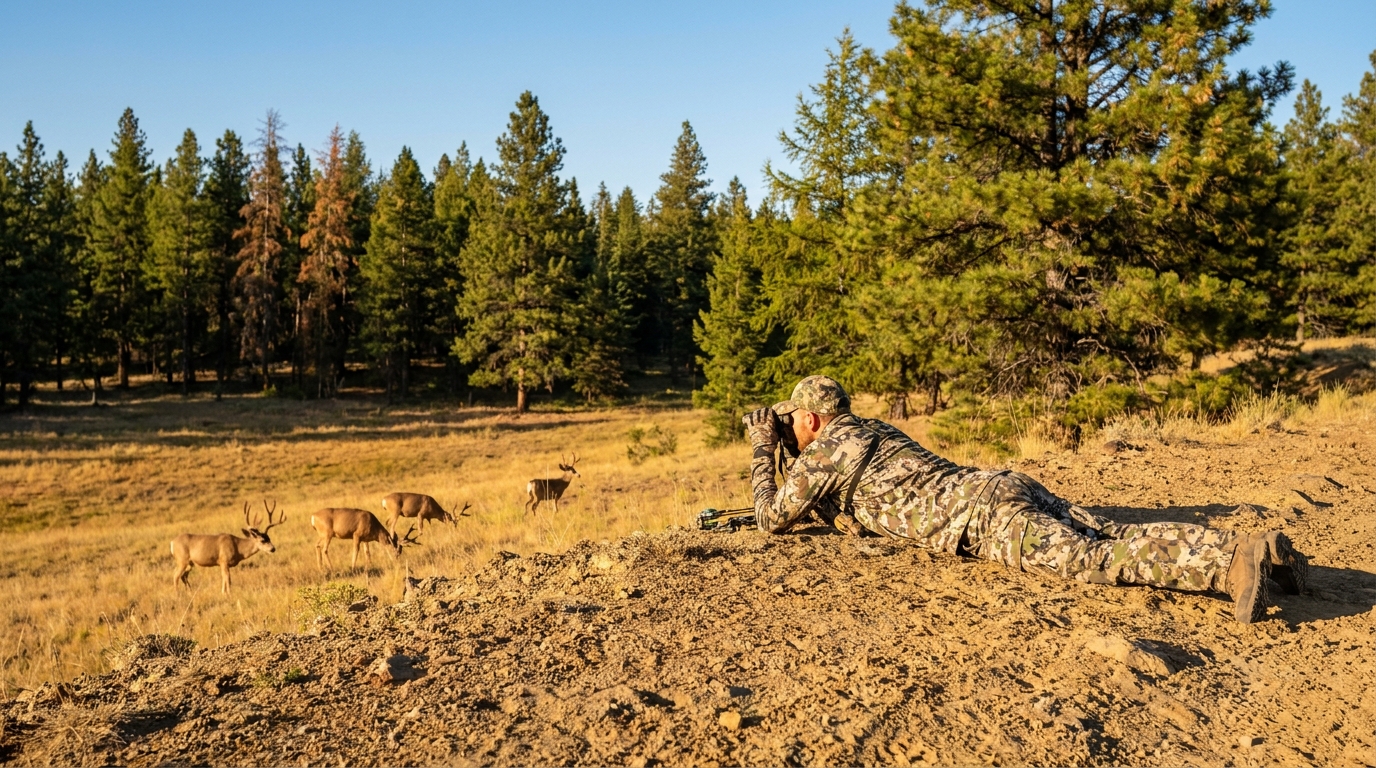
This is the primary technique for summer and early-season archery mule deer in open country. Get to high glassing points before first light with a quality spotting scope and systematic glass the feeding areas below. When you find a mature buck, study his routine. Mule deer are creatures of habit — a buck feeding a particular meadow edge at dawn will often return to the same spot for days or weeks if undisturbed. Plan your stalk for the next morning, using wind, terrain, and first light to your advantage.
Keep stalks to 200 yards or less before committing to a final approach. The last 60 yards — inside bow range — require absolute wind control and patience. Use available terrain: rock outcroppings, drainages, and brush to break your silhouette. Move only when the deer's head is down.
Waterhole Ambush
In dry late-August conditions, setting up a ground blind or natural ambush at a reliable spring or seep can produce consistent daylight encounters. Hang a trail camera first to confirm deer are using the water and determine timing. Set up with prevailing thermals in mind — typically downslope in the morning and upslope in the afternoon. Keep the approach path scent-free by wearing rubber boots and storing your clothing in a sealed bag with natural vegetation.
Realistic Expectations
The Grizzly Unit is not a trophy factory. Most bucks harvested are 2x2 to 3x3 class animals, with the occasional 4-point (western count) showing up for hunters who put in real scouting time. If you're after a 200-inch deer, look elsewhere. If you want a legitimate DIY archery mule deer hunt on public land with real solitude and hard-earned rewards, the Grizzly Unit delivers. Pack your patience, your binoculars, and a tag — and start glassing before the season opens.