Oregon's fall wild turkey season is one of the most underutilized hunting opportunities in the state. While spring turkey hunting gets most of the attention — and most of the social media posts — the fall season offers a genuinely different and rewarding challenge, with abundant birds, uncrowded woods, and shooting seasons that overlap nicely with archery deer and elk. If you haven't tried chasing fall turkeys in the Willamette Valley foothills or the western Cascade foothills, this is your year.
Oregon Fall Turkey Season Basics
Oregon's fall turkey season typically runs from mid-October through mid-November in most western zones, with general season and archery-only options available. Tags are sold over the counter for most zones — no draw required — making fall turkey one of the most accessible hunting opportunities in the state. Check myodfw.com for current season dates and zone-specific regulations before you purchase a tag.
Both Rio Grande and Merriam's turkeys inhabit Oregon, with Rios dominating the Willamette Valley and the western Cascades and Merriam's more common in eastern Oregon. For most western Oregon hunters, the Rio Grande birds in the oak-fir foothills of the Willamette Valley, the Coast Range transition zone, and the Cascade foothills between Eugene and Salem are the primary target.
Where to Hunt — Best Western Oregon Zones
Willamette Valley Foothills
The private-land oak woodlands and grass pastures of the Willamette Valley foothills hold some of the densest Rio Grande turkey populations in the Pacific Northwest. Birds roost in big Oregon white oaks and Douglas-fir edge timber, then work down into pastures and agricultural fields to feed. Linn County, Polk County, and Yamhill County farmland edges are classics — if you can get permission from a landowner, you'll find birds.
Public land access in this zone is tighter, but BLM lands in the Eola Hills and the Chehalem Mountains WMA provide huntable populations. The Willamette Mission State Park area is worth scouting too — the oak groves hold birds, and the nearby WMA has huntable sections.
Cascade Foothills — Eugene to Salem
The foothills east of Corvallis and Albany, including the BLM's Soap Creek Valley units and the Marys Peak Road corridor in Benton County, hold solid fall turkey numbers. Here, birds move between oaks on south-facing slopes and conifer draws during the day. Look for fresh scratching in the leaf litter under oaks — fall turkeys spend much of their day excavating acorns, and fresh sign in October is a reliable indicator of a hot area.
Southern Willamette Valley — Lane and Douglas Counties
The oak woodlands and hill country south of Eugene toward the Roseburg area and the Umpqua Valley carry excellent bird densities. Private timber company lands (Weyerhaeuser, Lone Rock Timber) often have public-access programs — check their websites for gate codes and rules. The BLM's Cottage Grove and Roseburg districts have huntable public parcels as well.
Fall vs. Spring: How Turkey Hunting Changes
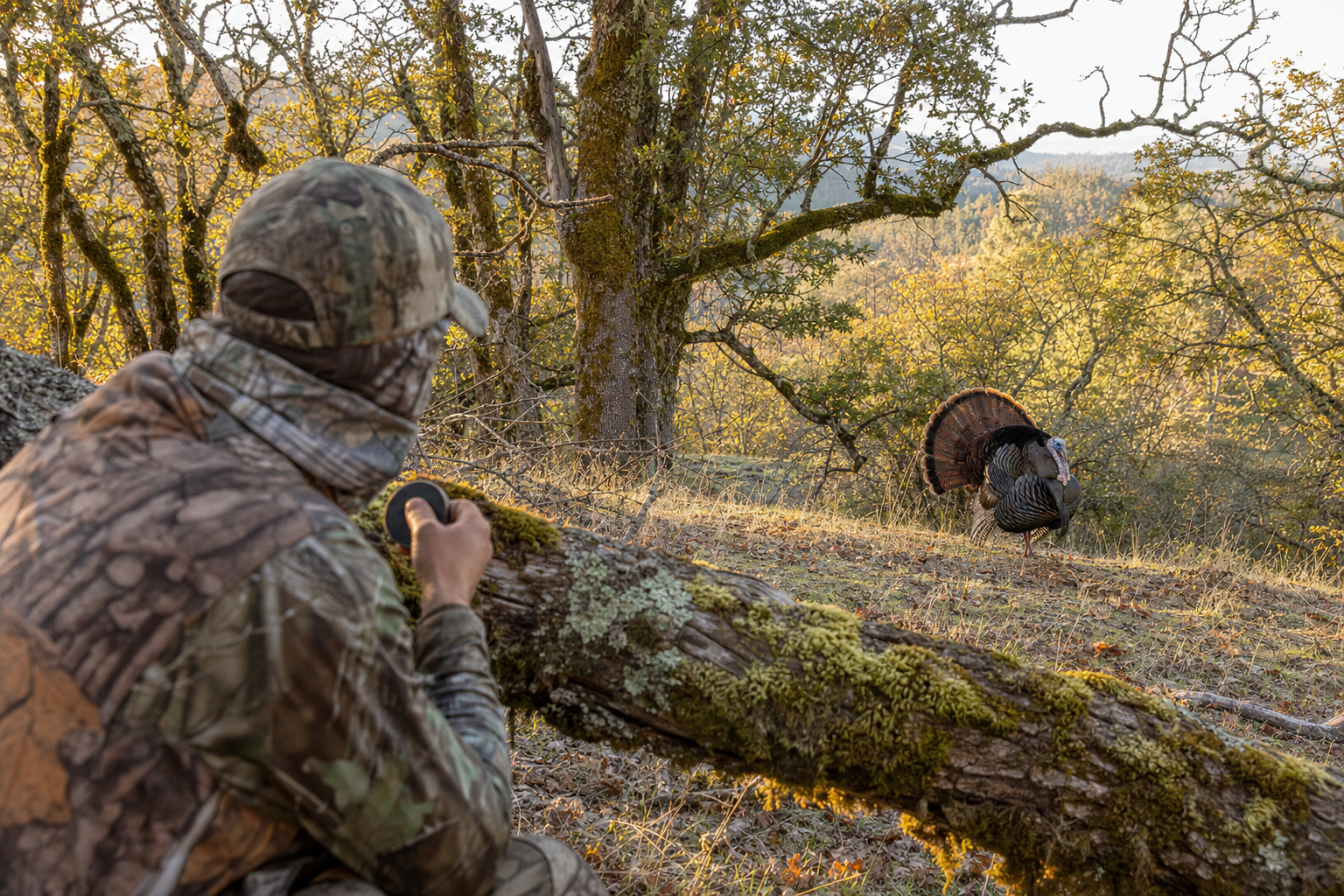
Fall turkey hunting is fundamentally different from spring. In spring, toms are actively gobbling and henning-up, making calls easy to pattern. In fall, the flock structure changes — adult toms often group in bachelor flocks separate from hens and juvenile birds. The vocalization is subtler, and the classic spring setup of using a locator call and setting up on a gobbling tom doesn't reliably work in October.
The most effective fall strategy is the flock bust:
- Locate a flock feeding or moving through the woods by visual scouting or listening for clucking, purring, and scratching sounds
- Move in aggressively and scatter the flock in all directions
- Set up immediately on the bust site and begin calling with soft yelps, clucks, and assembly calls
- Wait — birds will begin filtering back to the bust site trying to regroup, often within 20 to 40 minutes
Juvenile birds — jakes and jennies — regroup faster and more predictably than adult toms. Adult toms may take an hour or more to return, and sometimes they won't come back at all on the same day. Be patient. A flock bust in a good oak hollow on a quiet fall morning is some of the most exciting turkey hunting you'll ever do.
Calls for Fall Turkeys
Fall birds respond to a different vocabulary than spring birds. The key sounds to master are:
- Kee-kee run: The distress call of a young-of-year turkey that's been separated from the flock — a series of high-pitched whistles descending into a yelp. This is the most effective fall call after a bust.
- Assembly yelp: The call a hen uses to reassemble scattered flock members — a series of 5 to 10 yelps at moderate cadence. Works on both hens and juvenile birds.
- Tom yelp: Adult toms have a deeper, coarser yelp than hens. If you're targeting a bachelor flock of toms, deep raspy yelps on a box call or slate can bring them back.
Slate pot calls and box calls are both effective. Diaphragm (mouth) calls leave your hands free when a bird is close, which matters for bowhunters especially.
Gear and Shot Setup
Fall turkey hunting is often close-range work in timber and brush. Here's what to carry:
- Shotgun: 12 or 20 gauge with a tight turkey choke, loaded with 3-inch No. 5 or No. 6 shot (TSS tungsten loads are devastating and allow lighter guns). Most shots will be inside 30 yards in fall timber.
- Bow: Standard archery tackle works well for fall turkeys — shot distances after a bust tend to be short and the woods give you cover to draw. A ground blind set on a known roost-to-feed trail eliminates most of the movement problem.
- Camouflage: Head-to-toe camo is non-negotiable — turkeys have exceptional color vision. Mossy oak or Realtree patterns in autumn oak tones work well for western Oregon foothills.
- Vest: A turkey vest with a fold-out seat, call pockets, and a rear pouch for a decoy keeps you organized and mobile for the bust-and-setup style of hunting.
Scouting Tips for Fall Birds
The best scouting for fall turkeys happens in September and early October. Hit the oak ridges at first light and listen — turkeys are vocal as they fly down from roost, and a flock of 15 birds working through dry oak leaves sounds like a small army. Look for:
- Fresh scratching in leaf litter under white oaks (tells you birds are actively feeding acorns in that area)
- Dusting bowls in dry dirt or sandy soil on south-facing slopes
- Feathers and droppings near roost trees (large Douglas-firs and oaks)
- Tracks in soft ground along creek drainages or logging road puddles
The Bottom Line
Oregon fall wild turkey hunting is a sleeper season — over-the-counter tags, birds that haven't been called to all spring, and some of the most beautiful October oak country in the Pacific Northwest. If you can locate a flock, scatter them well, and set up with patience and a good kee-kee call in your arsenal, a fat fall tom or a pair of jakes will be well within reach. Don't sleep on this season — it's one of Oregon's best-kept hunting secrets.