There is something deeply satisfying about pulling a fat razor clam from the wet sand and dropping it in your bag. Clamming on the Oregon coast is one of those quintessential Pacific Northwest traditions that does not require much gear, costs almost nothing beyond a license, and pays off with a bucket of some of the best seafood you will ever eat. Whether you are digging razor clams on the wind-scoured beaches near Seaside or pulling gaper clams from the mudflats of Tillamook Bay, this guide covers what you need to know to do it right.
Know Your Oregon Clam Species
Oregon offers two distinct clamming experiences: ocean beach species and bay and estuary species, each requiring different techniques and gear.
Razor Clams
The Pacific razor clam (Siliqua patula) is the prize of the Oregon surf beaches. Found in the wet sand of Clatsop County beaches near Seaside, Gearhart, and Del Rey Beach, razor clams are fast, powerful diggers. They live within 20 feet of the surf line in the top 6 to 12 inches of sand, though a big one can go deeper. The daily bag limit is 15 razor clams per person, and all clams retained must be counted regardless of size or condition.
Bay Clams
Oregon bays hold several species worth pursuing:
- Gaper clams (Tresus capax): Large and meaty, can reach softball size. Found buried 12 to 18 inches deep in bay mud. Look for the distinctive siphon holes that squirt water when disturbed.
- Cockles (Clinocardium nuttallii): Shallower at 2 to 4 inches deep, excellent for chowder.
- Littleneck clams (Leukoma staminea): Found in gravel-sand substrate near the low-tide line. Outstanding for steaming.
- Butter clams (Saxidomus gigantea): Dense and firm, common in Coos Bay and Tillamook Bay.
For bay clam species combined, Oregon regulations generally allow 36 bay clams per day. Always verify ODFW regulations before you go since biotoxin closures can be called on short notice and carry real health risks.
The Best Clamming Spots on the Oregon Coast
Seaside and Gearhart Beaches
The most consistent razor clamming happens on the broad, flat beaches of Clatsop County. Access is easy and parking is plentiful. Walk south from the Seaside turnaround toward the inlet on a big minus tide for excellent digging numbers.
Tillamook Bay
A destination for gaper, cockle, and butter clams. The area around Bay City and Garibaldi exposes productive mudflats on strong minus tides. Access on foot at low water or by kayak for the deeper flats.
Yaquina Bay (Newport)
The tideflats on the south side of Yaquina Bay near South Beach expose at minus tides, providing access to littleneck and cockle clams in gravel substrate. One of the most accessible mid-coast options with reliable production.
Coos Bay and South Slough
The largest estuary on the Oregon coast holds big populations of gaper and butter clams. The South Slough National Estuarine Reserve offers public-access tideflats. Check closure notices before each trip as Coos Bay sees periodic water quality advisories.
Tides: The Non-Negotiable Variable
You need a minus tide to dig productively. Anything below 0.0 feet on the NOAA tide chart exposes good clamming ground. A -1.5 foot tide is solid; -2.0 or lower is excellent. Your window typically runs from two hours before to two hours after the low, with peak digging centered on the predicted low.
Use the NOAA Tides app or pull the chart for your nearest station (Seaside, Newport, or Charleston). Arrive 30 to 60 minutes before the low so you are set up and digging as conditions peak, not still walking out to the beach.
Gear and Technique
Razor Clam Digging
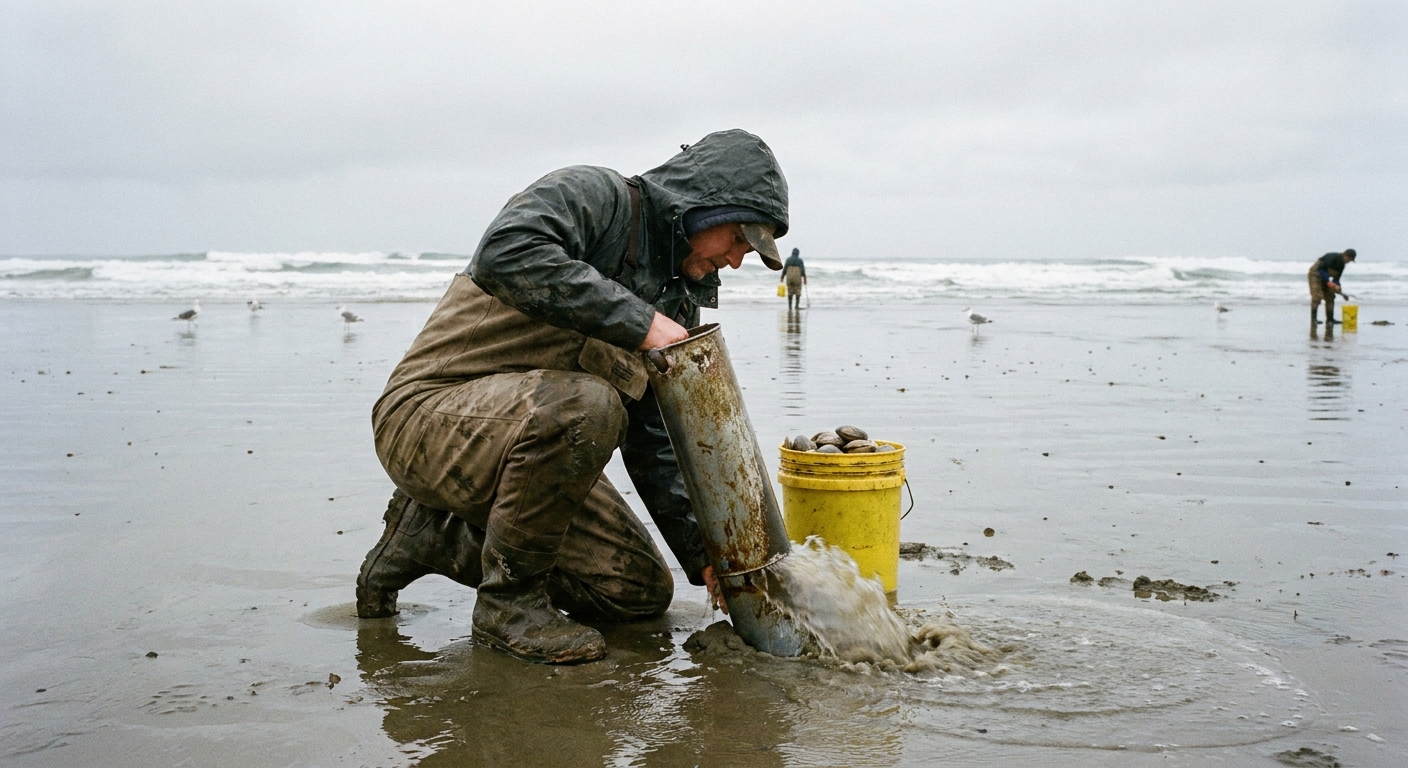
The standard tool is the clamming gun (also called a clam tube): a PVC or aluminum cylinder about four inches in diameter. When you spot a show, the small dimple or keyhole-shaped depression indicating a buried clam, place the tube over it, push down with a twisting motion, cover the air hole, and pull straight up. Suction lifts a core of sand containing the clam.
Some diggers prefer a short curved clam shovel. The shovel is faster when clams are shallow but risks cutting the shell. A firm Oregon rule: retain every razor clam you touch, regardless of condition. Do not cut one and throw it back.
Bay Clam Digging
A garden fork or wide-tined clamming fork works well for gapers and butter clams. Locate the siphon hole and dig to the side of it rather than straight down to avoid slicing the shell. Gapers sit deep and will try to dig away once disturbed, so work fast and decisively.
Licenses and Regulations
A valid Oregon fishing license is required. Shellfish harvesting is included with the standard license, and youth under 12 dig free. The Oregon Department of Fish and Wildlife manages bag limits, area closures, and biotoxin advisories. Check the ODFW shellfish page before every trip since closures can be issued with very little notice.
From Beach to Kitchen
Razor clams should be cleaned and refrigerated as soon as possible. Blanch briefly to open the shell, remove the meat, trim the digger and gills, and rinse thoroughly. Pan-fried razor clams, breaded simply with flour and egg and fried in butter, are the classic Oregon preparation and difficult to improve upon.
Bay clams hold well in seawater for a few hours. Steam them open and eat straight from the shell with butter and lemon, or build a chowder. Gaper clams make an exceptional chowder base; their deep, briny flavor stands up to cream and bacon in a way that defines Pacific Northwest seafood cooking at its best.
Go Dig Something
Clamming is one of the most accessible wild-harvest traditions on the Oregon coast. No boat required, no specialized background needed, gear investment is minimal. A license, a tube or fork, a bucket, and the discipline to check the tide charts before you leave the house. Do those three things and you will come home with dinner every time.