The Jordan Valley unit sits in Oregon's most remote and forgotten corner — 60 miles from the nearest traffic light, pressed against the Idaho and Nevada borders, and buried deep inside Malheur County's high desert basin-and-range terrain. Most Oregon archery hunters never consider it. That oversight leaves opportunity for those willing to make the drive.
This is classic Basin and Range country. Broad, flat sagebrush valleys hemmed by fault-block mountain ranges — the Trout Creek Mountains to the south, the Owyhee Uplands to the northeast, and the Pueblo Mountains anchoring the western horizon. Elevation runs from around 4,200 feet on the valley floor to over 7,000 feet on the ridge tops. Mule deer work all of it depending on season, rainfall, and forage availability.
The Unit and Access
The Jordan Valley unit covers roughly 2.5 million acres — a massive chunk of real estate that's mostly BLM-managed public land. Private ranches control the valley floors and a patchwork of productive mid-elevation ground, but the BLM acreage is substantial and genuinely accessible. BLM's Vale District manages the bulk of it.
The town of Jordan Valley itself (population around 170) sits on Hwy 95, which cuts north-south through the unit. This highway is your spine. Most access roads are graded gravel or two-track, and conditions vary dramatically by season. By August, most roads are dry and firm. Bring a spare tire — probably two.
Download the onX Hunt app, grab the Oregon layer, and study the land ownership patterns. There are more BLM checkerboard sections than you'd expect in the mountain ranges. The Owyhee River canyon drainage, the Leslie Gulch area, and the Trout Creek Mountains all have substantial public access. Don't let the private valley land fool you into thinking this unit is locked up.
What to Expect from the Deer
Jordan Valley's mule deer herd has seen some fluctuation with weather cycles, but it carries a good number of bucks. This is not a trophy unit in the sense that you'll encounter huge numbers of mature 4x4s. It's a unit where a serious hunter willing to cover miles and glass hard can find good bucks that haven't been pressured. The archery season here is genuinely quiet — you might not see another hunter in a week.
Bucks in late July and early August are still in velvet. They've established summer ranges in higher elevation basins and north-facing slopes where residual moisture keeps forage green. By the archery opener (typically August 1), bucks are patternable — moving from bedding in rimrock to feeding in basin flats during low-light periods with some regularity.
Scouting the Jordan Valley Unit
This unit rewards digital pre-scouting more than almost anywhere else. The terrain is wide open, access roads are clearly mapped on BLM data layers, and the landscape features are easy to identify via satellite imagery. Spend several evenings on onX or Google Earth before you go.
Glassing Positions
The high desert glassing game is different from Cascade country. You're not glassing cliff faces for deer in timber pockets — you're glassing broad basins and gentle ridgelines. Look for north-facing slopes with stands of mountain mahogany, serviceberry, and bitterbrush. In drought years, these shaded slopes hold the best forage and the most deer.
Set up glassing positions on ridge tops 30–60 minutes before first light. Use a quality 10x42 binocular to scan, then dig in with a spotting scope at 50–60x when you mark deer. Cover ground optically before you ever move — you can burn a whole day on foot in this country and see less than 30 minutes of effective glassing from the right ridge.
Water Sources
In the Jordan Valley unit, water dictates deer movement more than anywhere else in Oregon. By August, natural water sources on the BLM ground are limited. Guzzlers, stock tanks, and isolated springs become magnets. Mark every water source you can find on your map — they're on the BLM surface management layer if you look.
Get in the night before archery opener. Find a water source deer are using, set up a ground blind or natural hide within bow range, and be in position an hour before first light. This is your highest-percentage play in a unit where stalks can be tough on flat, open terrain.
Stalking in Open Country
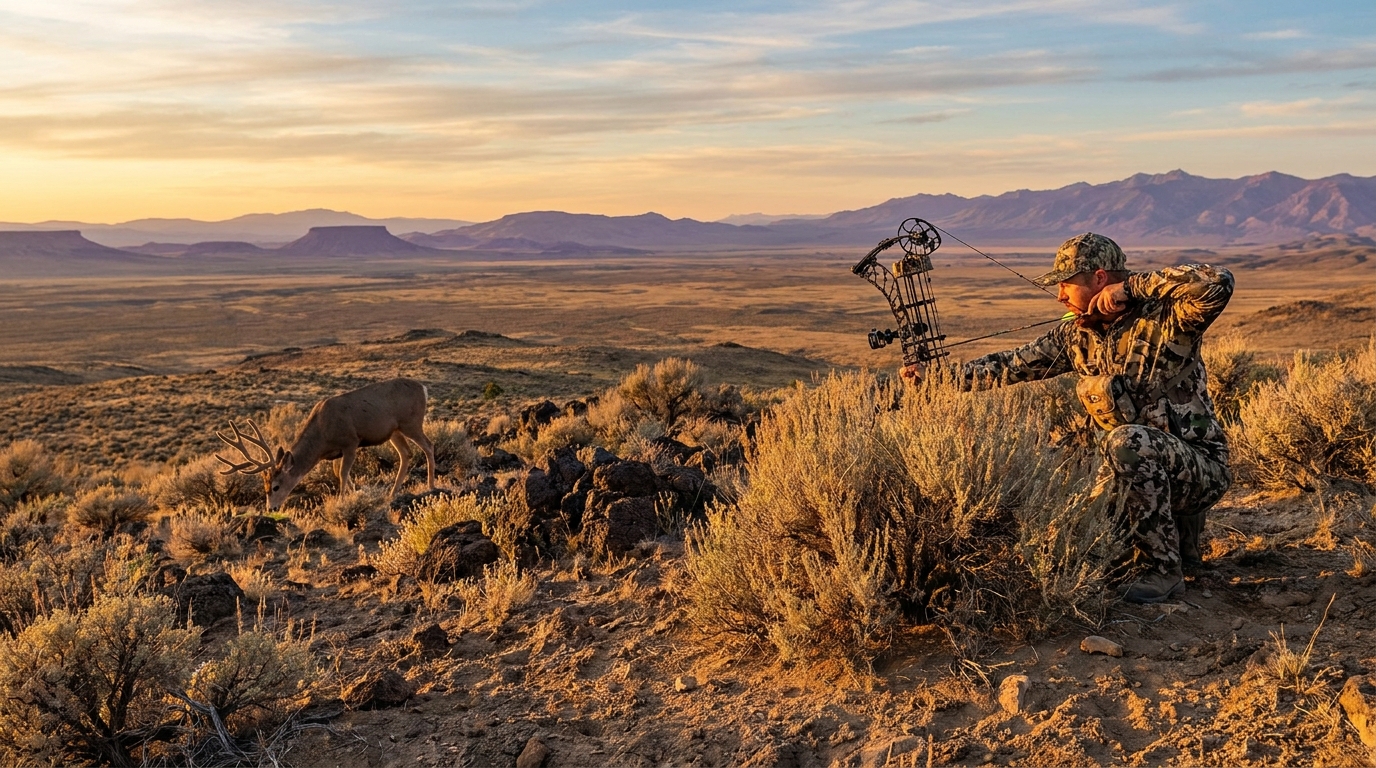
The Jordan Valley unit punishes impatience. When you locate a buck at distance, fight the urge to move immediately. Watch him. Identify the terrain he's likely to use. Look for the hidden drainage, the fold in the sagebrush flat, the rimrock bench that lets you approach from below the ridgeline. The wind in this desert country swirls off heated rock by 9 AM — plan your stalk for first or last light when thermals are more predictable.
Soft-soled boots are non-negotiable on this terrain. The crunch of dry sagebrush bark and brittle basalt is the sound that kills stalks. Move slow, keep low, and use the terrain. A buck facing away or feeding with its head down gives you a window — take it without hesitation.
Camp and Logistics
Jordan Valley is primitive camping country. BLM dispersed camping is legal on public land throughout the unit — no fee, no facilities in most spots. The town of Jordan Valley has a small motel and a couple of gas stations. Stock up in Ontario or Boise before coming out — supplies are limited and hours unpredictable.
- Fuel: Fill up in Jordan Valley. The next gas may be 60+ miles away in the field.
- Cell service: Spotty at best. Download your maps offline. Have a paper backup.
- Water: Carry at least 6 liters per person per day. Desert hunting in August is hot.
- Vehicle: High clearance preferred but most main access roads are manageable. Side roads require it.
The Tag and Draw Odds
Jordan Valley archery mule deer is often available as a controlled unit with moderate draw odds — not a guaranteed draw like some Southeast Oregon units, but achievable in 1–3 years for most applicants depending on point accumulation. Check ODFW's current draw statistics. The unit occasionally sees leftover tags after the draw, making it worth a look even if you missed the initial application window.
The miles of public land, the minimal hunting pressure, and the genuine opportunity to find a quality buck in a place that looks like it was designed for spot-and-stalk archery hunting make Jordan Valley worth banking points toward. For the hunter who wants solitude, big country, and a legitimate challenge — this is one of Oregon's best-kept archery secrets.