Most Oregon waterfowl hunters are already thinking about mallards, pintails, and the full Pacific Flyway migration by the time September rolls around. But before those birds arrive, a golden early-season opportunity is sitting right in front of you: resident Canada geese in the Willamette Valley. These birds — non-migratory year-round residents — congregate on grass fields, golf courses, parks, and stubble ground throughout the valley, and September hunting pressure on them is surprisingly light. Here's how to take advantage before everyone else figures it out.
Understanding Oregon's Resident Canada Goose Population
The Cackling Canada goose and the western Canada goose subspecies that live year-round in the Willamette Valley are distinct from the migratory flocks that pass through later in the fall. These residents hatch here, raise broods here, and spend their entire lives in the lowlands between the Coast Range and the Cascades. By September, family groups — this year's goslings now full-sized but often still flocking with adults — are moving between loafing areas, feeding fields, and wetlands in predictable daily patterns.
The resident population has grown substantially over the past two decades. ODFW manages a September special early season specifically targeting these birds. Knowing the difference matters both legally and tactically: migrators respond to big spreads and loud calling; residents, having lived around humans their whole lives, can be call-shy and decoy-wary in ways that require a different approach.
Season Dates and Regulations
Oregon's early resident Canada goose season typically opens in early September, running through mid-month, before the regular waterfowl season begins in October. Check the current ODFW regulations booklet for exact dates, bag limits, and any zone-specific rules — the Willamette Zone has historically had a generous limit of 5 birds per day during the early season to help control the resident population. A valid Oregon hunting license and federal duck stamp are required. Non-toxic shot (steel, bismuth, or approved alternatives) is mandatory statewide for waterfowl.
Finding Permission-Land Birds
The Willamette Valley's resident geese live on private agricultural land. This is the critical challenge and the biggest separator between hunters who scratch limits and those who go home empty. Geese in September are feeding heavily on:
- Grass seed fields: The Valley's dominant crop. Harvested fields leave waste seed that geese target all day. Look for fields that have been combined in August with visible chaff lines.
- Winter wheat stubble: Any field being prepped for fall planting will hold geese working the remaining grain.
- Irrigated pasture: Dairy operations with open green grass pull resident geese hard, especially in the morning hours.
- Unharvested vegetable fields near harvest: Sweet corn edges, pea stubble, and bean fields all attract September birds.
Drive county roads — particularly through the Tualatin Valley (Washington County), the Eola Hills area (Polk County), and the broad flats between Corvallis and Albany — in the early morning and late afternoon. When you find a large flock actively feeding, mark the location and approach the landowner in person during daylight, away from the hunting hour. A sincere, brief introduction with a business card goes further than a phone call. Offer a brace of cleaned birds; most farmers appreciate the help controlling a species that damages crops.
Decoy Spreads for Resident Birds
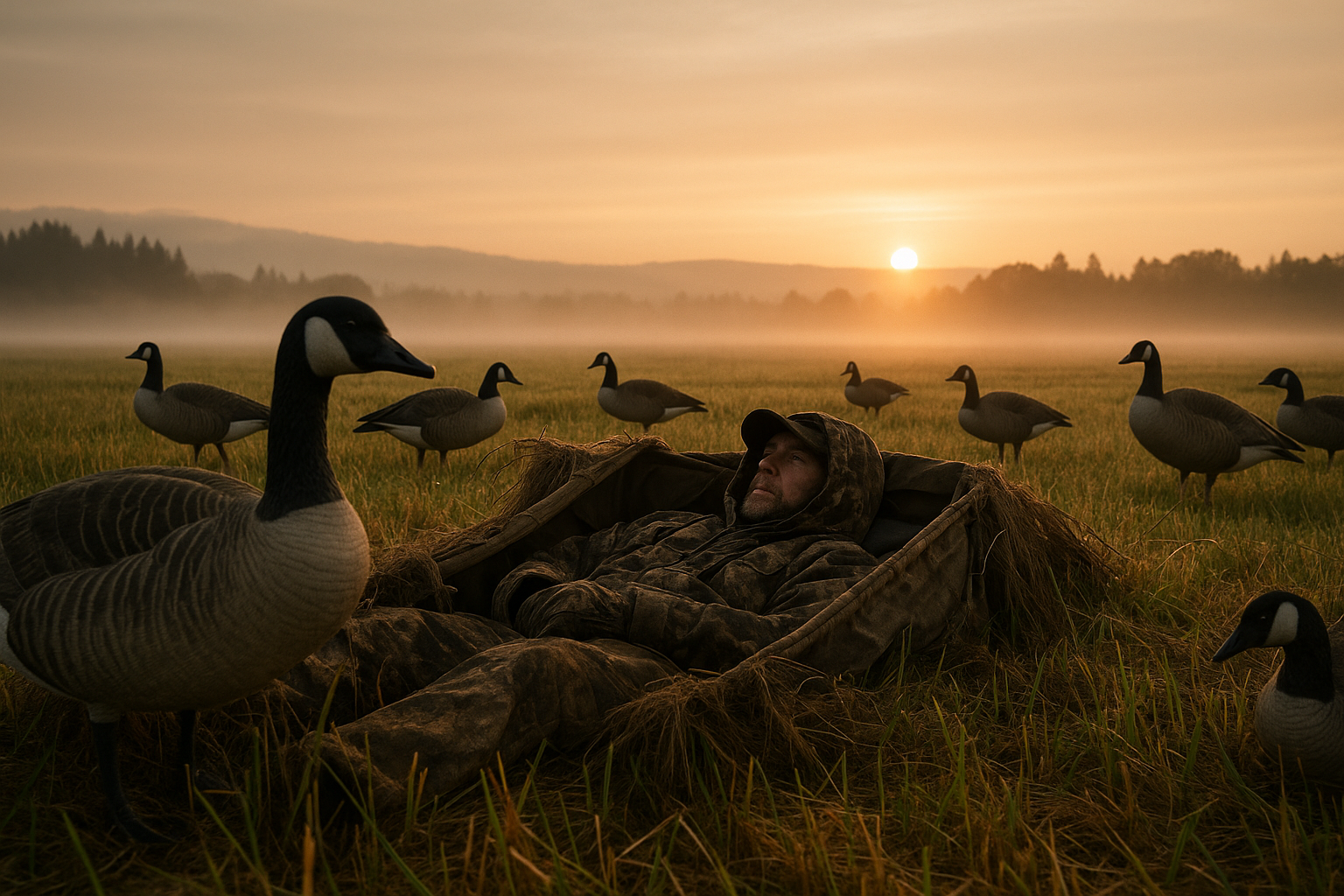
Forget the 6-dozen full-body mega-spread you might run for migrating birds in November. September resident geese have seen decoys all spring and summer near parks and golf courses. A smaller, more realistic presentation outperforms a big spread:
- 12–24 full-body Canada goose decoys: High-quality shells or full-bodies in relaxed feeding and standing positions. Avoid decoys with bright, reflective paint — residents will flare from shiny plastic.
- Motion: One or two flapping-wing or spinning-motion decoys are worth including in early season when the geese aren't pressured yet, but retire them if birds start flaring.
- Spacing: Spread your decoys loosely rather than tight clusters. Feeding flocks spread out. Tight bunches look like resting (nervous) birds to incoming geese.
- Landing zone: Leave a 15–20 yard gap into the wind from your blind. Geese land into the wind and you want them committed and in range when they do.
Calling Resident Geese
Less is more. Resident Canada geese — especially after a few days of hunting pressure — are not the easy, call-happy birds you might have read about. They know what Canada goose calls sound like because they are Canada geese. Bad calling flares birds; silence often works better than overcalling.
- The cluck and moan: Low-volume, conversational calls. Imagine you're trying to sound like just another bird in the field, not a goose caller at a competition.
- Hail call only when needed: If a group is flying away or on a line that won't pass within range, a hail call can redirect them. Otherwise, cut back to feeding chuckles and murmurs.
- Double-reed calls: Easier to produce authentic Canada sounds than short-reed for beginners. Companies like Primos, Flambeau, and Zink all make solid double-reeds in the $20–50 range.
Blind Setup and Concealment
Ground layout blinds (A-Frame or backpack-style) work well in grass seed fields when the grass or stubble is tall enough to break your silhouette. Cover the blind with material from the surrounding field — geese notice color and texture mismatches. In flat, sparse stubble fields with no cover, a pit blind built the night before is the most effective option. Wear full camo including gloves and face mask, and cut all movement when birds are working.
The shooting is close-range work. Most resident goose shots happen inside 30 yards when birds are committed to a good spread. Steel 2s or BBs in a 3-inch shell through a modified choke is a reliable, lethal combination. Pattern your gun before season to confirm performance at 30 and 40 yards.
Making the Most of September
September resident Canada goose hunting in the Willamette Valley is a genuine sleeper opportunity. The weather is still warm enough for comfortable all-day hunts, the birds are predictable in their patterns, and competition for access is a fraction of what you'll see when the full migration arrives in November. Do the legwork in August — identify fields, knock on doors, scout evening flights — and you'll be set up for one of the most productive and underappreciated hunts in western Oregon.