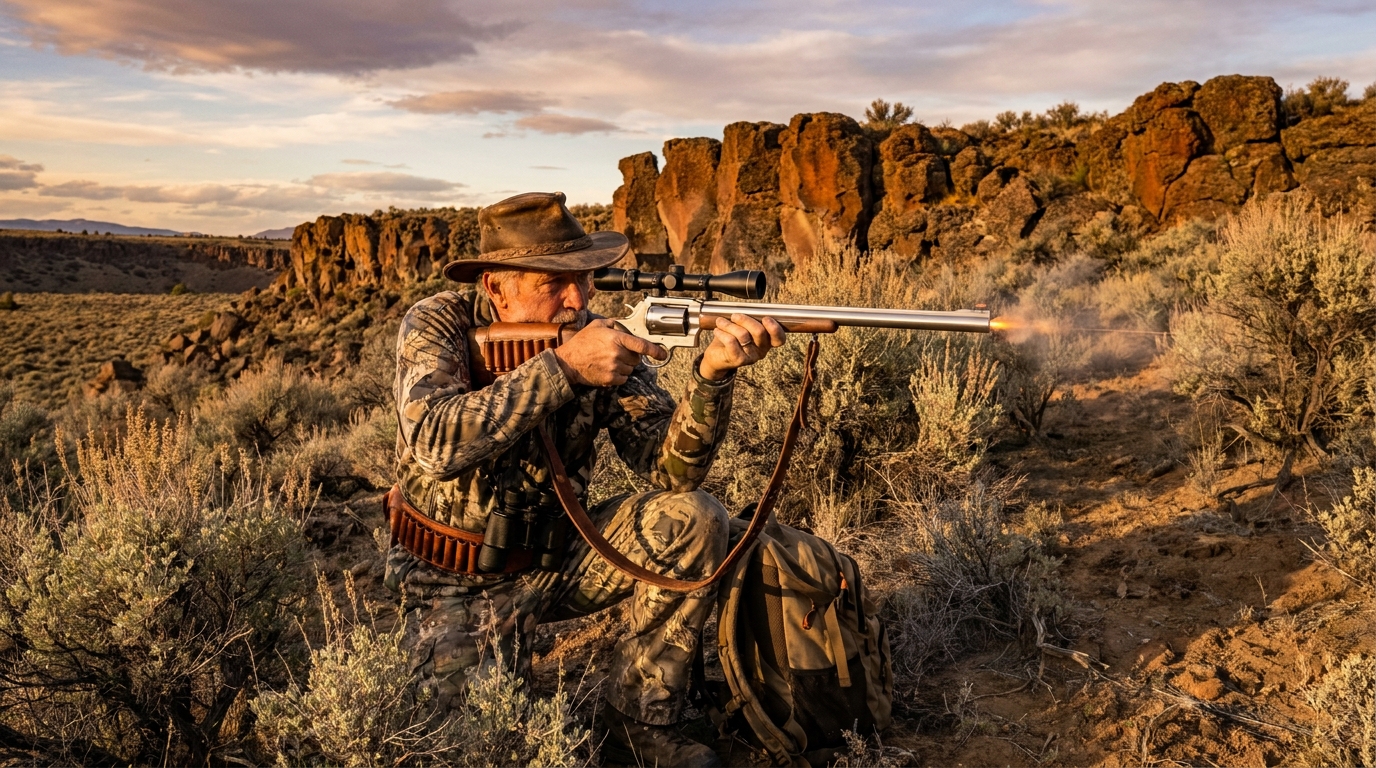
Hunting with a handgun isn't a stunt or a social media flex — it's a discipline that demands a higher standard of marksmanship than most rifle hunters ever develop. The reduced sight radius, lighter platform, and heavier recoil of hunting-grade revolvers and single-shot pistols mean that ethical kills require genuine skill. For hunters willing to put in the range time, handgun hunting opens up a rewarding dimension of the sport and is a legitimate option across Oregon's diverse big game landscape.
Oregon Regulations Overview
Oregon allows handguns for legal big game hunting with no special restrictions beyond the standard season and tag requirements. Deer, elk, black bear, cougar, and pronghorn can all be legally taken during their respective firearm seasons with a pistol, provided you're using an appropriate caliber. During archery-only seasons, handguns are not permitted. During muzzleloader-specific seasons, standard handguns are also excluded. When in doubt, read the ODFW regulation synopsis carefully for the season and unit you're hunting — rules around general seasons versus controlled hunts vary.
Caliber Selection for Big Game
The minimum benchmark for deer-sized game should be a caliber pushing a 200-grain or heavier bullet at 1,200 fps or better from your specific barrel length. This isn't the place for 9mm or .40 S&W self-defense loads. The following calibers have proven track records for field hunting:
Revolvers
- .357 Magnum: Marginally adequate for deer at close range (under 50 yards) with premium 158 to 180-grain loads. Better as a backup than a primary hunting handgun.
- .41 Magnum: Underappreciated and increasingly hard to find ammunition for, but excellent for deer and black bear. Sits between .357 and .44 in recoil and power.
- .44 Magnum: The classic hunting handgun cartridge. A 240 to 300-grain hard cast or bonded load from a 6 to 7.5-inch barrel is sufficient for deer, elk at close range, and black bear. Ruger Redhawk, S&W Model 29, and the Super Redhawk are the workhorses.
- .454 Casull / .460 S&W / .500 S&W: Heavy-recoiling magnum revolvers for hunters who want no doubt about terminal performance on anything in the lower 48. The .460 S&W is particularly versatile — it also chambers .454 Casull and .45 Colt.
Single-Shot Pistols and Semi-Autos
- Thompson Center Encore / Contender: The gold standard of the single-shot hunting pistol platform. Interchangeable barrels allow chambering in virtually any rifle cartridge — .30-06, .308, 7mm-08, .35 Remington — making this as powerful as you want at the cost of being limited to one round. Effective range stretches to 150+ yards with practice.
- 10mm Auto: In a long-slide platform like the Glock 40 MOS or a 1911-style longslide, 10mm launches a 180 to 220-grain bullet fast enough for deer at reasonable ranges. Carries better than a large revolver and offers a follow-up shot.
- .45-70 in pistol format: Magnum Research makes single-shot pistols in .45-70 that deliver lever-gun terminal performance in a packable platform. Devastating at close range for bear and elk.
Shooting Fundamentals for Field Accuracy
Most hunters can punch decent groups from a bench. The field is different. Your heart rate is up, your hands are cold, and there's no bench. Developing repeatable accuracy requires training with field positions.
Use a Rest Whenever Possible
A shooting stick, trekking pole, fence post, pack resting on a rock — any stable rest dramatically improves accuracy. Never shoot unsupported at game beyond 25 yards unless you've confirmed your kneeling or sitting accuracy at that distance under realistic conditions. A two-hand Weaver or isosceles hold is your baseline; a solid rest is your goal.
Dry-Fire Religiously
The single biggest improvement most handgun hunters can make is eliminating trigger-induced movement. Dry fire 10 minutes a night for a month and your groups will shrink noticeably. Use a snap cap to protect the firing pin and focus on breaking the trigger without disturbing the sight picture.
Know Your Ethical Distance
This is non-negotiable. Set a personal limit based on your actual demonstrated accuracy — not your best day, but your consistent performance under field conditions. For most hunters new to handgun hunting, 50 yards is a reasonable cap. Some experienced shooters with single-shot pistols and rifle cartridges can ethically extend to 100 or even 150 yards. Be honest with yourself.
Oregon Applications
Eastern Oregon's open high desert country — particularly mule deer and pronghorn habitat in units like Steens Mountain, Beatys Butte, and the Warner Valley — offers the long sight lines and spot-and-stalk opportunities that reward careful hunters who can close the distance. A deer at 40 yards in the sagebrush after a two-hour stalk is a genuine trophy whether you take it with a .300 Win Mag or a .44 Magnum.
Black bear hunters chasing bait sites or hunting coastal clearcuts often encounter bears at distances well within handgun range. For bear specifically, penetration matters more than expansion — a hard cast or Dangerous Game-style flat-nose bullet will outperform a fast-expanding soft point on a bear's heavy shoulder structure.
Handgun hunting requires more of you than a rifle does. That's the point. If you've been considering it, the barrier to entry is simply a good hunting revolver or single-shot and enough range time to shoot it well. Everything else is the same hunt.