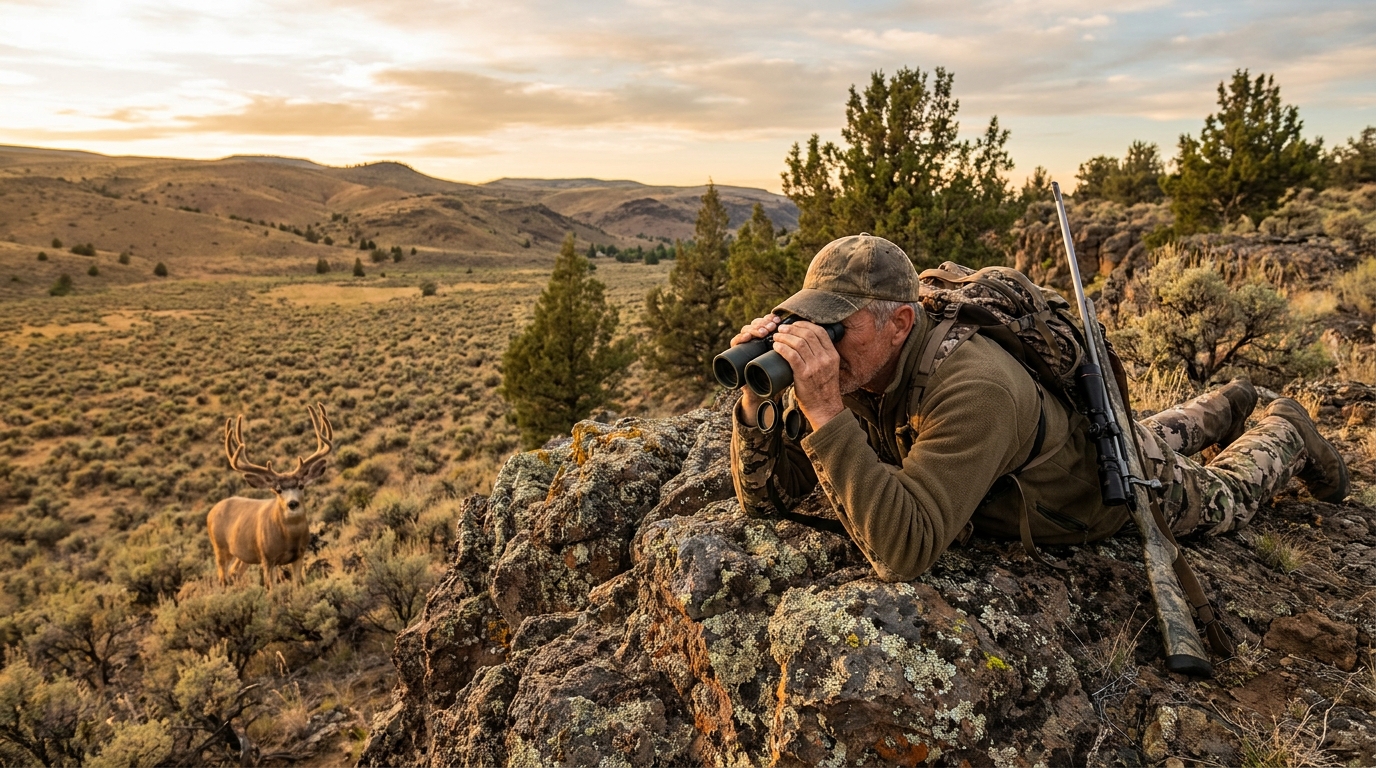
The buck steps out of the rimrock at 200 yards, quartering away. Your binocular comes up, your heart rate climbs, and you have maybe 30 seconds to decide if you're going to shoot or pass. It happens exactly like this — fast, imperfect, with adrenaline turning your careful pre-season study into static. Field judging mule deer is a learnable skill, and like any skill, it gets better with deliberate practice. Here's a practical framework for assessing eastern Oregon bucks in the field before the shot clock runs out.
Why Field Judging Matters More Than Score
Most hunters don't have a Boone and Crockett measuring tape in their back pocket, and you don't need one. Field judging isn't really about predicting an official score — it's about making a fast, informed decision: is this the deer I'm looking for? That answer depends entirely on your personal standards and tag type. A landowner tag holder hunting Unit 65 (Steens) with decades of experience should set the bar differently than a first-time B-Zone hunter on his first-ever deer. Know your standard before you leave the truck.
That said, understanding what makes a buck exceptional trains your eye and prevents the two classic field-judging mistakes: shooting a buck that looks big at 40 yards because you panicked, or passing a legitimate trophy because you couldn't process the geometry quickly enough.
The Four Key Measurements
Beam Length
Typical mature mule deer in eastern Oregon carry main beams of 22 to 26 inches. A buck whose beams swing well out past his nose when viewed from the side is showing you 24-plus inches. Beams that stop near the eye line are shorter. Use the length of the deer's face — roughly 11 to 12 inches from eye to nose on a mature buck — as a reference point. Two face-lengths of beam means you're looking at around 22 inches.
Spread
Ear tip to ear tip on a relaxed, alert mule deer is typically 22 to 24 inches. A buck whose antler spread just touches the ear tips is carrying about 22 to 23 inches of inside spread. A buck whose antlers clearly extend past his ear tips is 24 inches or better. Wide is flashy, but spread alone doesn't make a trophy — it's one measurement of four.
Tine Length
G2s are the most important tines on a mule deer frame. A buck with G2s that reach or exceed the length of his ear — roughly 7 to 8 inches — is showing you something. Tines that stick straight up tall enough to make the rack look like a raised hand are exceptional. Short stubs cost points fast; long, upswept G2s are what separates a 160-class buck from a 130-class frame with similar mass.
Mass
Mass is easiest to judge at the base and at mid-beam. Compare the beam diameter to the diameter of the deer's eye socket — roughly 1.5 to 2 inches on a mature animal. A beam that looks as thick as the eye socket at the base is carrying excellent mass. Watch the beam diameter at the H2 (second circumference, halfway to the first fork) — if it's still thick there, the buck has the kind of mass that pushes total scores well above raw frame.
Quick-Score Method for the Field
Here's a simplified formula you can run in 30 seconds with quality glass:
- Estimate inside spread: ear tip width as baseline (approx. 22 in.)
- Estimate beam length: face-length multiples (one face = approx. 11 in.)
- Estimate G2 and G3 length per side: how tall are those tines?
- Add a rough mass credit: gut-feel 3 to 4 points per side if mass is excellent
A typical 4x4 mature eastern Oregon buck with 23-inch spread, 25-inch beams, and 8-inch G2s will rough out around 140 to 150 inches. Push those G2s to 12 inches and the beams to 27 inches and you're looking at 160-plus.
What to Look For by Unit
Eastern Oregon mule deer quality varies significantly by unit. The Steens Mountain, Mann Lake, and Alvord Desert units produce some of the largest-bodied bucks in the state, with truly exceptional deer appearing regularly in the draw units. Beatys Butte and Juniper units in the high desert lake county produce good representative deer. The Ochoco and Blue Mountain units see more timber-edge bucks with heavier bodies but typically more modest antler development than the open high desert units.
Know what your unit produces historically. Talk to ODFW wildlife biologists — they're accessible, knowledgeable, and can tell you what's realistic for the ground you're hunting before you develop unrealistic expectations.
Common Field-Judging Mistakes
- Judging from below: Looking up at a buck on a hillside makes tines appear longer than they are. Get level or above when possible.
- Misjudging mass: Thin-beamed bucks with wide spread look impressive until the tape comes out. Practice mass estimation on every buck you glass.
- Counting points prematurely: A buck that looks like a giant 4x4 from the front might reveal crab claws, sticker points, or splits from the side that change everything.
- Rushing the assessment: If you have time, take it. Many hunters make irreversible decisions in the first 15 seconds. Let him walk to a better angle.
Building the Skill Before Season
The best field judges are the ones who've looked at the most deer. Glass deer every chance you get from June through August — velvet bucks reveal their frame clearly without the fall terrain complicating the view. Take photos when possible and try to score them from the image, then compare your estimate to any known scores from the area.
August is still velvet time in eastern Oregon. Get out and glass. Every buck you assess before season is a rep in the bank when it counts.