Reloading manuals give you a starting point. Your chronograph tells you the truth. For any serious handloader — and especially for hunters who depend on precise ballistics at extended ranges — a chronograph is not a luxury. It’s the instrument that connects the powder charge on your bench to the ballistic coefficient in your solver and the zero on your scope. Without it, you’re working with somebody else’s data from a barrel that probably isn’t yours.
Here’s how to use a chronograph properly and what to do with the numbers you collect.
Types of Chronographs
Optical Chronographs (Traditional Screen Units)
The Caldwell G2 Ballistic Precision, Competition Electronics Pocket Pro, and similar units use two optical sensors separated by a fixed distance. As the bullet passes over each sensor, the unit measures transit time and calculates velocity. They’re affordable ($80–150), reasonably accurate, and work on any projectile. Downsides: sensitive to lighting conditions, require precise positioning in front of the muzzle, and a misdirected shot can destroy the unit.
Doppler Radar Chronographs
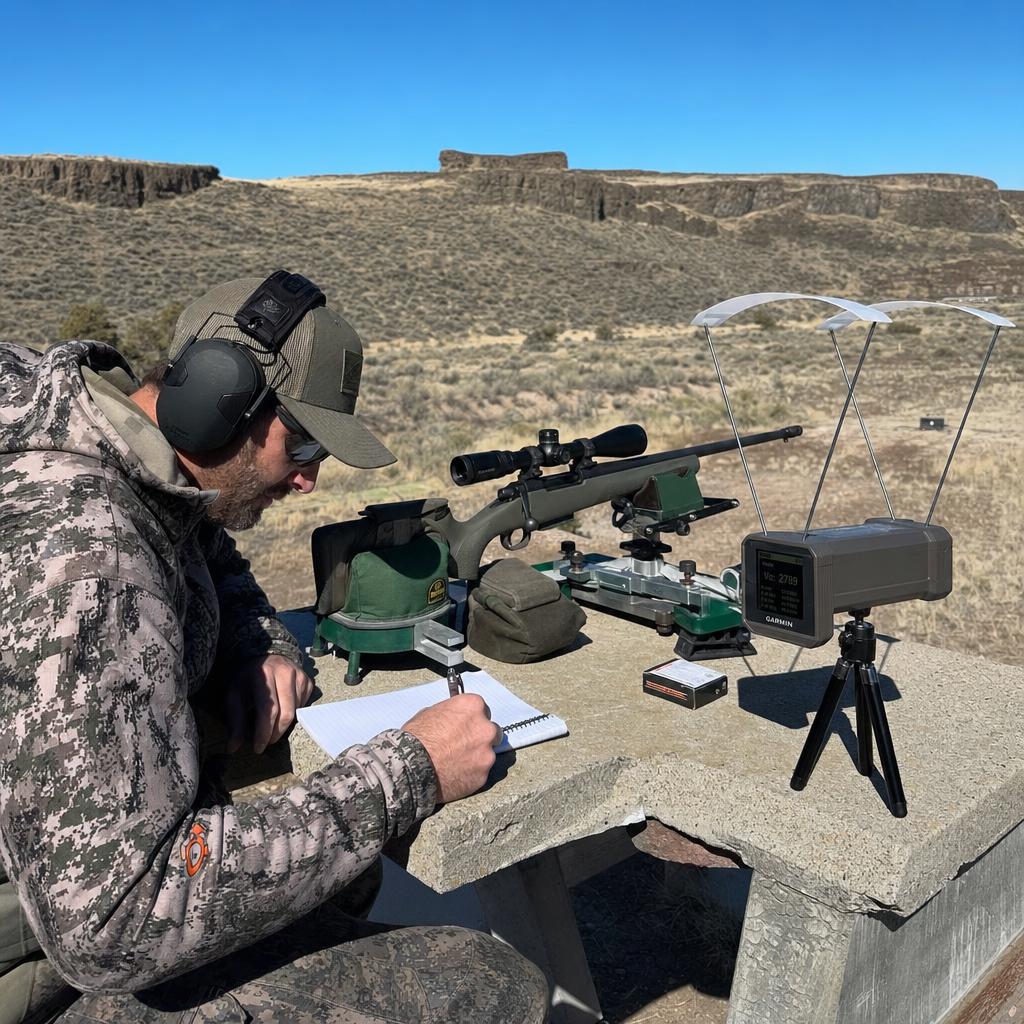
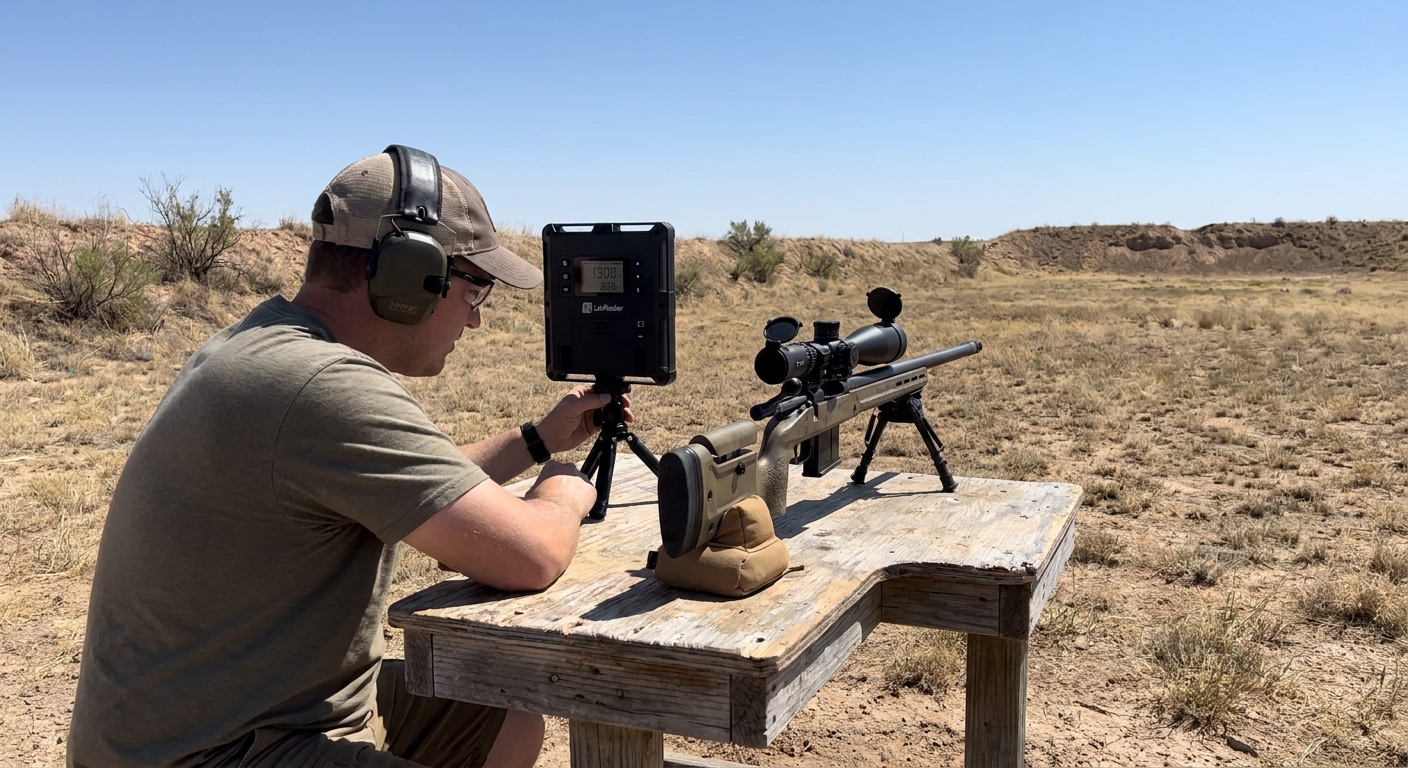
The LabRadar and Garmin Xero C1 Pro use radar to track projectiles and can measure velocity at the muzzle and at multiple downrange distances. This is an enormous advantage — you can actually measure your BC in the field rather than trusting published numbers. LabRadar runs $650–750, which is expensive, but for serious precision shooters and hunters building real DOPE at distance, it’s worth every dollar. It sits beside you rather than in front of the muzzle, eliminating the accidental shot risk.
Muzzle-Mounted Units
Magnetospeed and similar units clip to the barrel or suppressor and measure the bullet’s passage through a magnetic field. They’re accurate and weather-independent. The downside is that barrel attachment changes your point of impact during data collection, which means you can’t simultaneously shoot for groups and measure velocity — a meaningful limitation for load development.
Setting Up for Accuracy
Optical chronograph errors come primarily from two sources: inconsistent lighting and improper muzzle-to-unit distance. Follow these guidelines for reliable data:
- Distance: Position the chronograph 10–15 feet from the muzzle. Too close and muzzle blast interferes with sensors; too far and the signal drops.
- Height: Center the screen on your projectile’s flight path. This sounds obvious but is frequently wrong — shoot a sighter round at a target immediately behind the unit if you’re unsure of your path.
- Lighting: Overcast days produce the most consistent readings because diffuse light minimizes shadow variation across the sensors. Bright sun with partial shadows causes erratic readings. Sunshields help but don’t fully solve the problem.
- Temperature: Cold weather slows powder burn rates and reduces velocity; heat accelerates them. Always note ambient temperature when recording data. This matters more than most shooters realize when comparing loads across seasons.
What Data to Record
Shoot a minimum of 5 rounds per load; 10 is better. Record:
- Individual velocities for every shot
- Average velocity (MV)
- Standard deviation (SD): The key consistency metric. An SD under 15 fps is excellent; under 10 fps is exceptional. High SD (25+ fps) means inconsistent ignition, possibly from improper seating depth, primer selection, or charge weight variation.
- Extreme spread (ES): The difference between your fastest and slowest shots in a string. Less than 30 fps is good; less than 20 fps is outstanding.
- Temperature and conditions
- Exact load data: Powder, charge weight, primer, bullet, OAL, brass headstamp and number of firings
Using Velocity Data in Ballistic Solvers
Most hunters today use a ballistic solver — Hornady 4DOF, Applied Ballistics, Kestrel, or a phone app. Every one of these programs asks for muzzle velocity. If you use the book number from a reloading manual for a 24-inch test barrel, and your hunting rifle has an 22-inch barrel, you may be off by 40–80 fps before accounting for any other variables. That’s 1–2 MOA of error at 500 yards — enough to miss a vital zone on a mule deer.
Feed your actual chronographed velocity into your solver. Combined with a confirmed zero and your bullet’s BC, this produces firing solutions that actually work in the field rather than on paper.
Detecting Pressure Signs Through Velocity
Experienced reloaders use the chronograph as a pressure detection tool during load development. When you’re working up a load in increments:
- Velocity plateaus: If velocity stops increasing despite increasing powder charge, you’re likely approaching pressure limits where the powder can no longer efficiently burn before the bullet exits the barrel
- Velocity spikes: A sudden jump in velocity out of proportion to the powder increase is a pressure warning flag
- Increasing ES: As loads approach maximum, SD and ES often increase as combustion becomes less consistent
These velocity behaviors, combined with primer and case inspection, give you a much more complete picture of where you are in the pressure curve than case inspection alone.
Temperature Sensitivity Testing
For hunters who take ammunition from warm storage to cold field conditions — or the reverse — temperature sensitivity matters. Some powders (notably IMR 4350 and older Hodgdon single-base powders) lose significant velocity in cold. Newer Hodgdon Extreme powders (H4350, H4831sc, Varget, H1000) and Alliant’s Reloder series are significantly more temperature-stable. Testing your loads at the temperatures you’ll hunt in — rather than trusting that your summer-range data applies to a 25°F November morning — catches this before it costs you an animal.
A simple test: chronograph your hunting load at ambient temperature, then place loaded rounds in a cooler with ice water for an hour and chronograph again. A difference of more than 30-40 fps suggests you should consider a temperature-stable powder alternative.
Getting the Most from a Single Session
Chronograph time is valuable — especially if you’re paying range fees. Plan your session before you go:
- Pre-sort loads by powder charge so you work up from light to heavy without reshuffling
- Label each load clearly with a sticker on the bottom of the box
- Bring a notepad or use a phone app (AB Analytics, Hornady Load Development) to record data in real time — don’t trust memory
- Shoot groups for each load after recording velocity data to correlate accuracy with consistency
The Bottom Line
A chronograph closes the loop between your bench and your barrel. It converts guesswork into data, reveals pressure trends before they become problems, and feeds accurate numbers into the ballistic solvers that extend your effective range in the field. If you’re reloading hunting ammunition and you don’t own one, fixing that is more valuable than any other upgrade you could make to your setup.